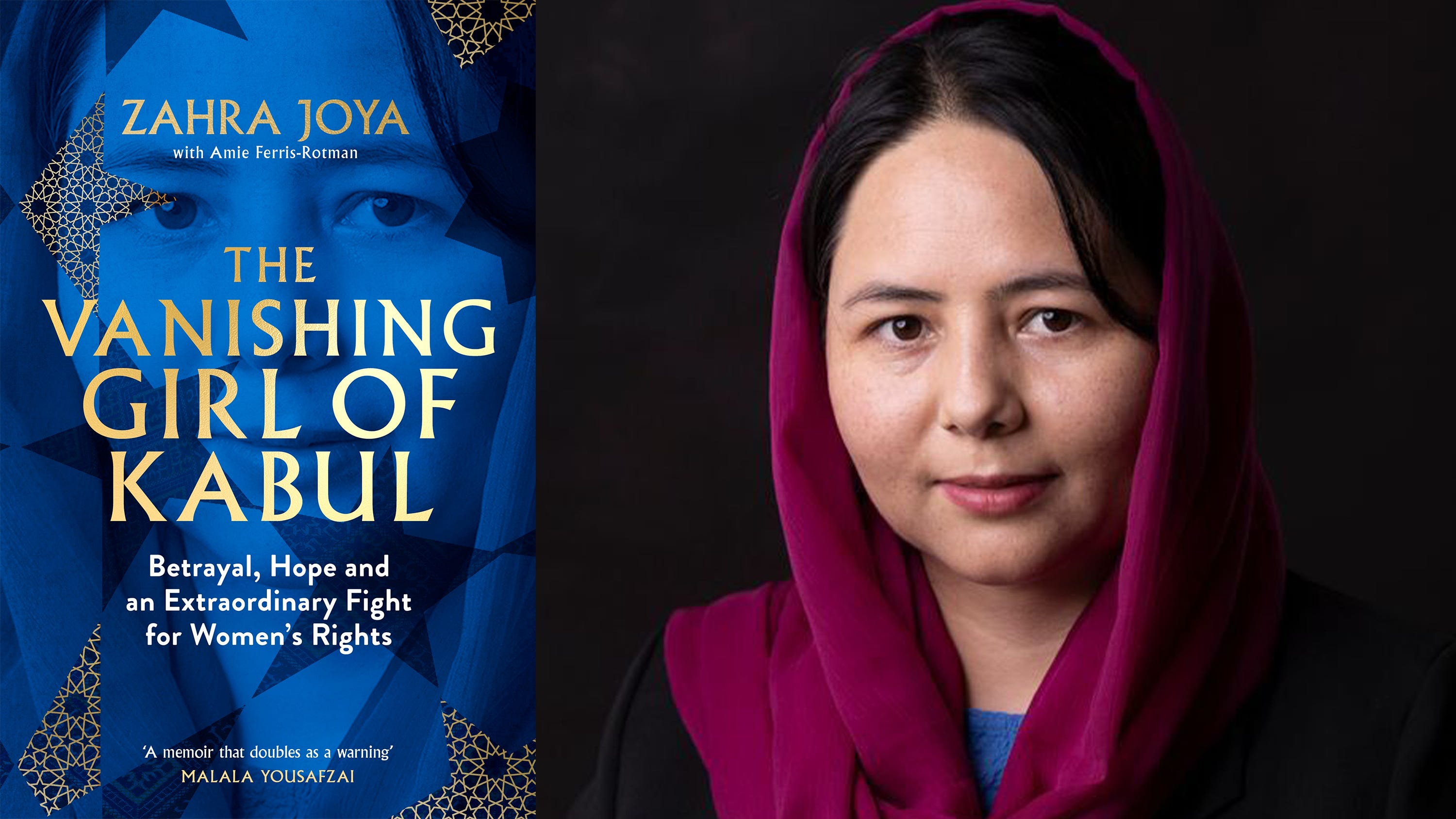
Cover courtesy of Robinson; Photo credit Bill Knight
Long before the Afghan journalist and media founder Zahra Joya was named one of TIME’s Women of the Year, before she became a primary target of the Taliban during its second takeover of Kabul in 2021, and before she was among the precious few female journalists documenting the persecution of ethnic Hazaras in Afghanistan, Joya went by another name entirely: Mohammad.
It was a decision she made out of survival at just eight years old, during the Taliban’s first reign over Afghanistan between 1996 and 2001. To get an education, she went by the new alias, dressed in boys’ clothing, and walked two hours to school — there and back — all to claim a right that had been denied to girls across the country.
“I completely changed my identity, actually,” she tells me. “It was a potential risk for myself, for my family, and even for my neighbors, but I did it anyway.”
It was this education that would ultimately embolden Joya to become one of Afghanistan’s leading voices on the lives of women and girls under Taliban rule. In November 2020, she founded Rukhshana Media, which has since earned international recognition for its investigations into gender persecution and human rights abuses, something Joya herself argues should be criminalized by the International Criminal Court under “gender apartheid.”
Learn from top longform journalists and find the best in-depth reporting. Subscribe to Depth Perception:
Less than a year after the founding of the women-led newsroom, the Taliban swept back into power following the rapid withdrawal of Western troops in Afghanistan in August 2021. But instead of going dark, Rukhshana Media pressed on. Joya briefly went into hiding and eventually found refuge in the United Kingdom, where she remains in exile. Now, nearly five years to the day that the Taliban once again transformed the course of Afghanistan’s history, Joya is reclaiming that history in her own words through a new memoir, The Vanishing Girl of Kabul, written in partnership with the journalist and Joya’s longtime friend Amie Ferris-Rotman.
In this edition of Depth Perception, Joya makes another courageous case for why the world cannot — must not — turn away from the plight of women and girls. In turning the spotlight onto her own story, Joya hopes to show that surmounting the challenges to gender equality in Afghanistan would finally help strengthen the broader fight for women’s rights everywhere. —Kelly Kimball
What first drew you to write The Vanishing Girl of Kabul, and what are you hoping to convey with the book?
When I wanted to write this book with Amie Ferris-Rotman, a longtime journalist and friend, the idea began years ago, in 2021, after I arrived in the UK. It took a lot of time for the idea to finally become a book and appear on the page.
This is a story about Afghan history. It is about women and it is about the struggle and the hope that my generation and the entire people of Afghanistan had, and are still fighting for, in this country. We really don’t know when it will end. We really don’t know when we will see real change in our lives and in our country.
So that was the main purpose of the book, and I hope people can understand and read it and somehow help us to build this country in a proper way — without their own interests. We, the people of Afghanistan, can solve this problem, which is a very long and historical one.
Were there any specific moments in the book that you found difficult to revisit? Are there moments that readers might not expect you to write about?
I think this book was written in a very profound, challenging time, at a time when I was navigating a lot of depression, stress, anxiety, and hope, all at once. Yes, there are many issues that were difficult for me to talk about in public, obviously. I always feel that it is quite ambitious, and also I’m a bit nervous because I have put my life up for judgment in front of people.
There were lots of issues that I really wanted to keep safe for myself, but I thought, “No, it’s the time.” It’s difficult to be silent. Silence is not the solution.
One of the topics that was difficult for me to recount was the investigative journalism that I have done during the past five years, particularly when I wanted to reflect back on the notes and the calls that I had with women, particularly women who had been arrested by the Taliban and were sexually assaulted by Taliban soldiers in prison. That was quite a heavy experience, and heavy for me to write about.
Also the whole chapter on gender apartheid in Afghanistan. Obviously, it was also my childhood story.… I grew up during the first rule of the Taliban, when being a girl meant being denied the most basic rights. So, with that purpose of showing how difficult it is to be a woman in a country like Afghanistan, I tried to be more honest and bring the most accurate and real stories that I was living and experiencing.
Lifting Ukraine: One woman’s fight for her country’s survival
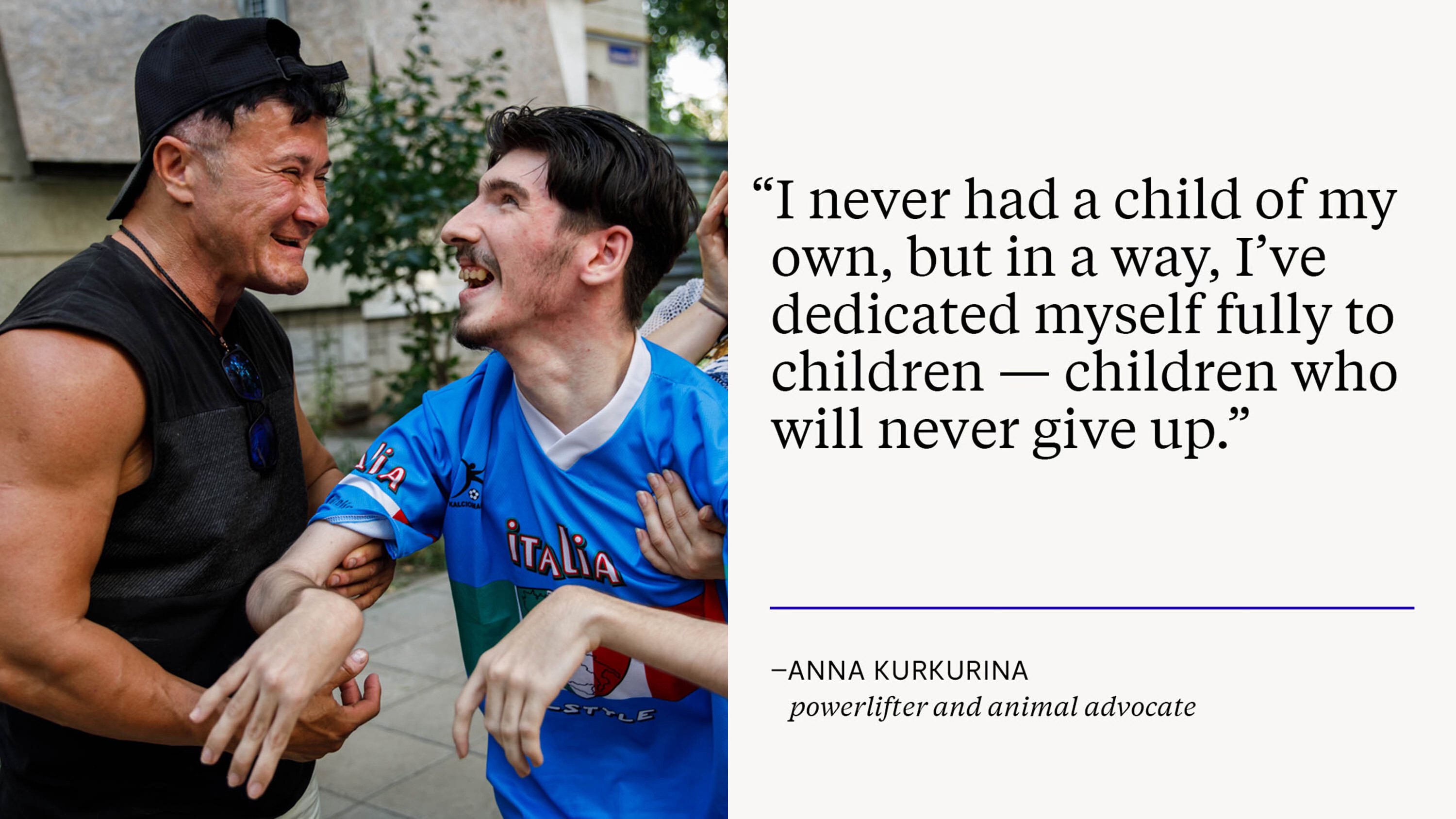
Anna Kurkurina shares a moment with Bogdan Popov, whom she has helped with strength training to counteract his cerebral palsy. Photo by Maranie Staab
On February 24, 2022 Russia invaded Ukraine. Since that day, Ukraine’s “volonteri,” a loose network of civilian helpers central to the country’s fight for freedom, has bolstered its battle-worn government across the country.
In the Webby Award-winning Long Lead photo essay, Lifting Ukraine, photojournalist Maranie Staab presents a striking profile of one volunteer, world-record-setting powerlifter Anna Kurkurina, who has fought the Russian invasion in her own way by keeping her community active and fit, and by rescuing and rehoming animals orphaned by the war. In her country’s fight for independence, Kurkurina has an inspiring mission to ensure that more than just the strong will survive.
You made a lot of sacrifices to give yourself an education. You had to fight for your rights back then. What is the state of women’s rights in Afghanistan now? Are the stakes even higher? Is it basically the same?
Unfortunately, in Afghanistan, we are seeing that history is repeating itself many times. It’s repeating with every regime change. So yes, I sacrificed a lot for my very basic human rights and my existence as a woman in Afghanistan during the first rule of the Taliban. When the first rule of the Taliban finished, I thought, “Thank God, it’s over.”
Then we started to take the opportunity that we had after 2001 and after the fall of the Taliban. We thought this was the time for us to work for this country, to build this country, and we wanted to bring real change. But obviously it didn’t happen. I mean, after 20 years, we are back at the stage where we were before.
I think, for me, I was one of the luckiest girls in my village in Bamyan. I had the chance and I had a supportive family. They supported my dreams and they gave me the opportunity to go to school. But when I’m thinking about millions of other girls, they are struggling with poverty. They are struggling with so many restrictions and the gender apartheid system the Taliban created. Also, millions of women are struggling with poverty, with deprivation.
So I couldn’t see any difference between the second rule of the Taliban compared to the first rule. They are the same because the Taliban are the same people. They have the same ideology. They have the same policy toward women and toward the education system.
In Afghanistan, unfortunately, as much as Afghan women have access to technology, the Taliban have the same access. They are using technology as a tool to spread fear, spread their ideology, and enforce the many restrictions that they have. Also, through technology, even the Taliban have followers in many countries. We have seen that after five years, Russia is one of the first countries in the world to recognize the Taliban regime as a legitimate government.
[Earlier this month], there were a lot of arguments and discussions about why Taliban delegations were able to come to Europe and have these conversations, and it is all concerning, honestly.
You founded Rukhshana Media during the U.S. occupation and were able to grow it into a successful, internationally recognized newsroom. I’m wondering if you can take us back to the Taliban’s second takeover and how you have been able to maintain coverage of women and girls in such a consistent way since then, while also maintaining the safety of your reporters.
Rukhshana Media is a platform for women and girls to amplify their voices. They have been forced into silence and there are so many barriers preventing them from raising their voices and asking for their human rights.
Yes, it is a very challenging task that I am working on, and there are a lot of problems. For example, one of the things that happened after the fall of Kabul to the Taliban is that independent media and independent journalism has died. It’s gone. The Taliban have imposed so many restrictions. They are controlling the media operating inside the country and they have red lines.
So what we are doing at Rukhshana Media is crossing those red lines set by the Taliban, which is dangerous. It is a very risky task. I am really grateful to my brave colleagues, most of whom are female journalists. They are still resisting. They are still using their bravery to gather information and to ensure the world does not forget us.
And also, yes, I know that I am outside Afghanistan. I have been miles away from my country, but mentally I am inside Afghanistan. I am with the women.
I think one of Rukhshana Media‘s messages — running in exile despite the many challenges that we are facing — is that we are not giving up. We are not letting this extremist group take our rights away. We are citizens of this world. We are human beings. So that’s our fight. It’s a consistent fight for me and for my colleagues at Rukhshana Media.
“What we are doing at Rukhshana Media is crossing those red lines set by the Taliban, which is dangerous. It is a very risky task.” —Zahra Joya
Being based in London, you’re in one of the media capitals of the world. I’m sure you have seen how coverage of Afghanistan — and coverage of women and girls’ rights in Afghanistan — has declined. I’m wondering if you feel like the rights of women and girls in Afghanistan are getting the attention they deserve. And if not, why do you believe their stories haven’t gotten the same attention as before?
You’re a journalist yourself, and you know how difficult it is now to bring the issue of Afghanistan, particularly women’s issues in that country, to the center of attention in the wider community.
After the fall of Kabul, so many things happened around the world: the wars in the Middle East, Gaza, and Ukraine, and so many others in Somalia, South Sudan, and elsewhere. But Afghanistan is still in a very serious human rights crisis. I feel like if we don’t pay attention to Afghanistan’s problems, and if we don’t see any willingness to help solve them, then by ignoring the situation, Afghanistan will get worse and the problem will not be solved.
So, for me, as a journalist, as the editor-in-chief of Rukhshana Media, and as a woman from Afghanistan, it’s really important to amplify the voices of people, even though there is no ear to listen to us. It is important for us to keep telling these stories to the world and warning people that this is a serious crisis. If you don’t take it seriously, I think it will become a bigger problem for the world, for the entire international community, and for the region beyond Afghanistan’s borders. But obviously it is tough. I mean, when you see that nobody is listening to you and you’re telling these stories repeatedly, obviously it’s heartbreaking. But there is no choice. You really don’t have a choice.
I’m still thankful to some of the people who still care about Afghanistan. For example, at Rukhshana Media, we have a very good collaboration with some other media outlets, particularly The Guardian. Hopefully one day people can realize that by ignoring Afghanistan, they will not solve the problem.
As a journalist and founder, you oversee breaking news and other types of journalistic storytelling. What was the experience like writing a book? A book is much more demanding. It’s much longer. Did writing this book give you the opportunity to more closely examine stories that did not make it into your articles?
Yes, I have worked as a journalist [for] more than a decade, and with this book in particular, I worked with my friend. It was a collaborative project and also the Little Brown team [was] behind us.
It’s completely different from what you are doing for an article. Obviously, you have to do fact-checking, you have to do verification, but in a book, when you talk about a specific topic, you have to bring more detail.
Also, in the world we are living in, people are so busy. People basically don’t have that much time for reading a book these days. I think it’s very important for a writer to keep the readers’ interests in mind when you are writing and presenting the information. For The Vanishing Girl of Kabul, it was a unique experience and I learned a lot. I’m really determined to continue this process if I can, hopefully.
This book is serving as a testament to the history of Afghan women. Most of the time, Afghan women have never had the chance to write their own history. Others told our stories and others narrated our stories. So this was, I think, a wonderful opportunity for me.
You argue in your book that the battle for equality is on every continent. What do you mean by this?
Unfortunately, Afghanistan is a home for men most of the time and there is not always a sense of belonging for its daughters. That’s why, if you see the last page of my book, I finish the book with hope for my niece. She is six years old, she is in the UK, and she has a lot of opportunities. But at the same time, she does not yet know where she actually came from.
Afghanistan has never given the sense that it belongs to its daughters or that it belongs to its women. That’s why it makes me stronger. It gives me more hope, and it gives me the strength to continue my work despite the many challenges that we are facing.
I hope that by writing, by sharing these stories, and by having conversations and talking, we can make a difference. That’s why I really hope that this country will one day belong to its daughters too.