What is antifa? Journalist Christopher Mathias documents the history of the vigilante movement
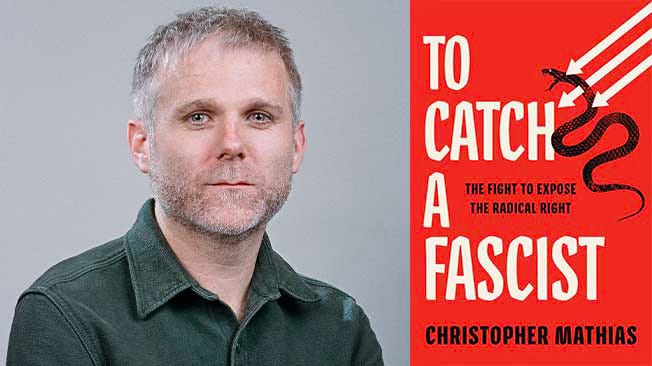
In his new book “To Catch a Fascist,” Mathias explores the pivotal role that the leaderless, decentralized, undercover organization plays in modern America.
Photo courtesy of Christopher Mathias; book cover courtesy of Atria Books
Ever since Trump entered the Oval Office the first time around, there’s been a consistent need for journalists who understand the far-right and are able to decode how they’re organized, their behavior online, and many different aspects of that world. Christopher Mathias is one of those journalists. His latest book, To Catch a Fascist, explores the efforts of anti-fascist organizers to infiltrate and unmask members of white nationalist groups in America.
The book focuses on the often misunderstood group of people we call antifa and the years of work the movement has put into unmasking fascists. Mathias has covered the far-right for years, using his reporting to similarly unveil white supremacists in our society who were cops, soldiers, teachers, and politicians. His work has shown that many people who appear to be regular citizens are living double lives and fighting for a racist cause.
Previously a senior reporter at HuffPost, Mathias now works as an independent journalist writing for outlets like MS NOW, Zeteo, and The Guardian. In the latest edition of Depth Perception, Mathias shares his findings from his research for this book, why antifa members’ efforts are important, and how all of this connects with the history of white nationalism in America. —Thor Benson
Learn from top longform journalists and find the best in-depth reporting. Subscribe to Depth Perception:
There’s been a long debate about antifa. Some people will say it’s this real, centralized organization that is controlling the left, and then others will say it basically doesn’t exist or that it’s just an idea. So how did you approach that going into this?
Like most Americans, I didn’t know what the fuck antifa was really before 2017. My association with them was largely from viral videos of black-clad leftists punching Nazis in the streets across America. I think that’s how antifa was kind of introduced to the public, and that initiated this flurry of “What is antifa?” explainers across the media.
But I was in Charlottesville, at the Unite the Right rally in 2017, and this was the largest white supremacist gathering in a generation. Afterwards, it was my task [as a journalist on assignment] to investigate this insurgent fascist movement, the “alt-right,” and to unmask its members. I quickly realized that there was already a network of people doing that work really effectively, and that network was antifa.
I realized that although, yes, antifa sometimes punches Nazis, the bulk of the work they do is actually research and intelligence gathering. I also realized why I think antifa is so inscrutable to the wider public, which is that it’s a very underground network. Its practitioners are anonymous to prevent reprisals from the far-right and from the state … Antifa is a style of politics. It’s a tradition — a militant tradition — of confronting the far-right by any means necessary. Anyone can kind of adopt it and do it. Because it’s like an anarchist enterprise, for the most part, it’s not structured the way most Americans conceive of things.
There’s no leader. There’s no headquarters. There’s not really membership fees or whatever. There’s no billionaire benefactors or hierarchies. It’s a tough thing, I think, for people to wrap their heads around sometimes.
Many on the left also get it wrong.
The flip side of the MAGA caricature of antifa is that a lot of liberals and centrists and Democrats insist antifa doesn’t exist. Because it’s just a shortening of the word “antifascist,” [liberals] think it applies to mostly everyone. I’m really trying to push back against that. I think antifa refers to a very specific thing and it’s a very specific tradition with specific tenets.
There’s kind of a liberal meme. It’ll be troops storming the beach at Normandy, and then it’ll say, “antifa, 1944” or whatever. That’s a misapprehension. Yes, the U.S. Army was fighting the Nazis, but the U.S. Army was also a colonial army. It was also a segregated army. Black soldiers fought in World War II and then returned home to live under Jim Crow. You could argue Jim Crow was a kind of a fascist social arrangement. I think the more instructive way to think about antifa is the Americans who went to fight in the Spanish Civil War — who were typically anarchists and socialists and communists.
Yeah, I once met some antifa folks at a protest before Trump first took office years ago. Like you said, they were wearing black, and they were passing out information. I didn’t think much of it. I’ve always thought saying you’re “antifa” was kind of like saying you’re punk or an anarchist. It’s just a label that anyone can take on. You can end up in certain communities and connect to other people with similar interests, but it’s not like there’s a punk headquarters.
Exactly. It’s like that famous Supreme Court ruling about porn: You know it when you see it. I feel that way about antifa.
The other thing I’m glad you brought up is the punk element. I think that is most people’s association with antifa and the aesthetics of antifa. That’s for good reason, because the modern iteration of antifa really did emerge from these previous networks of anti-racist action and skinheads against racial prejudice in the 1980s and 1990s that were formed to kick Nazis out of the punk scene. They grew more politically sophisticated and started to target white supremacist groups writ large. They developed a very specific set of militant confrontational tactics that really worked.
That’s what this modern iteration of antifa is based on. As my book argues, [it] is not so much a punk phenomenon anymore, although there are still many punks in it. The practitioners really represent a wide swath of everyday Americans — working class, middle class, rednecks, soccer moms, punks, warehouse workers, people barely scraping by, people living comfortably in the suburbs. It’s kind of all over the place.
“Less lethal” means “still deadly”
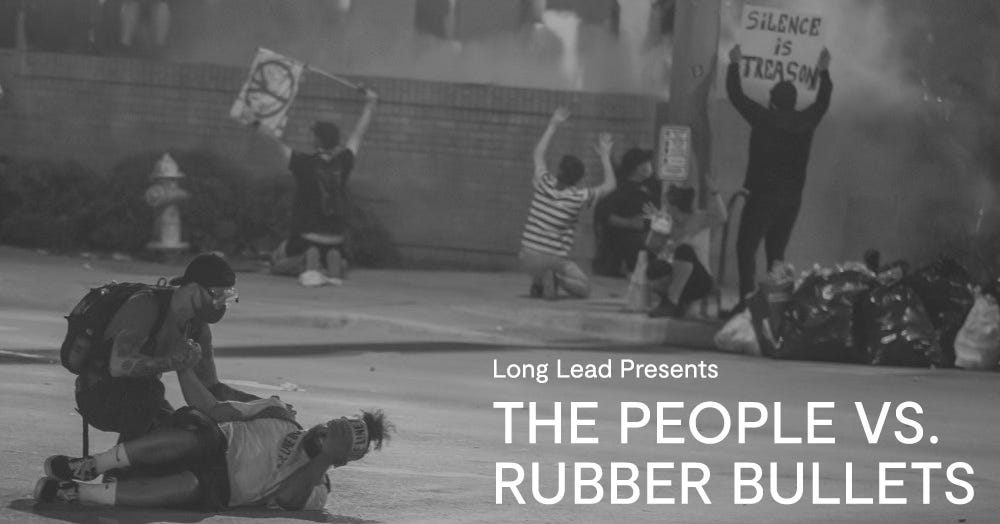
Tyree Talley lies in front of the Austin Police Department headquarters, after being shot by police officers with less-lethal weapons while protesting the death of George Floyd in May 2020. Ricardo B. Brazziell / Austin American-Statesman / Associated Press
For decades, police have championed less-lethal munitions as life-saving alternatives to deadly force. Their history, however, tells a different story — one of imprecise science, unmeasured usage, untrained police forces, death, and disfigurement.
With revelatory reporting by Linda Rodriguez McRobbie, stunning original and historical photography, and a captivating multimedia website, The People vs. Rubber Bullets tells the full, brutal story of kinetic impact projectiles and their usage, from rubber bullets’ invention in 1970s Northern Ireland all the way through the 2020 Black Lives Matter protests.
This award-winning, six-part, longform feature examines law enforcement’s use of these weapons in crowd control, chronicling a number of less-lethal victims and their struggle for justice. Read the stories of those whose lives were irrevocably changed.
It seems like you found that these people were doing some important work. Why isn’t the public more aware of what they’re doing?
My book is about anti-fascist espionage, research, and doxing. When I say the word doxing, I think most people associate it with posting someone’s private information, their phone number or address online, as a means of inviting harassment. That’s a tactic you see deployed by the far-right all the time. When I say doxing in the anti-fascist sense, I mean it to say the digital equivalent of ripping the white hood off of a Klansman.
It’s the act of identifying a previously unidentified white supremacist or Nazi who clocks into their day job as a professor, teacher, pastor, politician, [or] police officer. I think we kind of forget sometimes the degree to which Trump’s rise to power corresponded with this explosion in secretive white supremacist groups. The phrase I use in the book is an attempt to “resurrect the Klan’s invisible empire for the digital age.”
Antifa kind of took it upon themselves to figure out who was in this new invisible empire. They did this through a remarkable feat of what I would argue is data journalism and open source intelligence. They would infiltrate Nazi groups, sometimes in person. My book follows an anti-fascist spy that goes undercover into a group called Patriot Front, and they would come away from that infiltration having stolen hundreds of thousands of internal Nazi chats.
Those chats would then be posted in a public database that anti-fascist researchers across the country could mine for clues to identify their local Nazis. Over the last 10 years, as my book documents, they ended up unmasking thousands of American white supremacists and often revealing them to be people in positions of real power where they could do real harm. The intent of it was not only to alert your community about the guy down the street who might be liable to commit a hate crime, but it’s also to create a social cost for being in organized fascism.
If you want to join that fascist group, go right ahead, but we’re going to figure out you’re in that group, and we’re going to let your community know. We’re going to name and shame you. You might lose your job, you might lose your girlfriend, your family might be really mad at you.
There are stories I tell in the book, like when an anti-fascist spy went undercover into Identity Evropa, which was one of the main Nazi groups in Charlottesville. It’s a very kind of suit-and-tie fascist group. It’s mostly college-educated people. They have really good jobs and respectable jobs, and their whole goal is to infiltrate the Republican Party. Spies steal all of these messages, and they go into this public database over the course of the next year. Anti-fascist researchers unmask about 100 members of the group. There are many stories like that from antifa research and espionage, combined with other tactics like confronting fascists in the streets, which have led to the dissolution or disbandment of groups.
“This modern iteration of antifa is … not so much a punk phenomenon anymore, although there are still many punks in it. The practitioners really represent a wide swath of everyday Americans.” —Christopher Mathias
I don’t know when you stopped writing this book, but you might have noticed we have some masked people around these days. What do you think about how our law enforcement is masked now? And do you see efforts to unmask them?
One of the more interesting parts of the book for me was researching the history of masked fascism or white supremacy in America, which obviously led me to read a lot about the Klan. The first Klan wore masks to commit violence in an effort to destroy Reconstruction, to roll back all the gains won by freed black people.
There was a real effort to unmask and prosecute the Klan and to document their heinous crimes. They were destabilized and eventually dissolved. But also part of the reason that the first Klan dissolved is that they weren’t needed anymore. Reconstruction was abandoned, and that kind of ushered in this era, not only of Jim Crow, but of lynching.
The first Klan traded in the anonymity of the white hood for the anonymity of the lynch mob of the second Klan. A similar dynamic happens. There are millions of people in the second Klan, and they do meet fierce resistance and eventually dissolve for a bunch of reasons, but they take credit for the 1924 Johnson-Reed Immigration Act, which restricts immigration to a very select group of northern European countries.
The Johnson-Reed Act is named after a Klansman, [Albert] Johnson, who was a congressman [while] in the Klan. Incidentally, that’s the law Stephen Miller wants to return us to — that kind of immigration quota. I’m saying all this because the whole point of masked fascism is to create a world in which you won’t need to wear masks at all. It is an alarming prospect to consider that the people wearing masks now are armed agents of the state, and it’s alarming to consider a world in which they would feel comfortable not wearing masks.
I think what we are seeing on the streets of Minneapolis and elsewhere is an effort to create a social cost for being in ICE, to kind of say that, “If you don’t get out now, we’re going to let everyone know you were a part of this, and you will live with that shame for the rest of your life. You’ll never be able to wash it off.”
Antifa spent a decade unmasking this new generation of fascists, and now some of them are turning their attention to unmasking ICE agents. They’re putting up flyers with the identities of ICE agents. They’re analyzing videos of ICE agents committing brutality and figuring out who those ICE agents are.