When Susan Rinkunas tells me she went from covering marathons at Runner’s World to becoming one of the country’s most trusted abortion reporters, I can’t help but think about how many journalists stumble into their beats through sheer circumstance. But for Rinkunas, who recently co-founded the worker-owned publication Autonomy News with fellow journalist Garnet Henderson, the path seems less like stumbling and more like a deliberate march toward something that needed to exist.
The Pennsylvania native, who now lives and works in New York, spent years watching reproductive rights coverage get flattened into political horse race stories at mainstream outlets — the kind where “both sides” get equal weight regardless of whether one side is actively spreading misinformation. After stints at VICE (where she first edited Henderson’s work) and Jezebel (before G/O Media CEO Jim Spanfeller killed it), plus freelance contributions to outlets like The Guardian, The Cut, and The New Republic, Rinkunas had seen enough. When Henderson approached her in February about starting their own publication, the timing felt right.
Autonomy News, which launched earlier this year, is a publication that explicitly rejects the pretense of objectivity in favor of clarity. It refuses to paywall information about bodily autonomy and is willing to hold both right-wing extremists and nominally progressive organizations accountable when they fail the people they claim to serve. It’s also, as far as Rinkunas knows, the first worker-owned publication dedicated to this beat — a model inspired by successful ventures like 404 Media and Defector, but adapted for the specific needs of reproductive justice reporting.
In this edition of Depth Perception, I spoke with Rinkunas about building a sustainable model for journalism, the challenges of covering a beat that’s becoming increasingly dangerous, and why she believes traditional “both-sides” reporting actively harms public understanding of reproductive rights. —Parker Molloy
Subscribe to Depth Perception to learn from top longform journalists and find the best in-depth reporting.
What prompted you to co-found Autonomy News? Was there a specific moment or accumulation of experiences that made you think, “We should do this ourselves?”
I would say it’s definitely an accumulation of experiences and external events that led my co-founder and I to work on Autonomy News. It was actually Garnet Henderson who reached out to me in February of this year and asked if I wanted to start a worker-owned publication with her. And Garnet’s someone I’ve known for years. When I was an editor at VICE, I edited her freelance work, and so we’ve been work colleagues for a while.
I think it was a good time to do it because we need more coverage of attacks on people’s rights. And that’s not to say that mainstream outlets aren’t covering it, but I think increasingly they’re doing it in a very flat way that you are probably familiar with in your media criticism work, right? So there are people who cover things just as if it’s a political football or, you know, this person says this and that person says that, and they’re not giving you the full picture of why a certain group is attacking a certain right or the history [of the attack].
The groups that are working on these laws have a larger project. So it’s Alliance Defending Freedom, and then also First Liberty Institute, which is where Judge Matthew Kacsmaryk worked before he got nominated to a lifetime seat on the judiciary, and also Stephen Miller’s firm America First Legal Foundation, and these other groups as well. These groups are working together and trying to enact this larger project, and I think that news stories that we get other places don’t always show you that.
To be frank, freelance isn’t making it sustainable for me to keep doing this, and I really want to keep doing this. I think I am good at it and I’m passionate about it. So I think that a worker-owned publication is potentially a way to continue doing this work and have people support us directly through that model rather than the failing media business model that we see right now.
You’ve cited 404 Media, Hell Gate, and The 51st as inspirations. What specific lessons did you learn from their models?
We’ve taken inspiration from those publications, and I think also one that we didn’t cite but is subconscious to a lot of people is Defector. [It] really kicked this movement off of worker-owned media, which is great and led to [other publications] like 404 Media, Hell Gate, and The 51st following in [its] footsteps.
We decided to create an LLC for Autonomy News, and we now have a fiscal sponsor through the Tiny News Collective, which we heard about because The 51st is a member. It’s this nationwide organization that’s helping, usually hyper-local, newsrooms become sustainable, and we applied and they were happy to have us even though we’re not covering a specific city or county or state.
We have both fundamentally thought that information about bodily autonomy and these attacks should not be paywalled, but then that does get into a problem of, how do you support yourself as a writer doing this. So we are not paywalling our work. We heard from another newsroom that has a donation model and heard that they do really well with that. And so we decided, this fits with our values and it seems like it could potentially work, so let’s do that.
Your '“about” page explicitly rejects traditional journalistic objectivity. How does that philosophy shape your reporting decisions?
From earlier this week, we got a tip about a lawyer who is notorious in the anti-abortion space, Jonathan Mitchell, who filed a wrongful death lawsuit on behalf of a woman who says that her boyfriend literally slipped abortion pills into her drink. So this is reproductive coercion, this is against your will, this is horrible. But we can include that in that story and also note that this is kind of a coup for Jonathan Mitchell because he not only found a woman plaintiff — because his past lawsuits have been aggrieved male partners suing over their exes’ abortions — [but also] this man reportedly got the abortion pills from Aid Access.
That’s the kind of story where other outlets have absolutely reported it, but they’re not covering it the way that we are. They’re not showing those other pieces and then also noting that this lawsuit cites the Comstock Act of 1873, which Mitchell and other organizations are trying to get a federal judge to recognize as active when it is really dormant and hasn’t been enforced.
Another part of that story that we mentioned on Autonomy News that I haven’t seen mentioned in other coverage is that another anti-abortion activist involved in that lawsuit is a man named Mark Lee Dickson, who is based in Texas, and he shared on social media that he first heard about this reproductive coercion case from a crisis pregnancy center in Texas. So that’s another angle that we haven’t seen covered, and it underscores that crisis pregnancy centers may share private medical information with activists.
Anthem Awards: Your vote can amplify victims’ voices
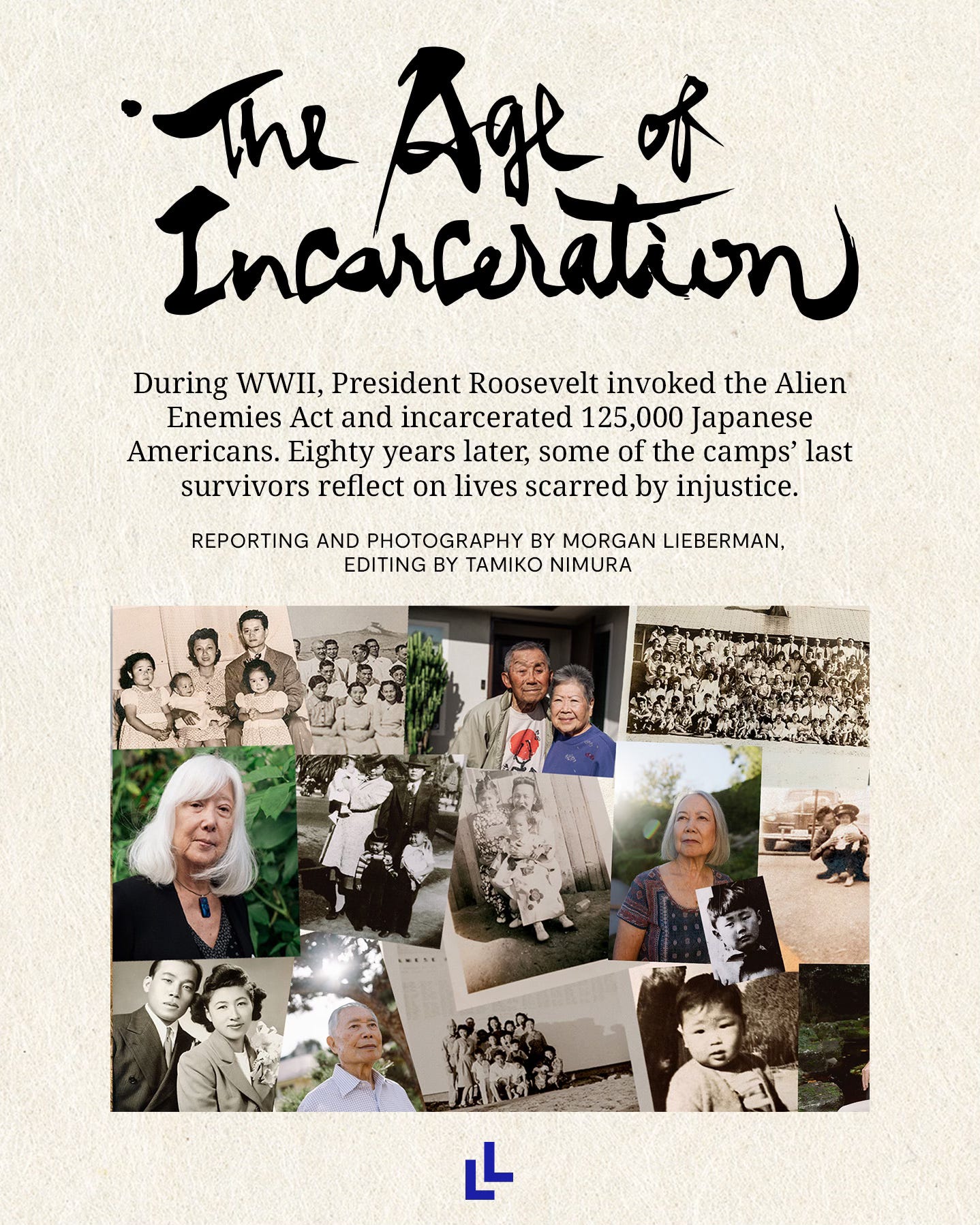
In “The Age of Incarceration,” photojournalist Morgan Lieberman captures the testimony and experiences of nine of the last survivors of Japanese American incarceration, 80 years after the war ended and these people were released. Reflecting on their experience of a childhood spent in detention, this series of portraits and interviews, shares stories not just of injustice, but of resilience, documenting what they endured, what they’ve carried with them the rest of their lives, and what about America’s past their country still hasn’t reckoned with. Experience the Anthem Award-nominated feature here: age-of-incarceration.longlead.com.
You write about holding both right-wing actors and nominally progressive organizations accountable. How do you navigate criticism of groups whose mission you generally support?
It’s very tricky to cover nominally progressive groups that say they are advocating for people’s rights but then make decisions that, in fact, limit people’s rights. One organization that people have seen Garnet and I cover from an accountability frame a lot is Planned Parenthood. They have almost 50 affiliates providing abortion and birth control and gender-affirming care across the country. However, they are a very large organization, and one thing that I’ve learned in my decade of covering this beat is that they are oftentimes more cautious than other groups, including independent clinics.
Workers will come to us and say, “This happened, did you hear about it?” and they either want people to know that there’s a change because they think patients should know, or they actually think that their employer has made a strategic misstep or is leaving people behind. So we’re just following the information that we receive.
How has the beat changed since Dobbs, and what stories are being missed by mainstream outlets?
In the past five years, there are fewer people dedicated to this beat. And I think that’s a story of consolidation across the media industry leading to layoffs, leading to people choosing to leave the industry. It’s also sometimes burnout.
The stories that are being missed are kind of the subtext or the kinds of things that I write reported analysis about. There’s a lot of, “this happened” and “this lawsuit was filed,” and “the Trump administration signed this bill,” but I feel like there’s much less “let’s zoom out, let’s look at the bigger picture of how perhaps Republicans are going to be able to effectively ban abortion without ever passing a new law to do so.”
I also think people are not seeing the larger picture of how closing clinics will affect all kinds of care, not just abortion. These reproductive health clinics — Planned Parenthood and also Maine Family Planning — they offer birth control, they offer STI testing and treatment, they offer cancer screenings, a lot of them offer gender-affirming care. So if these clinics close, that’s going to reduce a lot of people’s access to care, even if they never need or want an abortion.
“I’m not fear-mongering. And I think that people trust me and Garnet and Autonomy News in this way because they know we’re not claiming the sky is falling when every little thing happens.… We’re not crying wolf, people understand when something is a huge deal.” —Susan Rinkunas
What is the most misunderstood aspect of reproductive rights reporting by editors who don’t specialize in the beat?
A bigger picture thing that people don’t understand, I think, is that limiting access to reproductive rights is just part of a larger project to end people’s civil rights and send us back to the 1950s. And when I say people, I mean women, I mean people assigned female at birth, I mean trans people, I mean non-binary people — I mean mostly anyone who’s not a white cis man.
It’s not just about preventing people from having abortions and wanting certain people to have more babies. It’s also about reinforcing gender roles, right? There are people openly talking about birth control causing abortions, and that’s wrong, but I think it speaks to conservatives being so mad about the fact that the pill let more women into the workforce, and then straight men couldn’t, you know, be patriarchs at home and tell them what to do. The sexual revolution upended the Christian patriarchal view of society.
Looking back at your time at Jezebel, VICE, and other outlets, what skills from those experiences serve you best now as a co-owner?
With the most recent experience at Jezebel, we had to do our own promotion because Jim Spanfeller let all the audience people walk out the door and didn’t rehire them. So I think knowing how to package a story, working with editors and knowing how to get attention around a story online.
At the same time, I’m not the kind of person who tweets like “siren emoji emergency.” I’m not fear-mongering. And I think that people trust me and Garnet and Autonomy News in this way because they know we’re not claiming the sky is falling when every little thing happens. But at the same time, when we say something is very bad, people are like, “Oh no.” Because we’re not crying wolf, people understand when something is a huge deal.
And finally, what story from earlier in your career best prepared you for the kind of journalism you’re doing now?
One story that has led workers in the reproductive rights and justice space to know that they can trust me when they have something to share about a nominally progressive organization is when I wrote in 2022 for Jezebel about the National Abortion Federation changing its policies in the wake of SB 8, the Texas bounty hunter ban.
Because [the] National Abortion Federation was reportedly worried about getting sued under the bounty hunter provision, they were requiring doctors in Texas, after the law took effect, to do second ultrasounds on patients. And these were transvaginal ultrasounds. There’s a waiting period in Texas of at least 24 hours. So the guidance from [the] National Abortion Federation was you have to do an ultrasound at the first appointment, and then you have to do an ultrasound at the second appointment to make sure before you do this abortion that there is no cardiac activity.
I had a doctor tell me that she felt like she was being forced to sexually assault her patients. I mean, she felt really strongly about that, [because] it’s a completely unnecessary transvaginal ultrasound, twice.
Having workers trust me with those stories and then weathering what National Abortion Federation said afterward about the story — just riding that cycle of people coming to me with something, an organization responding and not really disputing anything I say, and then trying to do damage control — I’ve been through that cycle now multiple times, and that has really prepared me for the work I’m doing at Autonomy News.


Unless I missed it, why no reference to Jessica Valenti's Substack, Abortion, Every Day?