

The algorithm isn't going to serve you this Nicholas Carr interview
The crisis of “content collapse” is here, says the "Superbloom" author, and it’s causing everything to make us miss out on everything else.


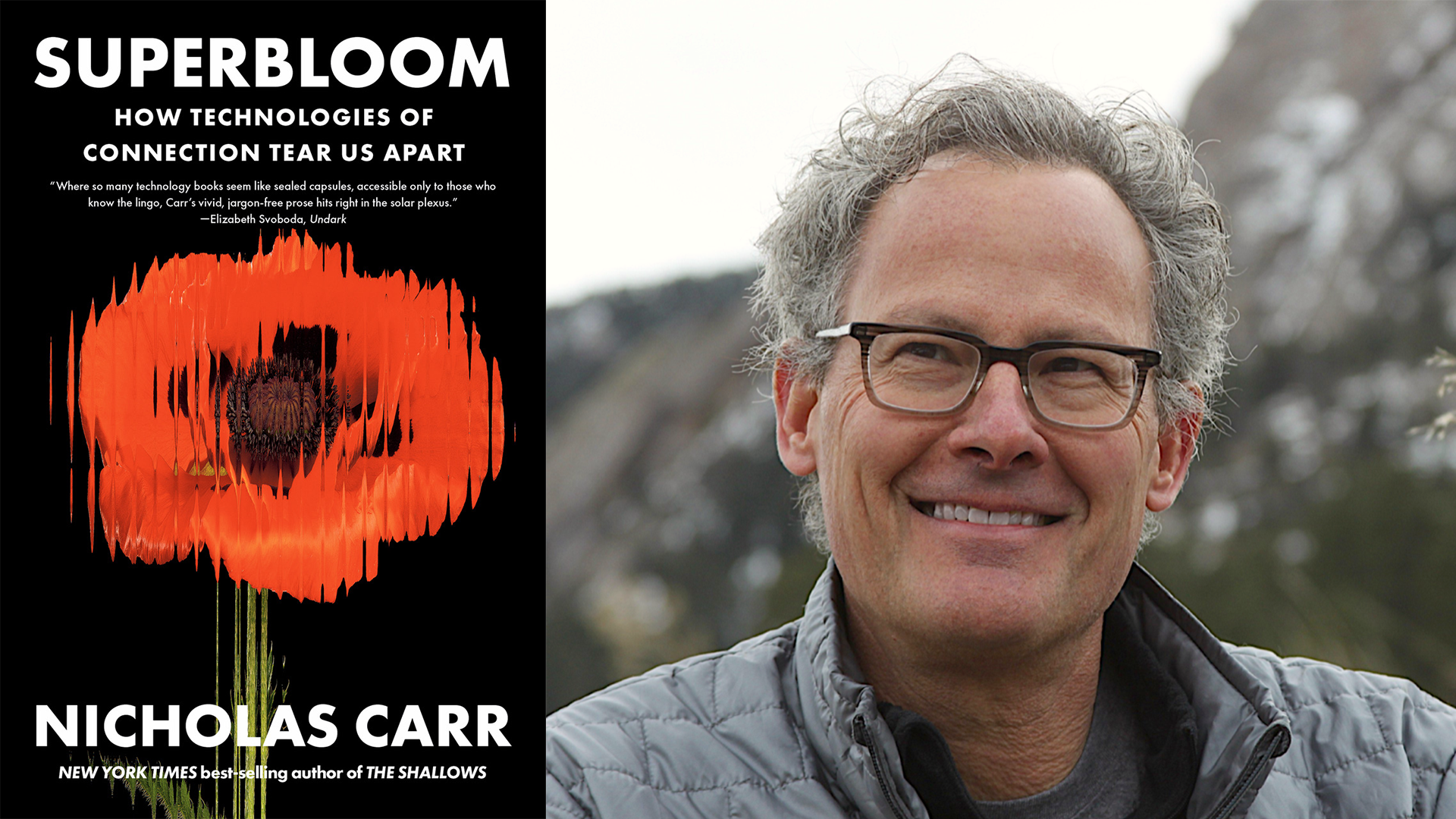
Nicholas Carr’s book, Superbloom, opens on a scene of social media influencers literally running amok. It’s the spring of 2019, and the poppies of Walker Canyon, 70 miles southwest of Los Angeles, are bursting with color. YouTubers, TikTokers, and Instagrammers storm the sensitive naturescape to capture the moment. They snap selfies, crush the flowers, and ultimately incite online outrage.
The scene is both a portrait of and a metaphor for the generations of people who’ve been handed powerful communication tools that have somehow made us ever more disconnected from each other and reality. “We live today in a perpetual superbloom — not of flowers but of messages,” Carr writes. “We spend our days sharing information, connected as never before, but the more we communicate, the worse things seem to get.”
Carr’s sixth book, Superbloom, is out in paperback this month. As with many works exploring the impacts of the internet — like his newsletter New Cartographies — it’s about a wild array of topics. (Index entries include, for instance: Carlin, George; ChatGPT; and cults of personality.) But its unifying theme is how communication technologies have shaped the world and people’s perception of it. And as the machines have begun to take over, the changes we’ve endured haven’t been for the better.
Superbloom pairs perfectly with The Shallows, Carr’s New York Times bestseller (published in 2010 and updated in 2020) about the cognitive and behavioral effects of the web. In this edition of Depth Perception, we speak with the Pulitzer Prize-finalist about the consolidation of media, the politicalization of tech leaders, and the future of journalism in the age of the algorithm. The following conversation has been edited for length and clarity. —John Patrick Pullen
Superbloom is fantastic, but let’s start with The Shallows, which pardon the pun, made some big waves. That book stemmed from an Atlantic cover story by you, “Is Google Making Us Stupid?” about 20 years ago. So the question is: How dumb are we now?
One of the drawbacks of being a prophet of doom is that if you are proven correct, you can’t take any pleasure from it. The trends that I described in The Shallows and “Is Google Making Us Stupid?” have unfortunately accelerated. If anything, we’re more distracted, less able to control our own thoughts, to control our own attention. So sadly, I think my diagnosis has panned out.
Of course, this month’s Atlantic cover story is Rose Horowitch’s “The End of Reading is Here.” And here we are, an author and an editor. Are we whistling past the graveyard or tourists at the apocalypse?
Gutenberg invented the printing press around 1450. For the next 500 years, I think the printed page, and in particular the book, was kind of the center of culture. At the beginning of this century, it’s almost been a clean break. We shifted away from the printed page into the computer screen. I think that does fundamentally change the way we read, the way we communicate.
To say that reading itself is going away is probably an exaggeration. But I think literary reading, or what some call deep reading, where you are focused on a long text, word by word, line by line, page by page, is becoming rarer and rarer. I think it is a reflection of the change in media technology.
You write in Superbloom about the chorus of remorse by tech leaders in 2016 who acknowledged they were “exploiting a vulnerability in human psychology,” as Facebook’s first president Sean Parker said. But they did it anyway. Yet you don’t lay the blame solely at their feet: The way we use this tech is human nature, and people have deceived themselves into thinking it can be fixed, you argue.
Many of those tech leaders stood next to Trump when he was re-inaugurated last January. Superbloom was published in hardcover one week later. Does the way tech has capitulated to and cozied up to political power in this term change your analysis?
Not really. I think what it’s shown is that those expressions of remorse are pretty superficial. There was a lot of social concern about the problems social media and smartphones had caused, particularly with young people, and [tech leaders] were taking the blame. So they kind of capitulated and started expressing remorse because that’s what they felt called upon to do.
But I think what we’ve seen in the last year or so is not so much that they’re cozying up to power or sycophantically putting themselves at the feet of Trump — though there is some of that — but it’s that they’ve realized that they can gain political power. I think until recently, the tech industry didn’t really care about politics that much. In fact, I think they kind of felt it was beneath them to dabble in this old, outdated way of running things.
Over the last five [to] 10 years, the political climate has changed and has gone against technology [and] against Silicon Valley. We saw that in the first Trump administration, but I think we saw even more in the Biden administration, where you saw efforts from both the right and the left to think about regulating the industry, to call industry leaders like Mark Zuckerberg up before Congress to testify in very antagonistic ways, and a refocus on antitrust regulation or enforcement. Suddenly they no longer had the political establishment on their side. I think what they saw with Trump in the second campaign is an opportunity to influence him, to influence his administration — an opportunity to use the changes in American politics to gain political power for themselves. They realized that this was important to their business. They realized that they like power and so they went for it.
More from Depth Perception
“Just the tip of the iceberg”: The New York Times’ Zach Seward on embracing AI
·Zach Seward’s first byline appeared in his fifth grade class newspaper. “I was one of those people who knew what I wanted to do for a living from about that age and never, ever detoured,” Seward tells Depth Perception. His path led him to Quartz, where he became a founding editor in 2012. After a stint as CEO, he serv…

For me, the most impactful part of Superbloom came early on, when you outlined how the physical technology of making music records influenced albums’ content. We wouldn’t have art like John Coultrane’s “A Love Supreme” without what you smartly recognized as “what Mark Zuckerberg disdainfully calls friction on the processes of information production.” In a world of generative AI and short-form content, where it’s becoming ever-easier to create but increasingly harder to fit deep meaning into the message, what are we gaining and what have we lost?
When we look back at what I’ll call analog media, pre-digital media, we tend to see a big mess. You didn’t have a phone that could do everything. Our phones now have all information of all sorts, whether it’s entertainment or news or whatever, digitized. It can be fed through a single device. You look back into the ‘70s, ‘80s, even the early ‘90s, and you had separate devices for all of these things. You had to have a record player or turntable, a radio and a television, a physical photo album and an old school telephone — and it seems like, “Oh my gosh, that was so horrible.”
But what I argue is that it actually gave us a sense of differentiation among different forms of information, even different experiences. You had to make choices: Do I want to spend time with a newspaper now and read, or do I want to put a record on the turntable and listen to music, or do I want to write a letter to someone?
Specialized devices and specialized networks actually gave coherence to our use of media… and required us to impose a kind of set of choices of our own on how we spend our time. Built into this analog media ecosystem were distinctions between what’s important and what’s trivial, what’s fact, what’s fiction, what’s entertainment, what kind of things are of pressing importance. And I think that helped us navigate a time when we were already being inundated by lots of information.
It also meant that artists, musicians, and writers had lots of different established forms that they could work in. You mentioned the record album. An LP record is, in one way, determined by physics, how you know how much music you could fit on a piece of vinyl … When we had the arrival of it, suddenly musicians had this new form that they could express themselves through. So it was no longer just a 45 RPM single song record — it expanded their horizons — and in what looks like constraint, actually was enormously freeing.
Looking back, we can see certain advantages to having this messy, highly specialized media landscape. Now everything comes through the same device and everything competes with each other in the same way. You have to keep everything short. You have to grab people’s attention because everything is pulling at you at the same time. And I think we’ve lost a lot of formal differentiation in communications, art, and entertainment. We’ve also lost the ability to control our own consumption of all that stuff. We’re constantly looking at what our phone tells us to look at, rather than making moment-by-moment decisions about how we’re going to spend our time.
“It goes against their interests for us to be deeply immersed in reading a longform article, or even watching a long movie, because they make their money by us changing our focus — it gives them new opportunity to show us ads.... Their algorithms are fundamentally opposed to any longform, anything that’s going to gain a long, extended purchase on our attention. We’re fighting that.” —Nicholas Carr
There, at the end, you’re talking about consuming the content that’s served to you. I always make the argument that the world needs more editors, but it seems as though algorithmic curation is just off the rails at this point — it’s run amok. In the book, you talk a lot about the news feed. Is that where we went wrong? Was it the feed that broke us?
The feed fundamentally changed our relationship to information and media of all sorts. Suddenly, machine technology began to take over the editorial function. It was no longer a person, an editor, or a producer deciding what would be sent to the audience. That was always a flawed process, but it was a person, many of whom actually cared about quality, veracity, and things like that.
Then human beings began to be replaced by an automated algorithm, and the algorithm doesn’t really care about quality or veracity or anything else. It cares about reading signals that tell it what’s going to gain some immediate hold on a person’s attention. It doesn’t have to be a long hold — it can be a very temporary one before it serves up the next thing. It also removed from us control over our choice of what we were going to look at or listen to. That choice went to the machine, and to the corporation behind the machine.
“A squirrel dying in front of your house may be more relevant to your interests right now than people dying in Africa.” That’s a Mark Zuckerberg quote from your book that you call “grotesque not because it’s false — it’s altogether true.” You cite it because it’s the essence of what you call “content collapse.” This interview will be competing for attention in the feed against the war in Iran, National Hammock Day, and who knows what else. Can longform journalism survive content collapse?
Content collapse is what I was getting at earlier, where everything is served up through the same device, in competition with everything else, and mediated through algorithms. So everything tends to get shorter and gain a briefer purchase on a person’s attention.
One of the things we need to recognize about internet, social media, and AI companies now is that it goes against their interests for us to be deeply immersed in reading a longform article, or even watching a long movie, because they make their money by us changing our focus — it gives them new opportunity to show us ads and gain information about what triggers our behavior. Their algorithms are fundamentally opposed to any longform, anything that’s going to gain a long, extended purchase on our attention. We’re fighting that.
I don’t think longform writing will disappear — there are still going to be plenty of books and longer articles. But I think the audience for that is going to be smaller and smaller, and even the people capable of producing it, is probably going to shrink as well.
You’re a writer — this is your sixth book. The adage is “write what you know.” But if you knew how to write differently, what other way would you publish this information that would make it more relevant? Should Superbloom be a podcast or a Netflix series?
I think in terms of books, so for me, it was always a book. I did sense that it had a kind of episodic quality and moved through history while still having a common theme that might have lent itself to a documentary or a nonfiction TV series. Nobody’s offered to do that, so it’s probably not going to happen. But that’s more me seeing another opportunity there than me trying to think of a better way to reach an audience. So for better or for worse, I think I am still stuck in the literary culture.
Last question: When some AI company inevitably strips this interview of all its important points, what one thing do you think readers will lose most by not having read it?
If you interact with AI summaries of original things or AI replications of them, you begin to believe that they’re not worth your time, and you begin to lose even the ability to fully engage with the originals. And so, you become more and more dependent on the AI summaries or the AI slop as a substitute for the real thing, and less able to really grapple with or enjoy the real thing.
The danger here is that this does become a self-reinforcing cycle where the AI summary or the AI replication of the original begins to simply overwhelm the original itself. And once that happens, then you’ve got a real cultural problem because you’re starting to remove the incentives, not only for reading and viewing serious works of writing and music, but you are removing the incentives for producing them as well.
What’s one app, tool, or service that you can’t do your work without?
Probably the most important is the local library systems app or website for searching their collections. Because I’m not an academic, I don’t have access to an academic library, but I do a lot of research. And so what’s been a real boon to me is the fact that local libraries have joined into big consortiums that often include academic libraries, and you can search their collections and the broader collection. Pretty much any imaginable book or article I can find online through library websites.
What is a widely accepted journalistic rule or norm that you hate?
The way that you should avoid anecdotes and instead concentrate on hard evidence, surveys, experiments — I think that’s really wrongheaded. I think anecdotes, which are actually just people’s experiences, you can learn a lot more about even a very scientific or technological phenomenon by actually talking to people about the way they use an app or a tool, or the way they think.
What makes you think journalism is doomed?
Writing to the algorithm is going to erode the ability of journalism to really do its job, because you’re not even really writing for the audience. You’re writing for a machine that is between you and the audience. This narrows the range of what’s covered. It forces journalists to fit their work to a kind of inhuman editor that is very powerful. The mechanization of the editorial function, the content selection function, is very dangerous. At the same time, given the power that these algorithms have come to hold in getting between journalists or creators and the audience, it’s very hard to see how you escape the dynamic that we’re in currently.
What makes you feel hopeful for the future of journalism?
People. The good thing is that people are still curious if you give them an opportunity. I find it hard to imagine human curiosity going away. If we can sustain human curiosity, then there’s still hope.
Further reading from Nicholas Carr:
“Operation Gaslight” (The New Atlantis, April 16, 2026)
Superbloom: How Technologies of Connection Tear Us Apart, (W.W. Norton & Company, Jan. 28, 2025)
The Shallows: What the Internet Is Doing to Our Brains, (W.W. Norton & Company, March 03, 2020)
“Why Trump Tweets (And Why We Listen)” (Politico Magazine, January 26, 2018)
“How Social Media Is Ruining Politics” (Politico Magazine, September 2, 2015)
“Is Google Making Us Stupid?” (The Atlantic, July 2008)