In the early 2000s, photographer Thomas Dworzak and journalist Christian Caryl traveled to a secret location in Chechnya, one of Russia’s borderland republics, to meet a fugitive commander. They spent “half a week hidden in a safe house, watching Soviet TV comedies, and eating boiled sheep.” The commander never showed up.
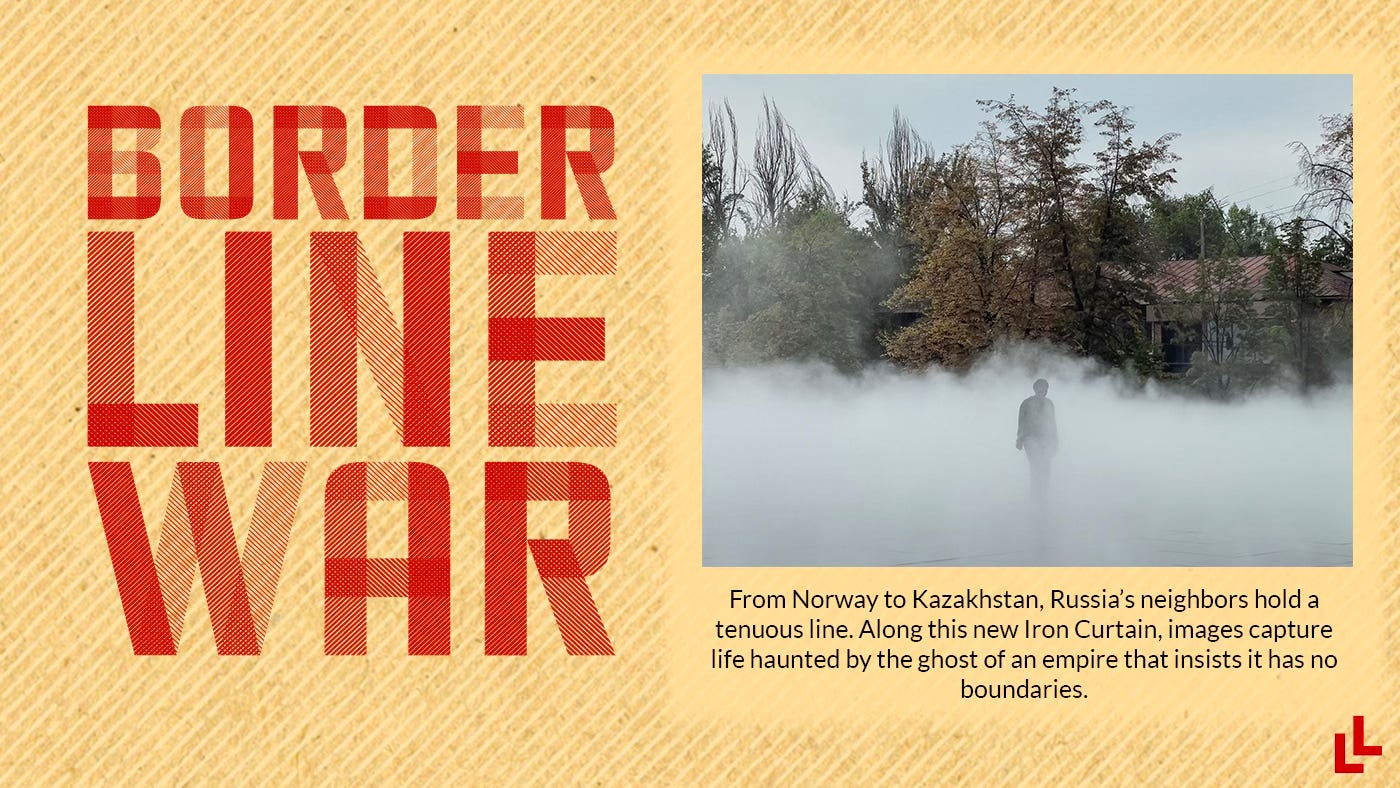
Now they’re together again, collaborating on a new feature for Long Lead. Their photo-first feature, Border Line War, is built off a line borrowed from Vladimir Putin: “Russia’s borders end nowhere.” Covering the Russian mining settlement on Norway’s Svalbard archipelago to the steppes of eastern Kazakhstan, Caryl’s analysis lays out the geopolitical reality of Putin’s stealth assault on his neighbors (hybrid warfare, election interference, Russian money flowing to politicians across six European countries) while Dworzak’s photographs go somewhere else entirely.
There’s no combat in these images. No rubble, no refugees in motion. Instead, there are monuments, museums, military training exercises, Victory Day concerts staged across a river, and Polish live action role players (LARPers) spending a weekend pretending to live in an American trailer park. As Dworzak puts it, “There is no war, except Ukraine.” But soon there might be, and these pictures are what that in-between feels like.
Learn from top longform journalists and find the best in-depth reporting. Subscribe to Depth Perception:
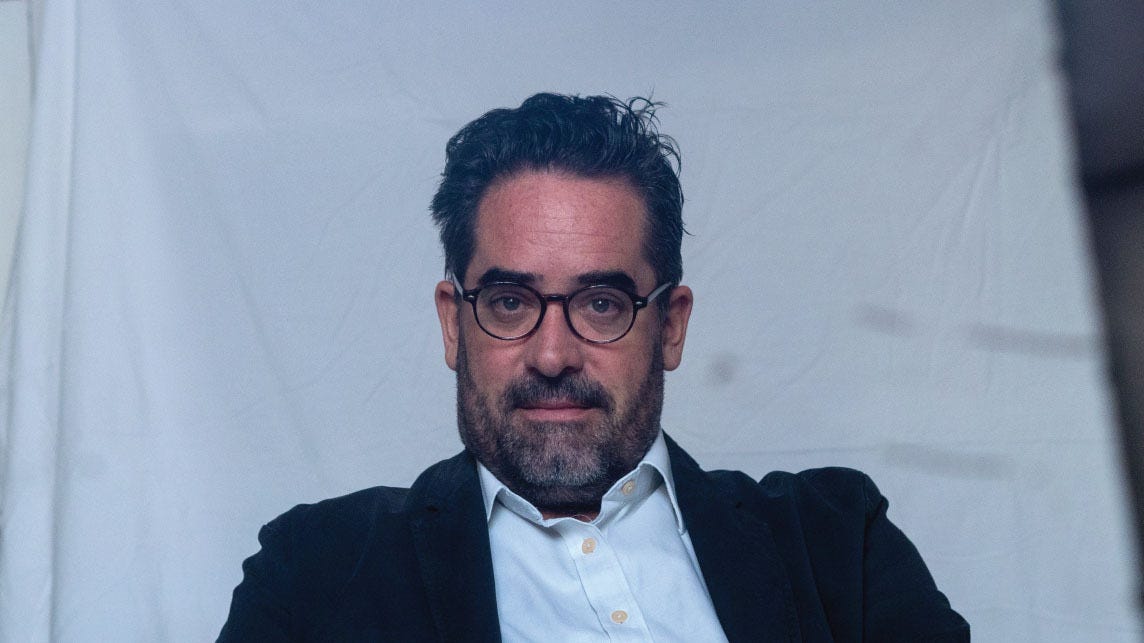
Dworzak has been a member of the Magnum Photos cooperative since 2004 and was the group’s president from 2017 to 2020. He’s been working in the post-Soviet world since his early 20s. He lived in Tbilisi, Georgia through the 1990s, covering the wars in Chechnya, Abkhazia, and Karabakh. His book, Taliban, published in 2003, collected retouched studio portraits of Taliban fighters that he found in photo shops in Kandahar after the regime fled the city. More recently, Khidi — The Bridge (2021) paired 15 years’ worth of photographs of Georgian soldiers in Iraq and Afghanistan with a feature-film screenplay.
Dworzak grew up six kilometers from the Iron Curtain in Bavaria. The border was closed. He never crossed it and never met anyone who did. Now, he says, that same divide has moved 500 kilometers east, and it feels familiar.
In this edition of Depth Perception, we speak with Dworzak about how this new feature came together, what it’s like to photograph places he’s known for decades as they brace for a war that may or may not be coming, and why he’s more fascinated by the fake than the real. This interview has been condensed and edited for length and clarity. —Parker Molloy
Where are you based now? You’ve lived in so many places over the years — Georgia, Germany, France. Where’s home at this point?
I’ve always had a connection to France since my high school time in the 1980s and [I’ve] had a flat there since the late ‘90s. And since 2015, I don’t live anywhere else. I only live in Paris.
You’ve talked about growing up in a small town in Bavaria and wanting to get out. You bought a ticket to Belfast at 15- or 16-years-old to see what war looked like, ended up too scared to photograph the soldiers, and took pictures of the sky instead. What was it about that experience that made you think, “This is what I want to do with my life?”
I didn’t choose to take pictures of the sky. I fucked up, so I took pictures of the sky. I thought I would take pictures of the soldiers. I don’t think I was naturally predestined. Going to Belfast, it wasn’t a rewarding experience. I was curious, but it was also a horrible challenge. I didn’t like it. I was very worried about it. It wasn’t like, “Oh, I went to a war and I felt really great about it.” No, I felt really bad. But I thought it was what I had to do. I think in a way it was the biggest challenge, coming from this very dull 1980s West Germany small town. I thought this was the most radical thing to do. Almost the most challenging.
You didn’t study photography, and you went to the Caucasus in the early ‘90s without any preconceptions about what images were supposed to look like. Do you think that lack of formal training shaped the kind of photographer you became?
I think it was good. At that time, you say, “I want to be a war photographer” — what are you going to do? There were no workshops, classes, studying. Now you can do a course or whatever. At the time there was no internet. There was nothing. One of the biggest problems I had is I didn’t know how to go about becoming a photographer. You want to become a lawyer, you study law, you become a lawyer. But there was nothing. So in a way I had to figure it out myself. I started studying languages and I traveled… So I did it on my own.
If I had been exposed to the full amount of photography one is exposed to currently in the modern world, I think I would have been totally intimidated. I would have had this feeling of, “Well, what else am I going to do? Everything has been done.” In the Caucasus, it was a very natural, healthy way of doing it. I was like, “Look, I’m really fascinated by this place and I want to make pictures of it.” Until the Caucasus, it didn’t make any sense what I was doing. It was just carrying a camera around. But there, it sort of clicked.
The latest from Long Lead:
Years of reporting across thousands of miles. A global power imposing itself on other countries without restraint. A view of the world as you’ve never seen it before. Read Border Line War, the latest from Long Lead, produced in collaboration with Magnum Photos.
How did Border Line War start, and how did you and Christian Caryl end up working together on it?
My whole life, I would always go to conflict. When I moved to Paris, I had definitely moved away from [capturing] day-to-day conflict. It wasn’t a time in my life where I would try to run off because there’s a war in Iraq or something in Haiti.
So when Ukraine started, it was very complicated for me. What am I going to do now? I’m 50 years old. Am I going to move to Kyiv? And there was a sort of déjà vu. I’ve been running from Putin’s bombs so many times in my life, I didn’t want to do it. I’m married, I’m older. So there was this whole complicated thing. In the end, I didn’t go. I did not rush to Ukraine like everybody else did.
Although I had only been to Ukraine twice or three times, I was really almost all the time in Russia and the Caucasus. Ukraine was sort of on the way through. But of course Ukraine feels familiar. It’s part of this post-Soviet world. At the time I could speak Russian. It was this post-Soviet way of how everything works — very familiar.
Anyway, I didn’t go, but I thought, “What am I going to do? This is so much my corner of the world. What can I do? How am I going to deal with it?” And then I looked at it and I felt there was a sort of over-coverage of Ukraine, strangely, at a certain time. We kind of knew what was going on in Ukraine, but there were all these other places. So I decided to look at them and started the project. A lot of these places had been on my periphery — the Baltics, Central Asia — but I hadn’t really been there before. About a year later, I did end up going to Ukraine. But mostly I spent my time traveling along this new Iron Curtain.
“The old Iron Curtain was a very defining thing in my life. It was the end of the world.... I never crossed. I never met anyone who crossed.” — Thomas Dworzak
I grew up six kilometers from the old Iron Curtain. For me, the old Iron Curtain was a very defining thing in my life. It was the end of the world. The border was pretty much closed. I never crossed. I never met anyone who crossed. There was a lot of fear of war, [of] an invasion, [of] the Russians coming. So in a way, the thing that defined my childhood has now moved 500 kilometers to the east, but it’s coming up in a similar way.
I met Christian in Moscow in the early 2000s. We once had an assignment together where we would go and meet a fugitive Chechen commander in a secret location in Chechnya. All very cloak and dagger. We ended up spending half a week hidden in a safe house, watching Soviet TV comedies, eating boiled sheep, and the commander never materialized.
Some of the images go back to 2023, others are from 2025. Were you shooting with this specific essay in mind from the start, or did you realize at some point that work you’d been doing across these countries was really part of one project?
No, it became part of that. I came up with the idea and I started to trace this line. I sort of extended it. I started with the Baltics and then I was like, “Oh, we also need the Balkans, we also need the Caucasus.” The project kept getting longer, and I decided to follow the line all the way until it “evaporates” in eastern Kazakhstan.
There’s no direct conflict in these images. It’s monuments, museums, rehearsals, training exercises, TV screens, parades. For a feature about the threat of Russian aggression, that’s a striking choice. How did you arrive at that approach?
Well, there is no war, except Ukraine. There is a hybrid war, but practically — look, I don’t have the means to drive around Eastern Europe waiting for a drone to hit a field in Poland, and it’s not going to be visually that interesting. There are many places that are very tense, very loaded. But otherwise, they’re not shooting at each other. Unlike in Ukraine, there is no war.
Sometimes I felt, could this be the last summer before the war? I don’t know what’s going to happen. There are people who think it’s going to happen very soon. There are preparations — people train, security. It’s not as dramatic as a real war, of course. But I had done a World War I project in the mid-2010s, around the anniversary, which in a certain way taught me to find more abstract, sometimes historical things.
I chose to go to a lot of museums, look at the stuff that is the historical component, bring this in. Those tensions, that’s what I do.
Clockwise from top left: A trench warfare training site in Romania in Jan. 2024; a ballet company in Moldova rehearses “Swan Lake” for a Victory Day celebration; Vladimir Putin on a television screen in the Bavarian town of Cham in 2024; anti-Russian graffiti in the Georgian capital of Tbilisi in 2024. Photos by Thomas Dworzak
Tehran is one of the places you’ve called home, and you’re publishing this essay about imperial overreach while the U.S. and Israel are bombing that city. I wanted to give you space to talk about that if you want to.
I’ve dealt with Russian imperialism in this whole thing — Russian expansion, Russian nationalism in the Caucasus, in Georgia, in the whole ex-Soviet Union, [and] now in Ukraine. In a way, it’s all connected.
What I find is that in the last month, the whole shift of tension — I don’t think anything has changed on the Iron Curtain. This project is from 2023 to now. Everything from 2023 is still relevant now. We’re still in this phase. Now something else has come up — maybe because of our attention span — and it’s all moved that way. Right now it feels a little off the agenda, because we’re talking [so much] about the Middle East. But it hasn’t really changed.
If there was a real change, the whole body of work would suddenly have a totally different significance. If something happens, this would suddenly become history. It’s not history yet. Maybe it’s never going to be, who knows. But it’s still building up.
The piece ends on the Polish LARPers, where Europeans spend a weekend role-playing life in an American trailer park. That’s an extraordinary image to close on. How did you find that, and whose idea was it to end the piece there?
It was my idea. Parallel to this, I’ve been obsessed with war games — in a way as a reaction to me covering real wars for so long. I feel I’m entitled to do it because I’ve done the real things. I want to do the fake after the real. And in a certain way, I’m often much more fascinated by the fake. It fits with my life now. I had a great time at the Polish LARP.
For me, it was very important to define the border of this project very clearly. I’m not stepping into Russian-controlled territory. I spent 30 years of my life running around in the Soviet Union on the Russian side. Now I’m not going anywhere under Russian control. I don’t go to occupied territories. I don’t go to Transnistria. I don’t go to Abkhazia. Of course I could, and it could make sense along this undefined line, but I thought that was very important to stay on this side with a very clear line.
And there is a sort of decline in American presence, which I’ve seen. There aren’t so many in-your-face American things anymore. I remember there was a time when there was more Americana. You hardly see any American influence anymore. So the LARP was an extreme exception: “Oh, they’re actually playing a really American thing in Poland.”
After 35-plus years of photographing conflict and its aftermath across dozens of countries, what keeps you going?
I have definitely slowed down on the conflicts, honestly. My life, my job has changed a lot. I am older, married now. It’s funny, in a way I am back to where I started — working on longer, bigger, slower projects. Scratching together the funds. Previously, I was living in two-week cycles. I spent a long time really rushing from one thing to another. You don’t really have time to think.
I don’t have these jobs anymore. It forces me to focus. Think. It’s good.