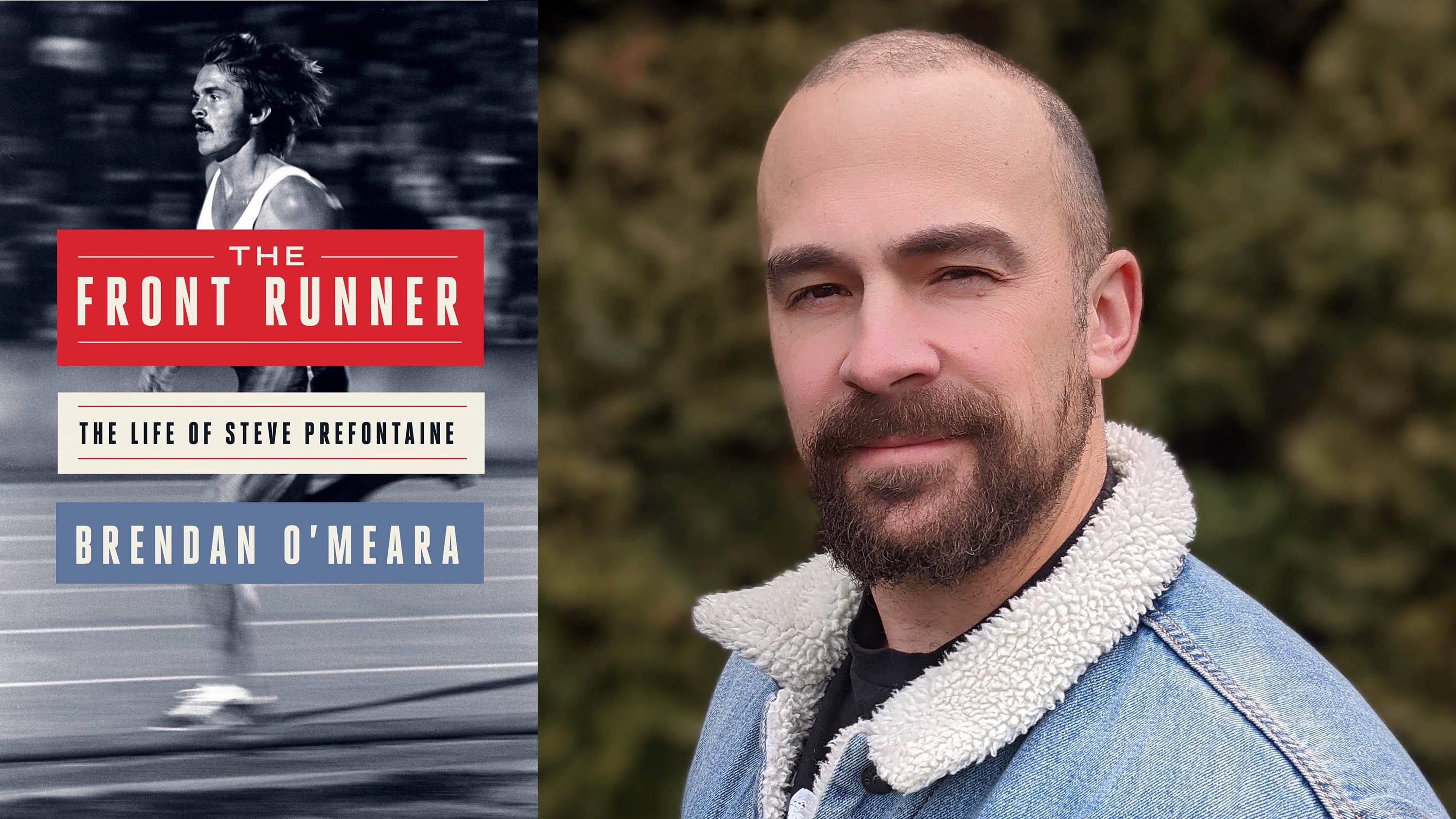
Cover image courtesy of Mariner Books; Photo courtesy of Brendan O’Meara
Last spring, Brendan O’Meara made the fascinating move to offer a backstage pass into the publishing process of his latest book, The Front Runner: The Life of Steve Prefontaine, even when doing so proved less than flattering. In his newsletter, Pitch Club, he broke down how his advance with a major publisher worked and laid out all the costs associated with completing his book. In doing so, O’Meara bravely shared data on the modest sales relative to his expectations and illuminated the impact of that on future opportunities with landing another book deal.
Why did he do this? Perhaps because, after hosting “The Creative Nonfiction Podcast” since 2013 and producing 499 episodes so far (with some of the top names in longform journalism and books including David Grann, Susan Orlean, and Patrick Radden Keefe) O’Meara knows the ins and outs of nonfiction publishing better than most. His struggle to break into journalism and book writing created enormous empathy for both starving journalists and for writers. Championing transparency while recounting his own professional experiences is no different than the efforts he’s put into learning about and sharing the career paths of hundreds of other writers on his podcast for the last 12 years.
Depth Perception spoke with Brendan O’Meara about his new book and assembling one of the most valuable repositories of conversations with writers that exists in the podcast space. — Brin-Jonathan Butler
Learn from top longform journalists and find the best in-depth reporting. Subscribe to Depth Perception:
One of the things that has fascinated me about your process after the release of The Front Runner, is your courage to be transparent about the whole process of your book deal, including the numbers involved and discussing the actual modest sales so far. What makes you want to be open about that on your Substack after suggesting the numbers aren’t meeting expectations?
I like being transparent about it because for so many years I was just so frustrated and bitter and resentful of the entire publishing ecosystem. And maybe even our peers. It just seemed like there was such a cloud over everything. I couldn’t get anything started. I couldn’t get any momentum.
That’s kind of why I started the podcast when I did, because I was just working through a lot of bitterness and jealousy of just seeing everybody else seemingly in “the club” and I was just outside looking in. A lot of that is because so much of the information just seems to be very, I don’t know, fenced off and walled off.
Book advances or book sales or just feeling crummy around all that kind of thing… Nonfiction book sales have been pretty sluggish this year in general. I like showing people the nuts and bolts, and if I can offer a little bit of light into the corner, I’m all for it.
As of this interview, you’ve done 499 episodes of “The Creative Nonfiction Podcast.” When you got a glowing review for the Prefontaine book in Publisher’s Weekly, what caught my eye was how the opening paragraph framed you as a podcaster who had written an “elegant biography.” You mentioned feeling some bitterness toward publishing, but what has jumped out to everyone I know about your podcast dealing with writers is how positive and supportive you are toward the people and the work you discuss. It’s generated a tremendous amount of goodwill. Why isn’t Publisher’s Weekly referring to your journalism and writing as opposed to your podcasting in discussing the creator of this book? Was that weird of them?
Yeah, it was. It’s so wild. I’m not a classically trained audio guy. If you saw my rig from 2013, when I was recording my earliest episodes, it was embarrassing. But I just taught myself how to do it. As I was saying earlier, those feelings of bitterness and jealousy, it was a fuel that wasn’t burning clean. And I was like, “You know, I need to be more celebratory of people and maybe in doing so, some of that goodwill will boomerang around to me eventually.” But that was never the intent.
The intent was recognizing there were a lot of people who were like me, with no one knocking on their door to have a conversation with them. So maybe I just need to build my own stage and invite people on who are on my level, which is to say pretty anonymous, but still have brilliant insights to offer. And then slowly from there, I saw maybe I could use this as bait to get some bigger fish. But to think I would be more identified as a podcaster versus a writer, which is probably where my ego wants to be more identified with — to be more identified by this very niche podcast in a discipline that is not my stock and trade?
[Podcasting] is just something that’s self-taught through trial and lots of error and lots of other trials. I just keep sticking around and keep showing up. More than anything else, it builds community. It curries good favor and it helps platform people who might not otherwise get that platform. It wasn’t until I started to try to serve other people, that good things started to happen to me.
Take a deep dive into immersive multimedia journalism
Image by Daan Verhoeven
On a winter night in 2010, Alenka Artnik, sunken by grief, found herself alone on a bridge, contemplating suicide. Ten years later, she has become the world’s greatest female freediver and is getting stronger with each record-breaking plunge. Only a few people — all men — have dived deeper than she has on just one breath. And soon, she may surpass them all.
“The Depths She’ll Reach,” written by Xan Rice and filmed underwater by Daan Verhoeven, recounts how Artnik emerged from obscurity and mental health struggles to become one of the world’s most elite athletes.
Published 4 years ago this month, “The Depths She’ll Reach” was Long Lead’s first multimedia feature. Winner of the Webby Award and Webby People’s Choice Award for Best Sports Website, it was included in Triumph Books’s The Year’s Best Sports Writing 2022 and listed as a “Best of 2021” by Longreads, Longform, and The Browser — and it still holds up.
When did you get your book deal for the Prefontaine book?
Early 2023.
This was your first major book deal, correct?
My first book came out in 2011 for a university press. But this was my first major book deal. There were 14 years between the two publications of each book.
This is something I think most people rarely get: a backstage pass into writers and publication of their books. You were very open about how advances for books function in publishing these days. Someone could sign a book deal for $100,000 and after taxes, agent fees, and the way advances are paid out in installments across many months — and even years — a writer could barely be living above the poverty line. It’s not like health insurance is included in the advance either. So what were your expectations going into publication for the Prefontaine book?
You come to realize that if a book deal was spread out over four years, a barista is making more money than some people with a book deal at a major publishing house. My advance for The Front Runner was $150,000. I shared that in my newsletter and broke everything down after fees and taxes.
I was definitely feeling a lot of heat and a lot of pressure for one, because I’m not a big name. I’m something of a “no name.” So coming into Prefontaine is just like, “Alright, I have to work really hard. I have to get really good interviews. I have to research thousands of articles and to get a really good shape on this so people can get beyond my name and sink into the story.”
I often talk about the 2 a.m. or 3 a.m. book panics of just waking up in the middle of the night and just thinking, “Can I come up with anything new?” There’s only so much that can be said about this guy. Am I just regurgitating everything that’s ever been said. Is Prefontaine’s sister going to run interference and tell people not to talk to me? All these little panics. So it was a pressure cooker type thing. Am I going to hit my word count that is in the contract? And then the question of whether I can say anything new and reach that word count.
When you finished the manuscript how did you feel? Did it land the way you were hoping it would?
I really liked how the short took shape with my editor. We were able to shape it into a way that felt like a really good story. [His] story almost plays like a hero’s journey. There’s the mythic Prefontaine who never gives up, but after his freshman year, he gave voice to quitting. He was so burned out.
And that was something you’ve never heard about Prefontaine. Pre asserted his voice on the track with a lot of hubris. Then he got humbled. Then he had to reckon with his hubris and also leveraged his platform and his celebrity to give others voice.
There were probably 10 to 12 rewrites of the manuscript in the final year before the book was published. But the rewrites helped bring the shape of the story into focus.
“[‘The Creative Nonfiction Podcast’] curries good favor and it helps platform people who might not otherwise get that platform. It wasn’t until I started to try to serve other people, that good things started to happen to me.” — Brendan O’Meara
What’s it like writing a book about such an icon? He looks like the James Dean of athletes. He doesn’t just die tragically at the same age as James Dean, but also by the same means via a car crash. There’s a specific kind of legacy with legends who die young, it transforms into a double legacy, what they achieved alive and what they might have achieved had they lived.
When you’re doing the, for lack of a better term, the math of a book project, you start thinking about these mythic figures that have outsized proportionality in the culture. Can we find something new? What is the framing? Why do they matter? Why do they matter now? Can we get beyond that mythology?
That was a big hurdle with the reporting on Pre. I would get people on the phone and hear, “Hasn’t everything been said about this guy that can be said about him?” But it turns out he intersected with thousands of people.
So if you can get a fraction of those people who all had their little experience, now you can start to triangulate a more three-dimensional portrait and maybe get to something that hasn’t been said before. The hope is that maybe you can get to a greater sense of depth because there’s so much more perspective.
Your book made me think about the situation of writing about or making documentaries with another icon, Muhammad Ali. The vast majority of documentaries and books about Ali didn’t take off. Unlike, say, Michael Jordan, Ali stands out to me for being such a beloved figure and popular athlete who was simultaneously tremendously difficult to turn into a brand or have any brand cash in on him. What are Ali’s Air Jordans? The books and films that did succeed about Ali are almost always the exception rather than the rule. Prefontaine has had books and films about his life, why do some land and others fall off the map?
Yeah, it’s such a lottery. All we can do is lean into what excites us about the subject. And sometimes maybe what catches fire is just the timing. It’s luck. It’s the framing of it.
The original framing of The Front Runner was: Steve Prefontaine, “the dawn of the modern athlete.” That was the subtitle. That was the framing. Because he hasn’t changed much, but in the decades since so much has changed about this idea of the professionalization and branding of athletes.
Steve was on the vanguard of what we would call branding today. He just did it instinctually. Sometimes it’s just catching the zeitgeist at the right moment. And I think that writers, we just have to ground ourselves in the work. Do the best possible thing and assume it’s not going to do anything, but still write it with the idea that maybe it could catch fire and land in a hundred thousand hands — knowing full well that it might land in a thousand if we’re lucky.
Further reading and listening from Brendan O’Meara: