Why Ori Magazine's Kade Krichko thinks the future of travel journalism is local
After years reporting around the world, the travel writer launched a new print magazine to put local journalists — not visiting correspondents — at the center of travel storytelling.
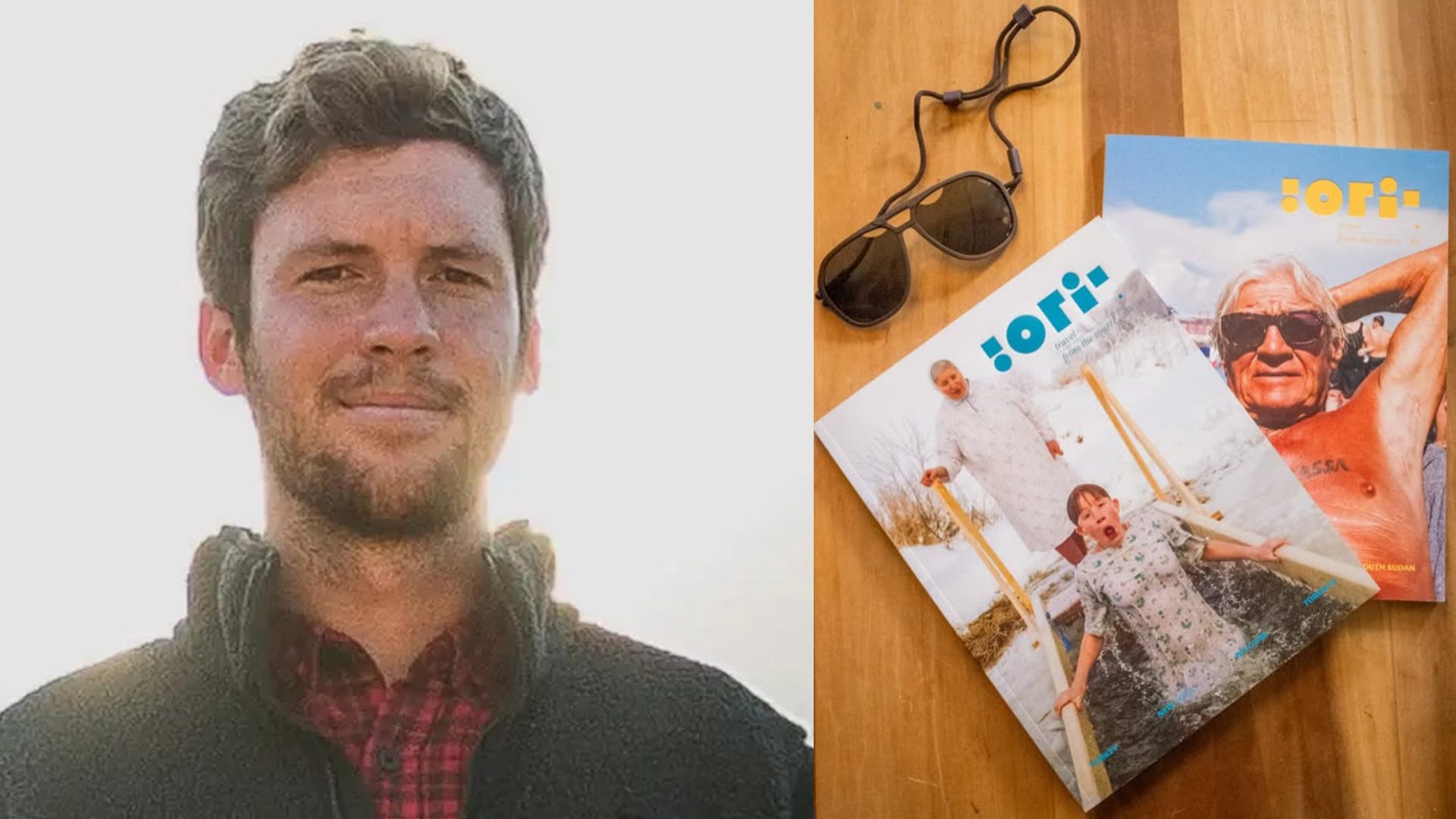
Photo credit Zach Doleac, magazine covers courtesy of Ori Magazine
Kade Krichko’s career as a travel writer and journalist is, perhaps, as close as one can get to living out the fantasy of Anthony Bourdain’s “Parts Unknown.”
In Krichko’s own words, he has “reported from the barbed wire surf scenes of Lebanon, to the cradle of skiing’s origins in China, to Cuba’s nascent skate movement, and many places in between” for the likes of The New York Times, ESPN, Condé Nast Traveler, VICE, and Outside. In those years on the road — spending as much as 180 days of the year in the world’s most bizarre and remote places — he realized some essential things about the beating heart of great travel writing. Among them, an inconvenient truth: Sometimes the very best travel writing comes not from those who are outsiders to the land, but rather those who know its contours intimately as a local.
“I still think I did those stories justice. But what I learned while I was out there was that I had a lot of help. I was working with fixers, translators, other journalists, professors, and sources in these areas,” Krichko says. “I started to realize — or just became interested in — getting their perspectives on similar stories.”
Enter Ori Magazine. In 2023, Krichko founded the print-only travel publication emphasizing visual storytelling and narrative journalism. He built its bones by first calling back some of the folks he met on the road and asking them what they were seeing in their own communities. It quickly became a globally distributed publication-plus-reporting-grant for journalists to write the ambitious travel stories they were longing to write, and for readers to read the stories they were longing to see about the great big world “out there.”
Krichko says that while the magazine centers local storytellers, great travel writing can, and should, come from anywhere and anyone. In this edition of Depth Perception, he talks about how the combination of local wisdom and an outsider’s fresh eyes can make stories sing, how Jon Krakauer’s writing changed his life, and how even a globally minded publication can still make a tangible impact on their own block. —Kelly Kimball
Learn from top longform journalists and find the best in-depth reporting. Subscribe to Depth Perception:
What inspired you to create Ori Magazine?
Ori Magazine was a project many years in the making. I call myself a reluctant business owner because that journey was not necessarily supposed to lead to running a magazine. But I’ve been a freelance journalist my entire career and was able to be semi-in-house at a couple of outdoor publications and see how the sausage was made. Through that process, I figured out that there might be a way to slightly tweak the model and create something special.
So that, I would say, is the very glossed-over version of how Ori was born in 2023. But I also like to say it was a project born from frustration. As you know very well, the freelance world is tough. You have to get a pitch through one editor, much less three or four editors, and then write it. By the time that happens, maybe the story’s completely changed, right?
And so I wanted to provide a new platform for people who had either worked with me before or whose work I was interested in so we could get down to business a little bit quicker. We live in the travel space. We are a travel magazine. But I found that it was a realm I didn’t know as much about and wasn’t necessarily that interested in, for the sole reason that I wasn’t really interested in the types of stories that were being told.
I wanted to see if we could enter that space and do something a little bit different. That’s where we kind of made our mark as a travel magazine, working with local contributors in the places where they’re based. So instead of sending someone like myself to Lagos, Nigeria, to write about Afrobeats, we’re finding the premier music journalist from Lagos to talk about his home city. That slight shift in perspective, we found, was a really cool way to tell these stories.
You’ve reported from some of the most remote and exciting places in the world. Why the decision now to turn to local journalists?
These are great questions that I’ve flipped over in my brain many, many times because, as you mentioned, I was out there doing it. I was traveling more than 180 days a year to pretty remote locations and remote communities and, in my mind, doing the best job I could. I was as objective and as educated as I could be going into those places … [and] I had a lot of help.
A whole lot of them were either educators or local storytellers. That really stuck with me when I went home. Obviously, we had a bit of a break with COVID and traveling wasn’t happening as much. I started to realize — or just became interested in — getting their perspectives on similar stories. So this project started as me calling a lot of those people back and asking what was going on.
I’m not saying that is the ultimate correct way to do things. That’s just a decision that I made and have been pursuing, and in a way, shifted my own career as a writer. We’re in year three, and I just wrote my first article for my own magazine.
Do you still see the value in journalists reporting on a place that they aren’t necessarily from?
I think there is absolutely a place for people to travel somewhere new with a fresh perspective, an open mind, and an open heart, and report on that. I say this about photography all the time: If you live on the same city block for 20 years, you’re probably not going out every day and taking a picture of that block anymore. But if somebody visits, they’re going to notice the birdhouse that you’ve walked by a million times.
The dream scenario, and something we’ve dabbled with quite a bit at Ori, is sending a photographer to meet a local writer so we have both perspectives in one piece. I think there’s a lot of value in that. I’ve learned through three years that even if I had this really idealistic mission, that mission can shift and still accomplish the goal.
Take a deep dive into immersive multimedia journalism
Image by Daan Verhoeven
On a winter night in 2010, Alenka Artnik, sunken by grief, found herself alone on a bridge, contemplating suicide. Ten years later, she has become the world’s greatest female freediver and is getting stronger with each record-breaking plunge. Only a few people — all men — have dived deeper than she has on just one breath. And soon, she may surpass them all.
“The Depths She’ll Reach,” written by Xan Rice and filmed underwater by Daan Verhoeven, recounts how Artnik emerged from obscurity and mental health struggles to become one of the world’s most elite athletes.
Published 4 years ago this month, “The Depths She’ll Reach” was Long Lead’s first multimedia feature. Winner of the Webby Award and Webby People’s Choice Award for Best Sports Website, it was included in Triumph Books’s The Year’s Best Sports Writing 2022 and listed as a “Best of 2021” by Longreads, Longform, and The Browser — and it still holds up.
I’d love to talk about the genre of travel writing overall. Where do you see Ori Magazine meeting a need right now?
Jon Krakauer was always a huge influence for me. I grew up reading Outside magazine, and he was the first one while I was growing up to turn a long-form feature into a book, and then a book into a movie. All of a sudden, something that was a singular event took on an entirely new life.
I read “Into Thin Air” and was greatly affected by it. Throughout journalism school, I said I wanted to write for Outside magazine as a result. I got there way earlier than I thought. I did write for Outside, and then I was actually at a party in Seattle, probably two or three years out of school. I was talking with this girl, and she was leaving the party early to go hiking because she was training for a mission to go to Everest Base Camp.
I was really impressed by that, and she said, “Yeah, it’s not as cool as you think. It’s kind of a long story.” I said, “Well, you’re talking to the right person. If you don’t mind letting me know what you mean by that.” She said, “Well, my dad was involved in an accident on Everest in ‘96, and he’s kind of well known in the mountain community. His name’s Scott Fischer.”
I kind of spit out my coffee, (I wasn’t even drinking any) and said, “Wow. No, I know your dad. I read about him in ‘Into Thin Air.’” She just looked at me deadpan and said, “Jon Krakauer ruined my life.”
The book came out very quickly after the article and there were some factual discrepancies that are still being argued over today. Basically, she was a five-year-old girl who was caught up in losing her dad while also hearing stories about him that she didn’t know whether or not they were true .
That really hit me. I had never met my hero, and all of a sudden I’m hearing that my hero might have unintentionally done some harm to a little girl in Seattle. That turned into a much larger conversation, and over a two- to three-year period, we actually wrote a follow-up story that was published in Seattle Met. I realized just how important our words are and how important the people are who tell them.
That was a message I’ve carried with me throughout all of this, and it definitely wraps into the work we do with Ori. For a lot of us, some of these stories are us passing through. For some of the people helping us report them, this is their life.
I love the concept of the Ori Creative Grant. How did you come up with the idea? And, looking ahead, how do you intend to keep building upon it?
The Ori Creative Grant was a tenet we basically built this operation on. It is another product of frustration in the freelance industry and the fact that journalists don’t receive bonuses. Maybe we get an award and make a little extra money off of that, but very rarely do we have direct interaction with people who can appreciate and reward our work for what it’s worth.
So what we built into Ori, in addition to paying pretty competitive rates, is a subscriber participation element to our model. We essentially take 2% of all subscription revenue and put it into a growing bank account. Obviously, the more subscribers and members we have, the larger that account grows. After each issue, we give folks a couple of months to read it, and then we turn around and ask them what their favorite material from the issue was. In that way, we’re inviting our audience to participate and give us feedback on the issue and, more importantly, on the people who put the issue together — these global creatives.
We then award a winner based on the votes, and that money is handed over as a non-binding grant to fund their next project. Essentially, if they have an idea they’ve been meaning to get off the ground but just need that little bit of a boost, this is hopefully part of what allows them to approach another publication, or come back to us, and actually bring those stories to life.
This is our way of giving a green light without having it be publication-dependent. We want to see these stories made. We think the world’s a better place when storytellers are doing what they’re meant to do. So it’s idealistic, but it’s based on real experiences — my own personal experiences — of not getting that green light.
I also think it brings our readers closer to the people producing the stories at a time when media distrust is at an all-time high. It’s hard to tell somebody that their news is fake when you funded their grant and voted for their story. There’s some buy-in there from the public. I want writers and readers to be closer together, and I want those readers who voted for that grant to follow that writer’s career and see where they publish their story.
“Journalists don't receive bonuses. Maybe we get an award and make a little extra money off of that, but very rarely do we have direct interaction with people who can appreciate and reward our work for what it's worth.” — Kade Krichko
As a writer, how are you thinking about travel journalism now? Are you approaching it differently, or does it still feel the same, just with new experiences from Ori in your back pocket?
I’m still doing it. I definitely don’t want people to think, through my descriptions of Ori, that there’s a holier-than-thou element to what we’re doing. I think there are a lot of good travel publications out there that are following a more traditional path, so much so that I’m still writing for some of them.
But for me personally, if I’m going to write for Ori, I’m going to stick within our model. I live in Seattle, Washington, and I just wrote a piece about grass in Central Washington. I swear it’s more exciting than it sounds. We actually got out on the World Cup grass and learned a little bit about how these stadiums come together at the last second. It was pretty nerdy, but very fun.
In the meantime, I wrote about a Basque climbing syndicate that shut down an active mine in Spain. I wrote a profile of a skier in France. I’ve written from Chile. I’m not stopping, necessarily. I have learned a lot through Ori, though, and I think I am more intentional. I am slower. I’m spending longer in places when I’m producing stories, and I’m producing fewer stories, to be honest. But [they‘re] stories that I’m proud of, so I hope to keep that momentum rolling. I’m still writing as much as I am editing, and I think it’s important to keep those two flames alive.
As you mentioned with the Ori grant, sometimes people just need funding for the things they’re meant to write. I’m wondering if there are any specific writers where you can tell they’re doing exactly the thing they’re meant to do?
I’m also realizing I didn’t answer part of your grant question, so I’m going to answer that first and then dovetail into this. With the Creative Grant, we’ve been able to fund projects in a bunch of different places. Our first four grants funded projects in Mexico, West Papua, Indonesia, Peru, and, most recently, New York City. New York City was by far the most familiar location on that list, but each one of those winners — and this wasn’t by intention or design — was a female writer, and most of them were female photographers as well. I’m not sure what that says. I just think it’s cool.
As far as writers who are inspiring me right now and really seem to be living their “writer truth,” Heather Hansman is an outdoors writer that I really admire. She has done the circuit through outdoor and adventure publications, but she’s now writing books on women in the American West, conservation, outdoor recreation, and public policy.
I just feel like that’s something she was always meant to do. She’s very much from the Jon Krakauer school of narrative nonfiction, and she brings some pretty dense topics to life. I’m one of the worst reading writers out there, but I can cruise through anything she writes.
Ori is a Seattle-based magazine that writes travel stories from around the world. I’m curious about some of the local work you’ve done?
I think the only new thing I’d like to mention about what we’re doing is that we’ve taken this very locals-first positioning on something that’s quite global. We’re a Seattle-based international magazine, and I always had this thought: We’re bringing the world to Seattle, but how are we projecting Seattle to the world?
We recently reorganized as a 501(c)(3) nonprofit, and a big part of that is that we’re now running after-school programs in Seattle. They’re essentially carrying the Ori ethos of backyard storytelling to a new generation of storytellers. So, on top of all these hats I’m wearing, I’m also teaching this course. We just finished our first semester at Garfield High School, which is a public high school here in Seattle, as a pilot program, and we’re looking to expand to more public schools.
I’ve pitched so many stories from here to national publications and had them say, “Oh, that’s not really the Seattle we know. Seattle is tech. Seattle is coffee. Seattle is grunge.” And I’m like, “Have you checked out the hip-hop, though? It’s pretty good.” There is a whole lot going on in the music world [here].
I wanted to foster that curiosity in a younger generation. Over 12 weeks, we created a little zine, and we just held a zine launch. It was a beautifully designed zine. Inside are these beautiful long-form features from the students. They did a great job. We held a public showing at the gallery we work with in town and then wrapped that into our last Ori launch party. We had the students at the party, and they were able to interact with our community and share their work. It all felt very full circle, and very much like what we’re supposed to be doing.
Yes, we’re branching out and connecting this larger global community, but we’re also building one at home.