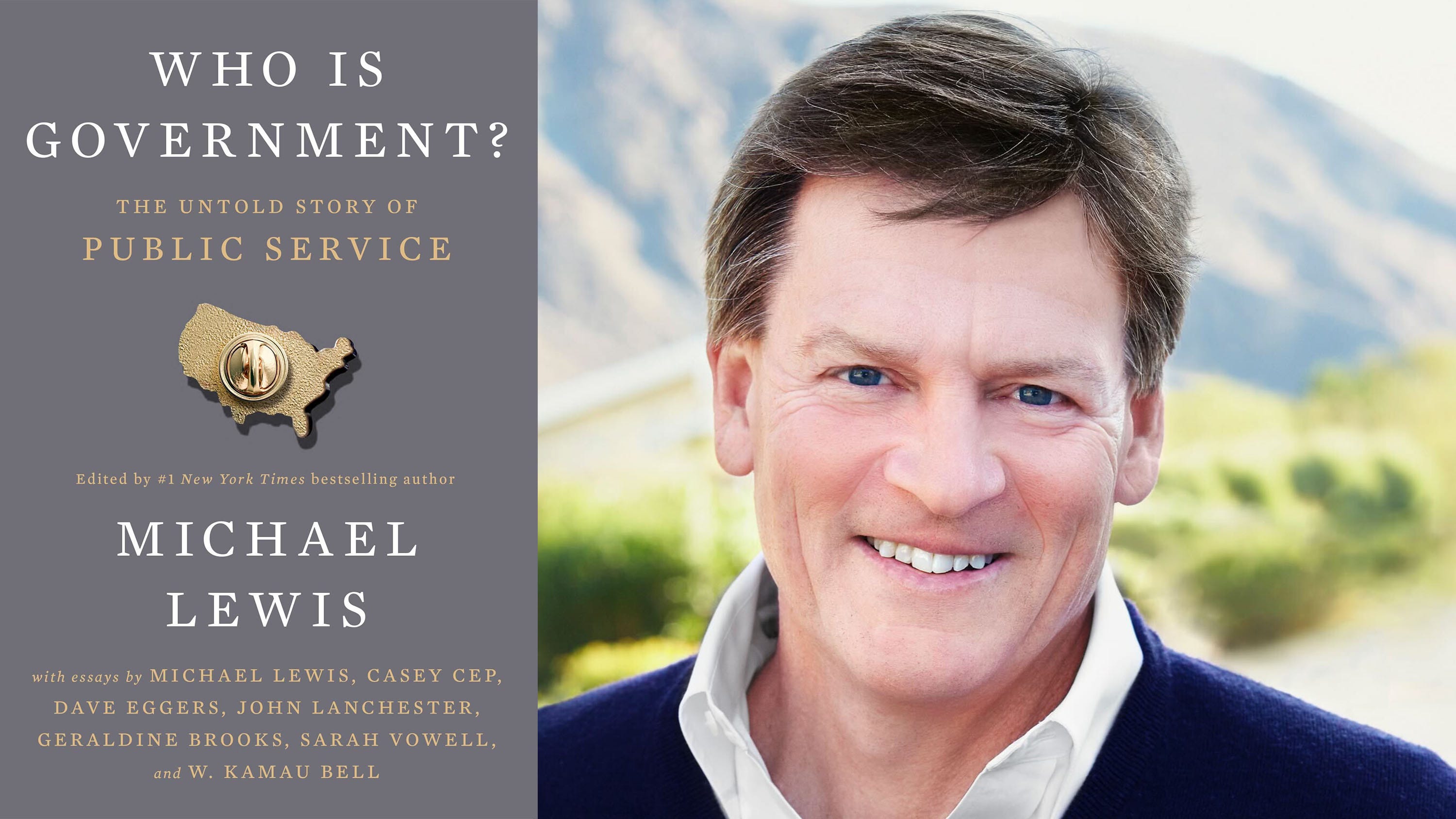
Book cover courtesy Penguin Random House; Photo by Tabitha Soren
Who Is Government?: The Untold Story of Public Service was published in the spring of 2025, just as Elon Musk and the Department of Government Efficiency (DOGE) thrust the role of the federal government into the forefront of a national debate.
Michael Lewis invited some of his favorite writers — including W. Kamau Bell, Geraldine Brooks, Casey Cep, Dave Eggers, John Lanchester, and Sarah Vowell — to locate fascinating government workers and offer a backstage pass to their exemplary efforts. Their essays were originally published in the Washington Post and subsequently compiled into Lewis’ book, Who Is Government? The timing and eerie relevance for the book’s publication proved disturbingly ideal.
Who Is Government? heartily challenges stereotypes about public servants as useless bureaucrats and instead shines a spotlight on how vital and essential these unsung workers are to making our country function. We meet quiet heroes discovering new planets, digitizing archives, and doggedly pursuing cybercriminals. We learn about a former coal miner saving thousands of lives through his efforts to improve mine roofs against collapse; an IRS agent with the backdrop of a crime thriller; and a manager responsible for turning the National Cemetery Administration into the best-run organization (public or private) in the country.
Subscribe to Depth Perception to learn from top longform journalists and find the best in-depth reporting.
The book appears at a time in American life when the general disdain for the work of government employees has never been higher. “Democratic government isn’t really designed to highlight the individual achievement of unelected officials,” the book says. “You never hear a word about who these people are or where they come from or why it ever occurred to them to bother. Nothing to change the picture in your head when you hear the word ‘bureaucrat.’ Nothing to arouse curiosity about them or lead you to ask what they do, or why they do it.”
Just ahead of the release of the audiobook celebrating the 15th anniversary of his recession-explaining book, The Big Short, Depth Perception spoke with Lewis about why the lives and work of so many uncelebrated and unrecognized government workers matter. This interview has been edited and condensed for clarity. —Brin-Jonathan Butler
Given how much media I’ve seen you do about this book so far, I thought I’d start with asking if there were any questions you haven’t been asked that you wish you had so far?
That’s funny. Well, it’s been treated as if it was just my book, because my name is so prominently on the cover. But I recruited all these other writers to do it. And nobody has asked me about them or how it happened. I mean, the book has been warmly received and I wrote a third of it, but nobody has really asked how it came about and who these people are.
How did you go about assembling the writers for this book?
It started on a hiking trail with David Shipley, who was the editor of the Washington Post. And we had been cooking up a project with the idea to parachute really great writers into places in America that have lost their local media. The assignment was, “Just find a story. Find what story is not getting told because there are no journalists there anymore.”
We wanted to show how impoverished we are by having lost this texture of media and defaulted to just the national news media. This goes back to just before COVID, and then COVID happens and it kills the project because nobody can travel. So during our hike, we discussed how the government was clearly not understood. Clearly parts of it are at risk in ways that it shouldn’t be. Then it was a question of which writers [we] should get. The first one I talked into doing it was Dave Eggers. He’s a friend of mine and we go hiking in Marin, [California] pretty regularly and I just mentioned it to him. From that point onward, whenever I saw something or someone that excited me, I asked that person if they would join this group. And some of them I knew and some of them I didn’t.
Did anyone turn you down?
The only people who turned me down were Percival Everett right before “American Fiction” came out as a film. He said, “My life’s about to get really busy, otherwise I’d do it.” He was right. His career has gone into orbit. Colson Whitehead was the other. But I had this feeling that if the writers were good and you let them just find something that interested them in the government, that the pieces were going to be really great.
Last chance — Long Shadow needs your vote!
Through three seasons of Long Shadow, the podcast has won five Signal Awards. With the release of season four, a sixth Signal would be good — but eight would be great.
The Signal Awards recently announced that Long Shadow: Breaking the Internet is a finalist in three categories. Listeners can propel the show to titles by voting for the podcast — but time is running out! Before October 10, you can vote here:
Winners of the Signal Awards will be announced October 15. Until then, catch up on Long Shadow: Breaking the Internet wherever you get your podcasts.
Walk me through how you think DOGE and the aftermath of Elon Musk’s intervention with the government has gone, from your point of view.
It was kind of him to take time out from his busy life to go restructure our government. It was a stupid exercise. It did the opposite of what they said they were doing: eliminating waste, fraud, and abuse. They’ve introduced the opportunity for lots of fraud by eliminating the watchdogs, the inspectors general chief among them. If you add up what they say they’ve saved, it’s been trivial. But much of what they say is false and there’s a tell on that. They’re lying about what they’ve cut and how much they’ve cut. I find it incredibly frustrating.
I think the most damaging thing they did was go in and cut who was easy to cut rather than who they shouldcut. The easy people to cut were the people who didn’t have civil service protections. The so-called probationary workers who’ve been there for two years or less. It’s young people. And it’s people brought in for some specific urgent mission. It’s exactlywho you don’t want to cut. We’ve got this aging, ossifying institution. They don’t really touch any of that, the lifers who were just like clipping coupons.
I think there was a version of DOGE that could have been really great. Instead, what we got was something that was the opposite of what it should have been.
Can we pivot to a more cheerful subject? How do you feel like the tariffs have gone?
I view the tariffs the way I view, I don’t know, prisoner exchanges. Trump is using federal funding to punish enemies. The only way he knows how to relate to the world around him is to create a kind of zero-sum transactional thing. It makes him feel important and it gives him headlines and distracts from other things. When the Epstein files hit the front page, you can do a deal with Japan and try to push it off the front page.
I think the tariffs have more to do with that than any legitimate policy goal. I’ve seen nothing from anybody who knows anything who thinks that the tariffs are going to actually revive American manufacturing. All it is is a regressive tax. A sort of sales tax and it’s ultimately paid for by people lower down on the income spectrum.
I think very little of the policy. I think the policy is interesting mainly in how it offers a reflection of how Trump’s mind works. It’s just noise. Just trying to make a headline. I try not to let some of these antics occupy my brain space if I can help it.
“I don’t like this idea that if the news feels awful, I’m not going to read it…. I’m a writer and I can join this battle.” —Michael Lewis
Are you good about that kind of hygiene mentally with elements of where the country is going and the general noise?
I have many other things that interest me other than Trump. With him — and hygiene is a good way to put it — it’s not that I’m sticking my head in the sand. I don’t like this idea that if the news feels awful, I’m not going to read it. If the country’s screwed, I’m not going to [not] pay attention and retreat into private life kind of thing. That would be wrong and especially for what I do for a living. Maybe if I did something else, it would make sense. But I’m a writer and I can join this battle. But howI join it matters a lot. I think the most intelligent way to join is to ignore a lot of the noise Trump generates and pay attention to the deeper consequences of him and the way people react around him.
I wrote about something like this in [my book], The Fifth Risk. Trump’s in that book, but what it really is using Trump is as an excuse to deliver a sort of curious civics lesson. That’s the hygiene. To deploy Donald Trump in my mind and use him. It’s very Trumpian, like how he uses everybody else.
I try to find ways that make him useful. It’s like, how can I use this barbarian to do really interesting things. When he does something crazy, so much crazy shit, it’s kind of, you know, crudely entertaining. It would be very entertaining if he wasn’t president. But he does stuff like that, which electrifies bodies of material. There’s no way I would have undertaken this book about the bureaucracy if he had not been involved. He’s made the material so much more interesting by jeopardizing it, by injecting risk into places and uncertainty. The hygiene is making it work for me.