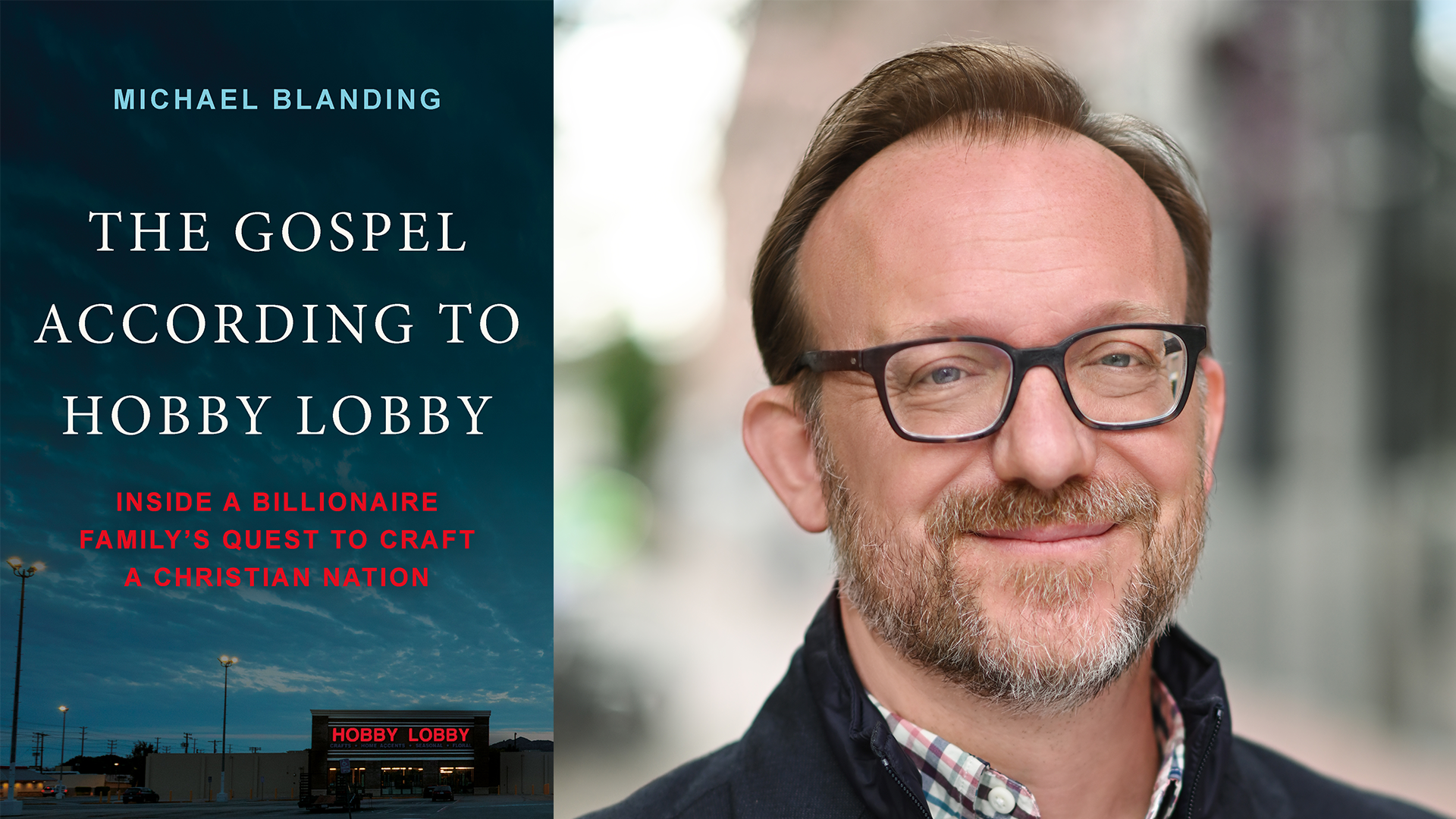
Cover courtesy PublicAffairs, photo credit Kevin Day
Michael Blanding’s four-year investigation into the family that owns crafting mega chain Hobby Lobby started, as these things do, with the journalist’s curiosity about an altogether different topic.
Blanding was reading a New York Times story about the 2020 “seizure of this rare cuneiform tablet called the Gilgamesh Dream Tablet” from the Museum of the Bible in Washington, D.C. The tablet was purchased in 2014 for $1.7 million by the Greens, the family that owns Hobby Lobby. The same family that owns the museum and, as Blanding writes in his latest book, is on a mission to collect the antiquities that they believe will prove that the stories of the Bible are historically accurate and true.
“That instantly set my journalistic senses ablaze,” says Blanding.
The author of books on antiquities and artifacts including The Map Thief and In Shakespeare’s Shadow, Blanding was all in. A book idea started forming. But then the story got bigger. Much bigger.
“I don’t take on small topics,” he says.
Learn from top longform journalists and find the best in-depth reporting. Subscribe to Depth Perception:
The story that started with stolen artifacts turned into The Gospel According to Hobby Lobby: a book that weaves the history of the Bible and how it’s been interpreted by different Christian thinkers over the years, with the history of the religious right in America. Also, antiquities trafficking, how the Green family reportedly helped overturn Roe v. Wade, and what tiny picture frames have to do with all the above. (Yes, tiny picture frames.)
The book is a sort of reporting homecoming for Blanding, who is no stranger to digging into a company’s backstory. His first book, The Coke Machine, examined The Coca-Cola Company through what he calls, “the lens of health, environmental, and labor issues.”
In this edition of Depth Perception, Blanding shares what it takes to report a story of this depth and breadth, how he proceeded when the Greens turned down his requests for interviews, and why Hobby Lobby has thrived when other craft retailers have tumbled. The following interview has been condensed and edited for length and clarity. —Jenna Schnuer
OK, let’s start sort of basic. Why the craft industry? How did the Greens start what is now a multi-billion dollar company?
It was something of an accident, to be honest. [Patriarch] David [Green] was working for this proto-Walmart type of department store. He wanted to go into business for himself. They were selling these little miniature picture frames [that were very popular], and [customers] couldn’t get enough of them. He got a couple of partners and he started manufacturing these little picture frames.
He eventually opened a retail store [in 1972] and started carrying other items as well. Ironically, he says, it was the hippies in the 1970s that were buying up beads that really became sort of the cash cow for them.
What he realized, from a business perspective, is that arts and crafts is basically a recession-proof industry. When times are good, people are buying arts and crafts supplies. But when times go bad, they are also buying it because they want to save money and they make gifts instead of purchasing them. So with one exception during the 1980s, when the company ran into trouble, they have just essentially minted money and slowly expanded from one store to five to 20 to 100. And now they have about 1,000 stores around the country. It’s a means to an end. It generates a lot of money for them that they can donate towards these religious causes.
Other craft stores haven’t fared as well in recent years. Is David Green that good of a businessman?
David will tell you that’s all because of the Lord and all because of God’s influence on the company. He runs the company according to biblical principles, and consults God as a silent partner in every decision he makes, whether it’s who to hire or what to sell. One of the things, though, that I do think has been really influential is that they decided very early on, for biblical reasons, that they weren’t going to carry any debt. Michael’s and JOANN [Fabrics] got overleveraged and kind of choked in debt. That was something that Hobby Lobby decided back in the ‘80s not to do, and it’s really served them well.
What was it like to be immersed in fundamentalist Christianity and the story of the Greens for the four years you were working on it?
There were definitely parts of it that were not fun. I didn’t enjoy being immersed so deeply in this Christian nationalist worldview, which I don’t necessarily share personally. I wanted to understand the language and the point of view. I was committed to doing that. But there were definitely a lot of days when I just wanted to take a break.
The antiquities angle of it, however, was really fun for me. I really enjoyed learning about the history of these artifacts, and particularly about the ways that they were trafficked. The Greens worked with this kind of, I’ll call him an “archeologist,” but I put that in quotes. He’s sort of a cross between Indiana Jones and P.T. Barnum.
He was a big talking antiquities dealer who ended up acquiring most of their collection [on their behalf], and it was really fun to follow his travels around the world and see the shady dealers and middlemen that he was getting involved with, and to try to track these items. I actually went to both Egypt and Iraq as part of my research. I got to see a lot of the ancient sites where these artifacts come from. I got to see the pyramids and ancient Babylon, and go to the Baghdad Museum, and try and find some of these more off-the-beaten-track sites that these antiquities were looted from. That’s the kind of reporting I just eat up. I love doing field research.
“May God give us strength.” Inside Haitians’ enduring fight for survival
Three days before the one-year anniversary of the earthquake in Haiti, a woman prays in the wreckage of the main cathedral in downtown Port-au-Prince, Jan. 9, 2011. Photo by Allison Shelley
On January 12, 2010, a 7.0-magnitude earthquake decimated Port-au-Prince, Haiti. The shockwave was so devastating that locals believed it was a force beyond man or nature: It was an act of God.
The quake’s survivors had been warned this day would come: rapture, the second coming of Christ, which would bring about the end of humanity. Fearing the flood that was to follow, they ran to the hills outside the city. But the prophecy never came. Five years later, an estimated — and astounding — 250,000 people would call Canaan, their new makeshift city on a hill, home.
The Long Lead feature An Unnatural Disaster tells how Haitians — penned in by the long, slow collapse of their country’s government and the rise of merciless gangs — have lived for years trapped on the edge of survival. Featuring 13 years of reporting by Jacob Kushner and stunning visuals by Allison Shelly, it explores how these people endured the wrath of nature and the fall of a nation, only to wonder what will happen next. And now, as Haitians lose their temporary protective status in the United States, their plight is as urgent and important as ever.
Learn more about the devastation that 16 years later continues to shake Haiti and its people. Read the Sigma Delta Chi Award-winning feature An Unnatural Disaster today at haiti.longlead.com.
What were some of the most surprising things you learned along the way?
To witness the interaction between the world of these evangelical Christians and the archeological world of these artifacts. The Greens went into this very naively. They had no idea what they were doing. They felt like they were on a mission from God to acquire these artifacts in order to prove something about the truth of the Bible. They dove in with both feet, especially Steve Green, the younger son [of David], and started gobbling up thousands and thousands of these artifacts, cuneiform tablets, papyrus fragments, and things.
I hit pay dirt in my reporting. I was able to speak with some former employees of the museum who were able to share some documents with me and describe the kind of madness behind the scenes. In some cases, a lot of these artifacts were kept in Hobby Lobby warehouses in Oklahoma City, and there was just a thin wall separating pallets full of glitter glue from these illuminated manuscripts. It’s horrific to think about these things in this unprotected scenario. They told me that they were on these shelves that were bulging under the weight of these antique Bibles. They were the same shelves that were being used inside the stores.
There’s this one great anecdote where they supported Marco Rubio for president. He visited to see the collection, and he was standing with a cup of hot coffee over a very precious million-dollar manuscript. One of the curators was just staring but felt like they couldn’t say anything. They sort of gingerly were like, “Would you mind keeping your coffee outside while you do this?”
But the kind of hubris and naivete through which the family just barreled into this world that they really knew nothing about. Of course they got their comeuppance when most of these items were later seized and taken back by the authorities.
It’s a strange thing for them to be such strong business people and then to be so naive in how they spent their money.
I think it comes down to this really fervent belief that God directs all of their actions. When it comes to the company, they truly believe that God is a shareholder and they need to follow “His” precepts. And when it comes to the causes they donate to, they do the same thing.
Mark Green, the older [son of David], for example, was involved in the movie industry and made these religious films. Of course, he grew up Pentecostal. He’d never even been inside a theater before he did this, and yet he somehow felt like, through divine providence, he was meant to do this.
I think Steve [thought] the same thing. Once he was approached with this idea of creating this Bible Museum, he felt like God was opening doors for him, and all he needed to do was step through them and follow God’s teaching.
There’s a passion following their religious views. [But] when things end up blowing up in their face, as they did with the museum, they don’t see that as God’s providence. Steve blamed these other dealers they relied on and said they were taken advantage of and things like that. They [didn’t] say, “Oh well God wanted this to happen.” There’s a real lack of accountability and responsibility that I found really fascinating.
“I wasn’t too hopeful that they would speak to me... But I always felt like there was a chance that maybe they would feel like God would tell them that they should talk to this reporter. I’m not kidding about that.” —Michael Blanding
The Greens didn’t speak to you for the book, right?
I decided from the very beginning I was going to do the book whether they talked to me or not. I did reach out to them fairly early on in the process and sent an email through Hobby Lobby. When I didn’t get a response that way, I tried to find the individual personal emails of as many of the family members as I could and was met with absolute silence.
I wasn’t too hopeful that they would speak to me because even though I really did want to be fair and accurately represent their point of view, I think they could see from my past, [I had published] more critical reporting about corporations. But I always felt like there was a chance that maybe they would feel like God would tell them that they should talk to this reporter. I’m not kidding about that.
Did you ever meet any of them?
A year or two into my reporting process, I visited Oral Roberts University in Tulsa. It’s a university that the Green family has invested heavily in and really saved it from bankruptcy in the midst of several scandals. Mark Green was actually the chair of the board of trustees of the university for a while.
So I visited the Oral Roberts library because it was one of the few places that had documents relating to the Greens’ church. I was doing research, looking at these documents about this sect, [when] the director of the library comes in and says, “Mark Green is visiting today and he wants to talk to you.”
I thought, “Oh no, he’s seen the emails that [I’ve] sent. He knows that I’m here doing the research.” I was trying as much as possible to take pictures of everything in case he kicked me out of the library. I actually put my recorder in my pocket because Oklahoma is only a one-party consent state, so I wanted to be sure I was going to capture any exchange that we had. He came in, shook my hand, and said, “What are you working on?” It quickly become clear to me that he had no idea who I was. He happened to be in the library, happened to hear there was a researcher there, and was curious about what they were working on.
So I told him, “I’m actually researching your family because I’m writing a book about you.” His face just went completely white. He realized instantly who I was. I asked him, “Have you gotten my emails?” He said, “Yep,” with this kind of Oklahoma drawl. I said, “Do you think you or your family will talk to me for the [original] article?” He shook his head and said, “I don’t think so.” He walked away.
That was my one and only interaction with the Green family.
So how did you get their side of things?
One thing that made me really confident in writing this book was the fact that because the Greens are evangelicals and because it’s so much a part of their identity to spread their beliefs and their mission, they have been very open and public about their story. They’ve written a number of books about the Hobby Lobby Company, about the religion, about the Museum of the Bible. They’ve done countless podcast interviews and newspaper articles. Their words are out there [and I knew I could rely on those sources] to tell it from their perspective.
I didn’t want to just write a critical book about their family. I wanted to have them explain their point of view, so that the reader could really understand it and really make up their own mind about what they thought of it.
Through all of those countless interviews that they did. I was able to both quote them directly in the book, but also create scenes out of their experiences to write the book in [my] narrative style.
After this deep reporting experience, what’s next for you?
One goal I have for my next book is [to find] something that doesn’t take quite the intensity of research that this one and my last couple have. I’d like to be able to write a book that I could maybe complete in a year or two rather than four.