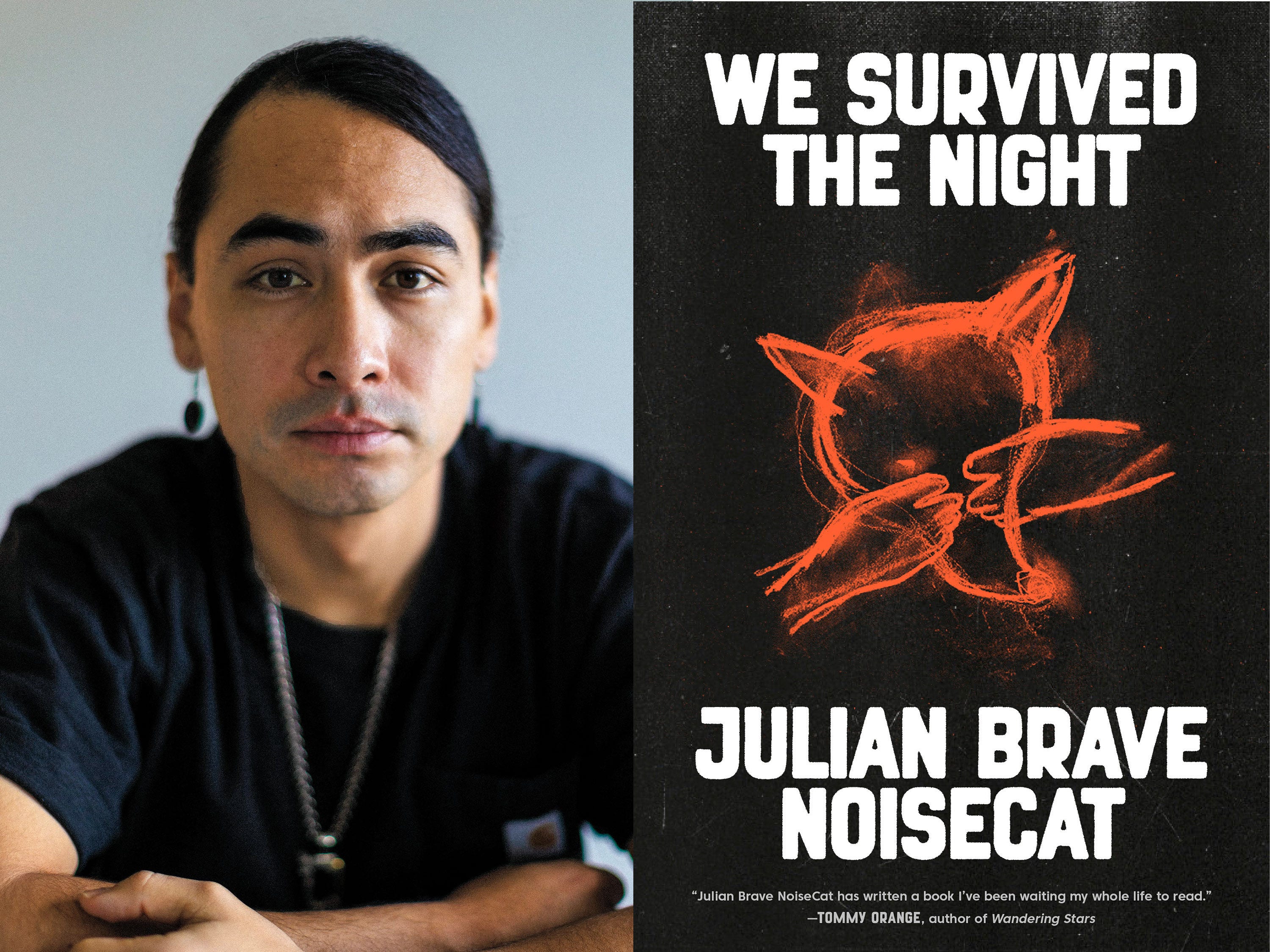
In his new memoir, the writer, Oscar-nominated filmmaker, and champion powwow dancer explores Native kinship, myth, and the necessity of weaving personal and collective histories.
Photo credit Emily Kassie | Book cover courtesy of Penguin Random House
For Julian Brave NoiseCat, storytelling has become an act of survival — resurrecting fractured histories, remembering what was taken, and imagining what might still be reclaimed.
The journalist, Oscar-nominated filmmaker, and champion powwow dancer has long worked at the intersection of personal narrative and collective memory. His debut book, We Survived the Night, shortly follows his 2024 documentary, “Sugarcane,” and is both a memoir and a woven meditation on kinship, myth, and the endurance of Indigenous life.
Raised in Oakland, California — “west coast, best coast,” as he describes it — by a single mother from New York, NoiseCat is a member of the Canim Lake Band Tsq’escen and descended from the Lil’wat Nation of Mount Currie in British Columbia. He says it felt like he grew up between two worlds: His father, a renown Native artist, left when NoiseCat was a kid. His white mother, whom he calls his “first editor,” made deliberate efforts to connect him to his heritage and community, sending him north each summer to spend time with family and learn the Shuswap language.
Learn from top longform journalists and find the best in-depth reporting. Subscribe to Depth Perception:
It was there, during his college years in Canada, that he first heard the phrase “you survived the night” — a morning greeting that NoiseCat describes as the bittersweet humor and resilience of his people, and which later became both the title and spirit of his book. His kyé7e (his grandmother) still keeps a mug with those words on it.
At the same time he was writing We Survived the Night, which was published last month, NoiseCat was co-directing “Sugarcane” with journalist and filmmaker Emily Kassie. The documentary investigated St. Joseph’s Mission, a Canadian residential school where members of his own family, including his grandmother, were sent. In tracing that story, he found himself piecing together how the violence and impunity of that system shaped generations of his family. The film would go on to win the Directing Award for U.S. Documentary at the Sundance Film Festival and be nominated for Best Documentary Feature Film at the 97th Academy Awards.
Like the film, the book is, as NoiseCat puts it, a “woven narrative.” Through memoir, reportage and mythology, We Survive the Night asks how stories can hold together what history has tried to tear apart.
“That feeling of not being ‘Native enough’ is something I think is inherent to Indigenous identity,” NoiseCat says. “Colonization took so much — land, culture, family — so the process of reclaiming is universal among us.”
For NoiseCat, the reflections in his latest book are themselves an act of reclamation. In this edition of Depth Perception, we speak with him about how by reclaiming, he is also redefining and enduring what it means to be Native today. — Kelly Kimball
You were working on We Survived the Night at the same time that you were co-directing “Sugarcane.” What was the inspiration to tell your story in these ways, and how did working in these two forms influence each other?
Well, the best answer is that I was always a very curious. I always wanted to be a writer, but directing and film were things that came to me kind of by accident. Just after I got the contract to write We Survived the Night, my colleague Emily Kassie reached out to me to co-direct “Sugarcane.” So that project was something that really came to me unexpectedly.
When you’re working on a film about the colonial system that nearly wiped your people’s way of life off the face of the earth, while also writing a book about yourself [and] your family, I started to think more purposefully about which traditions and parts of my people’s storytelling culture I had a responsibility to bring back to life.
Both [the film and book] are woven narratives. “Sugarcane” weaves together four storylines of people impacted by St. Joseph’s Mission and the ongoing investigation there. We Survived the Night weaves together memoir, family history, reportage, criticism, and mythology.
Part of the reason I’m so drawn to woven narrative structures is that, for my people — the Salish peoples — weaving is considered the highest art form. My great-grandmother was a weaver; her mother was a weaver. Their work — even though my father is a really noted artist — is actually what’s considered our family’s most prized possession.
So throughout We Survived the Night, everything from the title to the structure… comes from my culture.
You’ve mentioned having the liberating power to cut, rework, and recenter things in making We Survived the Night and “Sugarcane.” Was there a particular ethic you wanted to bring into each story that otherwise might not have been considered, given this freedom?
I moved in with my dad for two years while I wrote We Survived the Night and made “Sugarcane.” He left when I was six, and when I moved in, I was 28 — so we hadn’t lived together for 22 years. There was a lot of history between us. I’d even had to loan him money to come to my own high school graduation.
At first, I thought I’d use my people’s mythology as ornamentation in the text. But as I revisited the stories of our “trickster” ancestor, Coyote — stories that are now nearly lost — I saw parallels everywhere: with my father, who’s a bit of a trickster himself, and with the contradictions and paradoxes of human nature, of the world, of our culture’s survival.
I’ve only ever heard one family member tell a Coyote story — a distant uncle who’s now passed — so it’s truly a dying art form. Through writing, I felt called to bring that tradition back to life on the page. I wanted readers to understand that these stories contain truths worth taking seriously by nonfiction, by literature, by philosophy, which hasn’t often been the case.
Coming soon: Long Lead presents its latest feature
To date, Long Lead features have also roused critics. In the four years since our launch, our work has won an Edward R. Murrow Award, a RFK Human Rights Journalism prize, a Peabody Award nomination, two National Magazine Award nods, and plenty of other honors, including seven Webby Awards.
Later this month, the latest Long Lead feature — a rare tale of community and togetherness in these divisive times — will be released. Be the first to experience it by subscribing to the Long Lead newsletter here:
You have described yourself as being “a child of two worlds.” You have an Indigenous father and a white mother from New York; you grew up in Oakland, CA, but also spent a significant amount of time in the Canim Lake Indian Reserve in British Columbia. How do you navigate those cultural contradictions in your storytelling? Has your understanding of belonging changed through the process of writing this book?
My father… was a kind of mythic figure [to me]. But the father who connected me to my family’s rez, to my culture, to my identity, left when I was young. And so I think that ever since, I’ve been trying to sort out who he is and what caused him to leave.
While the book explores being “more than half but less than whole,” that feeling of not being “Native enough” is something I think is inherent to Indigenous identity. Colonization took so much — land, culture, family — so the process of reclaiming is universal among us.
I also don’t deny that I was raised by a white woman — my Irish-Jewish mother — who taught me to write. That’s part of my Irish heritage too. My grandfather was an Irish Catholic who went from seminary to journalism [and was] the lead writer for Look magazine for a while. So in a way, I’m continuing that Irish literary tradition.
Being a child of two worlds… helped me see the beauty in Native culture that’s often misunderstood or dismissed as “backward,” and to recognize that in the white world, people often long for the kinship and meaning that still thrive in Indigenous communities.
Your book is dedicated to your mom, who you’ve called your “first editor.” In the dedication section of your book, you wrote “For my mom, who showed me how.” What’s the story behind that?
The dedication actually follows the same four-syllable structure as all the poems in the book: “On the First Day,” “On the Second Day,” “On the Third Day,” and “On the Fourth Day.” Four is a sacred number in our culture. It’s dedicated to her, because I think that at every turn as a mother, she made very instinctually correct decisions to help me stay connected to my people and my culture and my family. I’m eternally grateful to her for that. I mean, I think that I would not be who I am as a Native person if it were not for my white mother, and that’s the truth.
And also, I just really love her. She’s the one who raised me, who showed me how to do, not just writing, but life. It felt right to honor her that way.
“I’ve only ever heard one family member tell a Coyote story — a distant uncle who’s now passed — so it’s truly a dying art form. Through writing, I felt called to bring that tradition back to life on the page. I wanted readers to understand that these stories contain truths worth taking seriously by nonfiction, by literature, by philosophy, which hasn’t often been the case.” — Julian Brave NoiseCat
The title of your book is We Survived the Night, which, as you say in your book, is a traditional morning greeting in your family’s language. What does “survival” mean to you, not just for Indigenous peoples broadly, but for you and your family’s story?
I learned the phrase from my kyé7e, my grandmother, during the summers I spent learning our language. When we were doing our language lessons, she would go fetch a coffee mug with tsecwínucw-k [written on it], which… means “you survived the night.” And that’s how I learned what that meant.
I wondered what it meant to greet one another with the simple but profound acknowledgement that we had survived the night in, for example, the winter of 1863 when two-thirds of my nation died of smallpox. [Or what it] would have meant when children were taken away to residential schools for their parents to say that to each other the next day.
I kind of chuckle at the sense of humor that put “you survived the night” on my grandmother’s coffee mug. [She] was sent to one of those schools, and is now one of two remaining fluent speakers on the Canim Lake rez. I think that there’s also a sort of dark humor in it too. And I think that that disposition towards the world and towards stories and words is one that I was struck by from the moment I learned what that meant, and one that I tried to carry throughout the text.
In revisiting your memories, were there scenes or chapters you struggled to get right?
Oh, all of it. One of the hardest things I learned while writing We Survived the Night, and making “Sugarcane” alongside my co-director Emily Kassie, is how difficult it is to portray yourself accurately as a character.
The last character to emerge [both in the book and film] was me. It can be hard sometimes to look in the mirror, but the truth of the matter is that I’ve been looking out and trying to tell the story of Native peoples as a journalist— as a reporter — for the last 10 years. And beyond that, I’ve been trying to figure myself out [and] what it is to be Native in a broader sense.