“We were already dissidents.” Julia Angwin on courage, media capture, and the fiction of objectivity
The “Proof News” founder spent her career doing the math on powerful institutions. Her new book is a manual for standing up to the most powerful one of all.
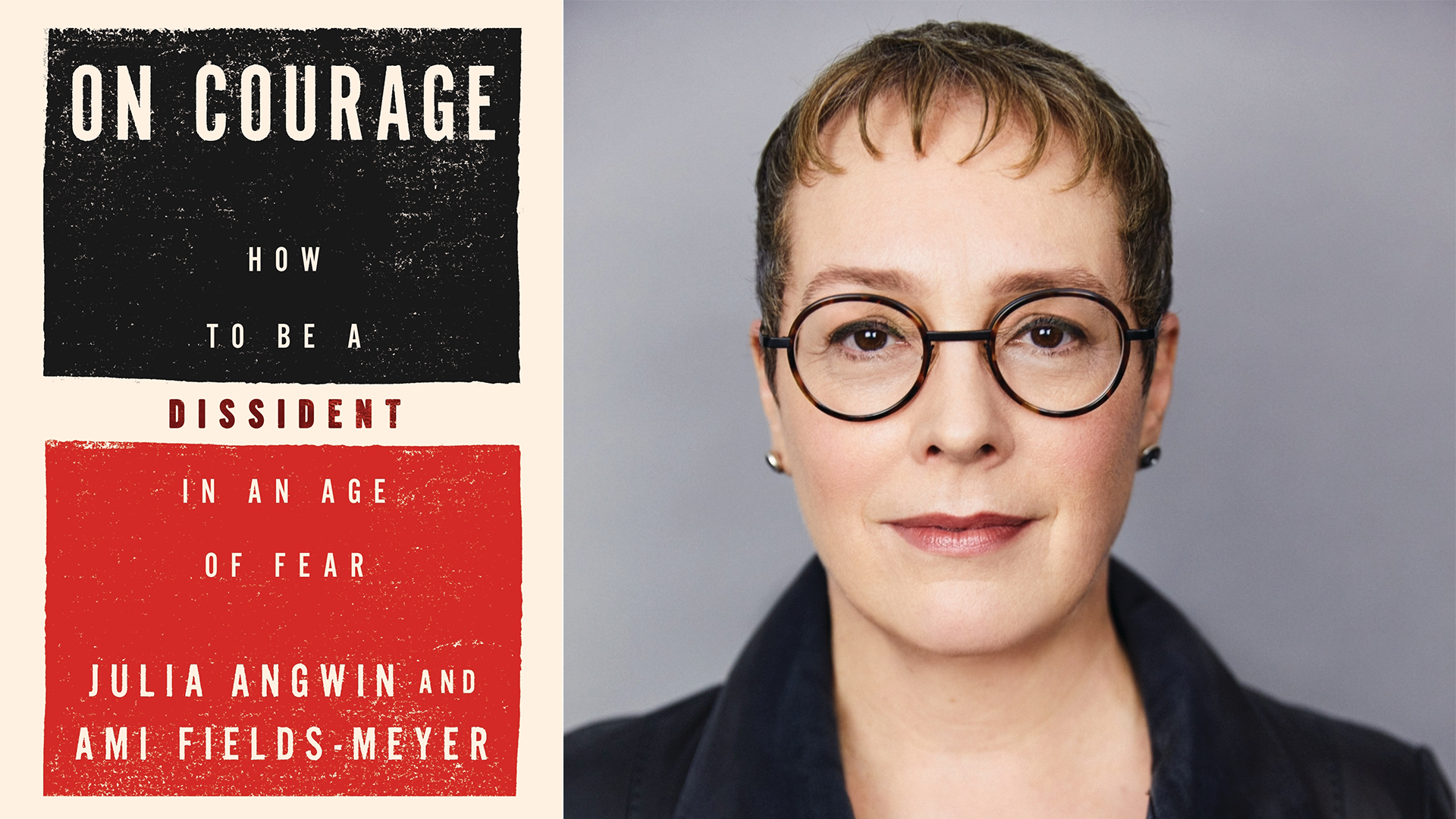
Cover courtesy HarperCollins; photo by Harold Mindel
Julia Angwin has spent her career thinking about threat models. It’s a concept from the security world: You can’t defend against every possible danger, so you figure out which ones are most likely to actually get you, and you plan for those.
For most of her adult life, Angwin’s threat model was corporate surveillance. She led TheWall Street Journal‘s “What They Know” privacy series, wrote a book (Dragnet Nation) about trying to escape the data dragnet, and spent years telling the rest of us to use encrypted messaging. Then she woke up the morning after the 2024 election and said she realized, “I had the wrong threat model.”
What she did next was second nature for her: She started reporting. Angwin, who founded The Markup and then Proof News, and who proved with math what legal scholars had only theorized about racial bias in criminal risk scores, teamed up with policy expert Ami Fields-Meyer and interviewed more than 100 dissidents around the world. First came a New Yorker essay, “So You Want to Be a Dissident?” Now there’s a book, On Courage: How to Be a Dissident in an Age of Fear. And after all those conversations, one of the country’s foremost surveillance reporters came away convinced that the thing that actually keeps you safe under authoritarianism is other people.
In this edition of Depth Perception, we speak with Angwin about ditching objectivity for transparency, why journalists shouldn’t bother asking whether they’re allowed to be dissidents, and more. The following interview has been condensed and edited for length and clarity. —Parker Molloy
Learn from top longform journalists and find the best in-depth reporting. Subscribe to Depth Perception:
Can you walk me through your path into journalism, from growing up in Palo Alto to everything since?
I grew up in Palo Alto, which is, to this day, the heart and soul of Silicon Valley. At the time, though, it was more of a Stanford University town. My parents were in tech, but my parents were weird compared to most of the other parents because it was still kind of a hobbyist thing — weird people doing stuff in their garages. But I grew up with multiple computers in the house and I never had a typewriter, which was something most other people had. I learned to program in fifth grade. I went and worked [at] Hewlett-Packard [during] my summers in college. I studied math at the University of Chicago because they didn’t actually have a computer science degree, so that was sort of how you did computer stuff.
But I fell into journalism because the college newspaper needed someone who knew how to use the layout software to lay out the ads. I was good at software, so I got a job there [and was] paid a couple bucks an hour to lay out ads. But hanging around in the newsroom, I just thought, all these people seem like they’re having a lot of fun writing stories. They were eating pizza, they were drinking beer. And so I was like, “I want to do that.” So I started writing stories, and I really fell in love with journalism.
When I graduated college, even though I had a job waiting at Hewlett-Packard, I decided I would do journalism for a little bit and then I would go back to real life. But after I went to D.C. and I was working at a wire service, the dot-com boom happened. All of a sudden, I was a journalist who understood tech and my market value really increased. I got a job at the San Francisco Chronicle covering tech and started my career as a tech reporter.
Did growing up in Silicon Valley make you more suspicious of the tech industry, or did that come later?
When I became a tech reporter … what I noticed was, there was one guy at every newspaper who was the tech reporter. And that guy was almost always a hobbyist. They were somebody who tinkered with tech in their garage and was really into it. And what I felt like was that the coverage was very much like sports coverage, and it was like fan fiction. It was like, “Oh, I really love Apple products,” or “Oh, I’m really into Yahoo versus Google search,” or whatever.
I just didn’t enter it that way. I entered it as: I have fallen in love with journalism and now, because of my skills, I’ve been asked to cover something I know about. But I wasn’t a fangirl, you know? I saw these guys for what they were, which was, a lot of them were just trying to sell you on a bunch of jargon. And I wasn’t falling for it because I knew the jargon, and I knew what computers can do and what they can’t do, and when you’re being sold a bill of goods. I think I entered it from, maybe not even a skeptical standpoint, but a little bit more of an expertise standpoint.
And I will say, one of the critiques I have of journalism is it’s not been a profession of expertise. This is changing now, but when I started as a journalist, the idea was you’re a general expert and you should be able to cover everything. And you should also write it at a fourth grade level, so it should be really dumbed down. And I think that harmed the sophistication of the coverage. You could definitely see it in the dot-com boom coverage, where people just fell for everything. And I think I was always one of the more skeptical reporters, only because I was seeing it clearly.
You wrote an essay for The New Yorker, published in April 2025, called “So You Want to Be a Dissident?” That was a bit outside your regular beat. Can you tell me a bit about how that came about, and how the idea later became a book?
I woke up after the 2024 presidential election with a lot of feelings and the most prominent [one] was that I had the wrong threat model.
I have spent a lot of my life reporting on and trying to mitigate the threats of the corporate big data collection that we all are subject to. So that means using encrypted messaging and trying to choose products that are more privacy-protecting, even if they’re sometimes a little bit more annoying. And that morning after the election, I just thought to myself, “You know, I need to think a lot more about authoritarian threats than I have been thinking about, and I want to understand what that looks like.”
I called up my friend Ami, who I knew [from reporting on] tech policy, because he worked on tech policy in the White House. He was at the Ash Center at Harvard, and that is a place where a lot of dissidents from authoritarian regimes go when they’re basically exiled from their country, and they do a fellowship there while they write a book, or they figure out what they’re going to do next. And so I was like, “Ami, can we interview some of the dissidents? Let’s get on the phone with them.” So we started doing Zoom interviews with them. And at first, I honestly wasn’t sure where we were going with it, but we ended up with this New Yorker piece that was called “So You Want to Be a Dissident,” and it was literally just like, “Hey, America, here’s how it works. Here’s what the dissident situation is.”
But after that piece ran, a bunch of book publishers came to us and asked if we could do this as a book and do it fast. And so Ami and I were like, “OK, yeah, we’re kind of game for this.” So we dove into it, we wrote it really fast. I think we got the book deal in June and we filed the manuscript in December. We interviewed more than 100 dissidents around the world and extracted the lessons from them. And so interestingly, all these themes were resonant in all sorts of different environments. They all spoke similarly about their experiences.
Fighting an imperial ghost that respects no boundaries
“We have an old rule,” Vladimir Putin declared in 2025. “Wherever a Russian soldier sets foot is ours.” This decree was not just about land, as his country’s neighbors have learned. The Russian president also seeks to recast history, identity, and language across Eastern Europe and Southwest Asia.
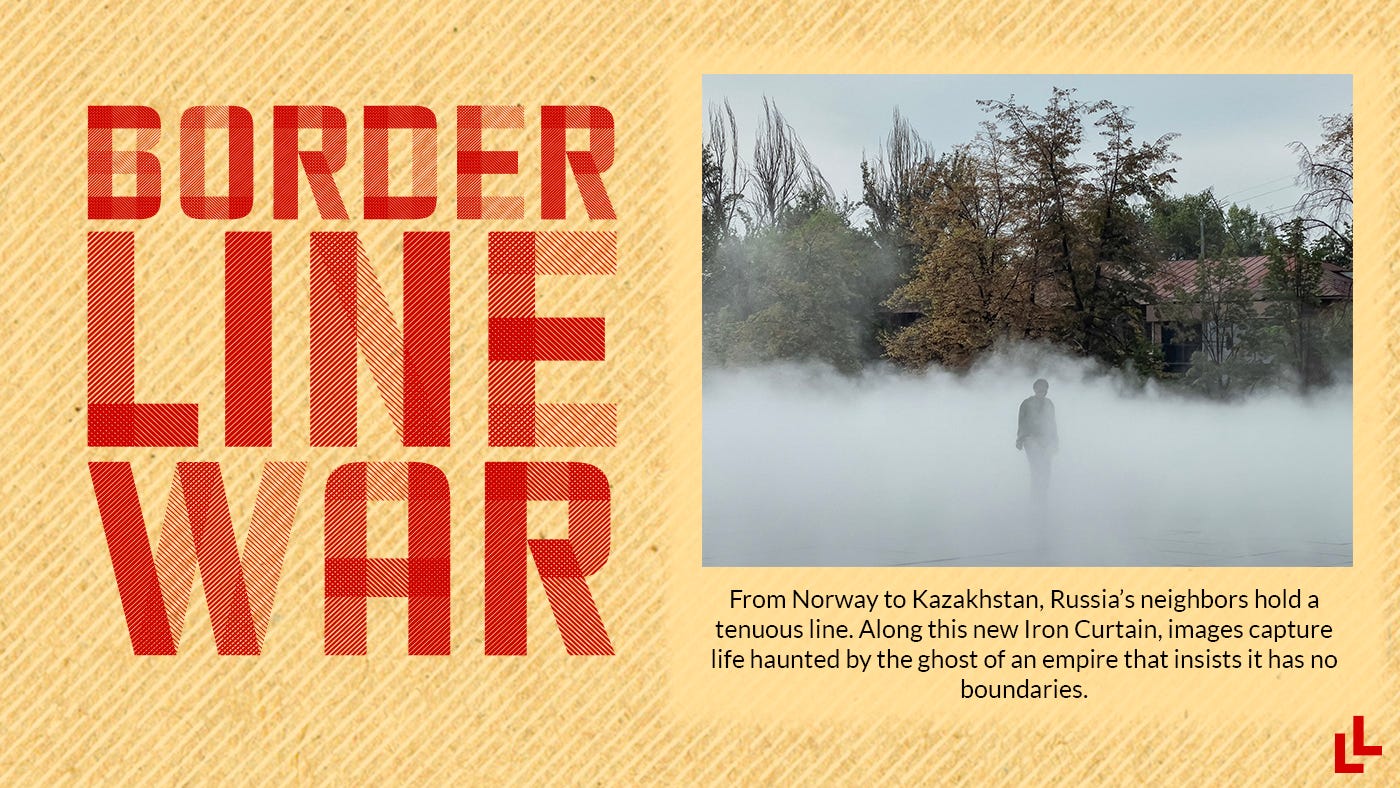
For the Long Lead photo-first feature, Border Line War, prolific conflict photographer Thomas Dworzak traveled thousands of miles to document the multi-country resistance to Russia’s imperial aims. To chronicle the impact of Putin’s war in Ukraine away from the battlefront, the Magnum Photos member began exploring the Russian border — from Norway to Kazakhstan — in 2023. Across a blast zone that extends thousands of miles, his camera captured protests, performances, museums, and military trainings, all gripped by the ghost of an empire that insists it has no boundaries.
Accompanied by expert analysis from foreign affairs columnist and former Moscow bureau chief Christian Caryl, this visual essay shows how countries from the Arctic, through the Baltics, and down into the heart of Asia have held the line with the menace next door — and what it’s like when the cold wind of war blows through this new Iron Curtain.
After having spent more time reporting for the book, do you look back at the essay and disagree with anything that you wrote?
I would say the thing that my thinking evolved the most on was the question of how you protect yourself. We had a little bit in the New Yorker piece on ways to keep yourself safe, because that was my animating first question. I think I really hoped I was going to learn that there’s a certain codebook and spycraft and techniques that you could use, and I was still a little bit in the throes of that in the New Yorker piece, so [that essay] is a little bit more prescriptive on [the] kinds of ways you can protect yourself.
And by the time I was done reporting the book, I really felt like the real protection is your community. It was, you know, a very woo-woo kind of outcome, but it really was what people told us. You have to do the best you can. You shouldn’t do stupid things, you should use encryption, and you should have discipline around some of your messaging practices and certain things you don’t write down, et cetera. But in the end, what really protects you is the fact that there’s a bunch of people who care about you and will advocate for you when something bad happens. And so we spend a lot of time in the book talking about how to build that community.
Of the 100-plus people you interviewed, was there advice you heard repeatedly that crossed cultural and geographic boundaries?
We found a real... we call it a taxonomy of dissent. We basically identified 16 different lessons that we learned from them all, and they were mostly consistent. I guess I would put them in four big buckets.
Bucket number one is: almost everybody described this feeling of not having a choice. You would say to someone, “Why did you choose to become a dissident?” And they would say, “I didn’t choose. I was called to it because I couldn’t stand by and watch this thing happening,” or “I couldn’t be complicit in this thing happening.” And they all describe sort of this breaking point that we call a moral collision, where the thing that they were doing was because they couldn’t live with themselves. But it was interesting because they were aware of the risks. They were like, “I knew I was going to lose my job,” or “I knew I was going to risk my physical safety.” There was a more existential risk, which was, “I couldn’t live with myself if I didn’t.” And so it was so interesting to me that none of them wanted to be called courageous. None of them wanted to be called a dissident. They were just like, “I did what I had to do.”
Another lesson was they all found other people. This is not work you can do alone. You have to find a political home. You have to build community with people who share your values.
The other thing that they all talked about was this whole section of the book we call, basically, “Don’t be stupid.” Don’t post all your stuff on social media, don’t cheat on your taxes, don’t speed in your car. Don’t give the regime easy ways to get you.
And then the final part of the book is about growing the movement, coalition building, which is the idea that if a movement is going to be successful, it’s always a numbers game. You’re going to end up in coalition with people you don’t like or that make you uncomfortable. And so we talk a lot about that discomfort, how to live with that discomfort, and how to find shared values within those kinds of coalitions.
You talked about how community is essentially the core of this, how a lot of staying safe comes back to community. And you spent a lot of time as the country’s foremost surveillance reporter. How did the privacy reporter conclude that technology isn’t the answer to staying safe?
I know, it hurt my soul, just to be really clear with you. It was a real disappointment. Ten years ago, I wrote a book on how to try to protect yourself against surveillance called Dragnet Nation. And in it, I go through all the steps I try to do to protect myself and my data. The ultimate conclusion of the book was that individual action wasn’t enough. In that case, I was basically hoping we would do things like pass a comprehensive privacy law, things that we have failed to do in past 10 years. I was hoping that we would understand this as a collective problem, but I was thinking of legislation, which is how we should, in a proper democracy, do collective action.
But we’re 10 years later, and everything that I wrote in that book as the most dire scenario, it is worse. My predictions were under-paranoid and my solutions feel a little half-assed because we can’t really count on the government to do this for us. This isn’t going to be a legislative solution. So when we talk about, “How do we collectively protect ourselves,” we do end up with the idea that... We have a whole chapter on this woman where what saved her is her neighbors, who told her there was a stalker outside. That is the level we’re at.
And I will say, doing the reporting for this book, I got a little radicalized myself. I realized I didn’t know my neighbors. I put flyers on every house on the block, held a little party for everybody, and started a neighborhood group chat, because I realized I needed to do this. I hadn’t been building community in my neighborhood. My husband, by the way, is Mr. Chatty, and he’s like, “Oh, so you’ve discovered community? I’ve been doing this my whole life.”
“Lies are how these regimes are built, and telling the truth is actually the piercing of that veil, and that’s why it’s so dangerous. And so when I saw my profession, journalism, in that light, I understood that we were already dissidents.” —Julia Angwin
Can a working journalist be a dissident? Should they be? Where’s the line for a reporter at an outlet whose owners settled with the president, for example?
I think that, first of all, it’s important to understand the way authoritarianism works these days. Authoritarianism is on the rise around the world. Three-quarters of the world lives under some sort of autocracy, and the U.S. is sliding in that direction. We just lost our status as a liberal democracy this year, according to the V-Dem Institute that tracks this stuff.
But a lot of the authoritarian regimes still hold elections. They masquerade as democracies. Putin has elections, right? What they do is they hollow out democratic institutions, and they have a regime that is basically corrupt and lawless. And yet it’s built on this web of lies: that we’re a democracy. And that, “All those little things you’re noticing going on? Those are just legal niceties you don’t need to worry about. Don’t worry your pretty little head. And the wars we’re fighting? We’re winning. And you think your prices are going up, but they’re going down.”
This is how authoritarianism has always operated. And Václav Havel, who led the Velvet Revolution in Czechoslovakia, overthrowing the communist regime peacefully, wrote so powerfully about this. Lies are how these regimes are built, and telling the truth is actually the piercing of that veil, and that’s why it’s so dangerous. And so when I saw my profession, journalism, in that light, I understood that we were already dissidents. This thing we ask ourselves, “Should we or shouldn’t we?” No, we already are. If we’re in the business of telling the truth, we are in that. We’ve already crossed that line.
It’s also important to realize that in almost every authoritarian regime, the first thing they try to do is capture the media, and they usually succeed. They capture the corporate media because big institutions, whether they’re media or not, are amoral. Especially in capitalism, they’re profit-seeking enterprises. They are not designed for morality, and so they will align with power if no other force holds them to account. So it’s not unusual that big media is captured almost immediately in an authoritarian regime.
What has always been the bulwark of resistance is independent media. And I particularly love the moment we’re in right now in the U.S., where there’s so much reader-supported media, because that is the most robust source of funding. They can’t take away all your $10 donations. I mean, they would have to round up all those people and steal their $10 from them. It’d just be a lot of work. So I really feel like independent media is the thing that we have to remember is so important at this moment. We have to defend it and advocate for it.
What is the best journalistic career advice you ever received?
So I’m going to do two. The first one wasn’t really journalistic career advice, but in high school, I think it was in ninth grade, we had to write an essay about, I don’t know, World War I, and I don’t remember what the exact topic was, but I wrote something that was basically along the lines of: these people sucked, but humans just suck, and this war sucked. Which, fair enough. But my teacher said, “Stay after class,” and he said to me: “You’re not wrong. You’re obviously smart. But cynicism is the easy path. It’s harder to be hopeful, and I challenge you to live your life that way.”
And I gotta say, that really stuck with me. And I think journalism, in a way, is endless hope, because what you’re doing is you keep hoping that your story is going to change the world. And sometimes it does, most of the time it doesn’t, but you still believe the truth is going to set people free, right? And so you have to constantly tap into that well of hope to do journalism.
My most actionable advice in journalism was when I joined TheWall Street Journal. There was this woman who was my mentor, Rebecca Blumenstein. She’s the head of NBC News. And I was like, “Rebecca, what do I need to know?” And I’m waiting for some really profound things. She’s like, “It’s all about beverage management.” And I was like, “Beverage management?” She was like, “Yeah. You have got to caffeinate right up to the right amount, but you can’t get too much or you can’t work. And then you’ve got to drink your alcohol with your sources, but you can’t have too much because you’ll forget what they told you.” And I was like, “Oh my god, she’s so right.”
Any bad advice you want to share?
I guess I would just use that prompt as an opportunity to rail against the fiction of objectivity, which I believe is a failed concept that has failed journalism and that we should abandon. It relies on this absurd premise that if your heart is pure somehow, and you don’t have views, then your reporting is pure. And I think it’s really important that we get rid of that. No one’s heart is pure. What’s important is: Is your reporting transparent? Is it replicable? Can somebody see why you are making the claim you’re making, and then say, “OK, I see how they got there, and that is something I’m willing to believe.” That’s why at my news outlet, Proof News, we have an ingredients label.
Literally: What sources did we use? What are the things that we’re concluding from those sources? And what are our remaining doubts? There’s always things you still don’t know. And I think transparency is so much more important than objectivity, and I would just like all journalists to make that pivot.
Finally, after 100 conversations with people who’ve lived under regimes worse than ours, what makes you hopeful for the future of journalism, and the world?
I think we’re doing a lot of things right here. I didn’t think the United States was going to be ready to fight back against authoritarianism. I felt, like a lot of people did, that we’re too wealthy, we’re too lazy, we’re too compliant. But I have been so impressed by the resistance that I’ve seen here. And it’s been, most importantly, non-violent. Non-violent resistance is twice as effective as violent resistance. And it’s really important, because when you have any violence on the side of the movement, the regime uses that to discredit the whole movement. And so I’ve been really impressed that in the U.S., we’ve had a lot of discipline.
And people are fighting not just in protest. They’re refusing to comply. The judges are refusing to comply with lawless orders. Universities are refusing to comply with coercion from the state. Even Congress, which barely exists, refused to comply with the [January 6 Anti-Weaponization Fund] slush fund. It’s important to make every bit of lawlessness and corruption hard for them to pull off, to hold the line at every front. And we’re doing that; we’re doing it well. We just need to take it up. You know, amp it to 11.