“There's no final victory — you have to keep fighting.” Kim Cross on why Title IX’s work isn’t done yet.
Battling intense grief, the narrative journalist couldn’t abandon reporting Long Lead’s latest feature “Title Waves.” It’s about decades of brave women who refused to quit.
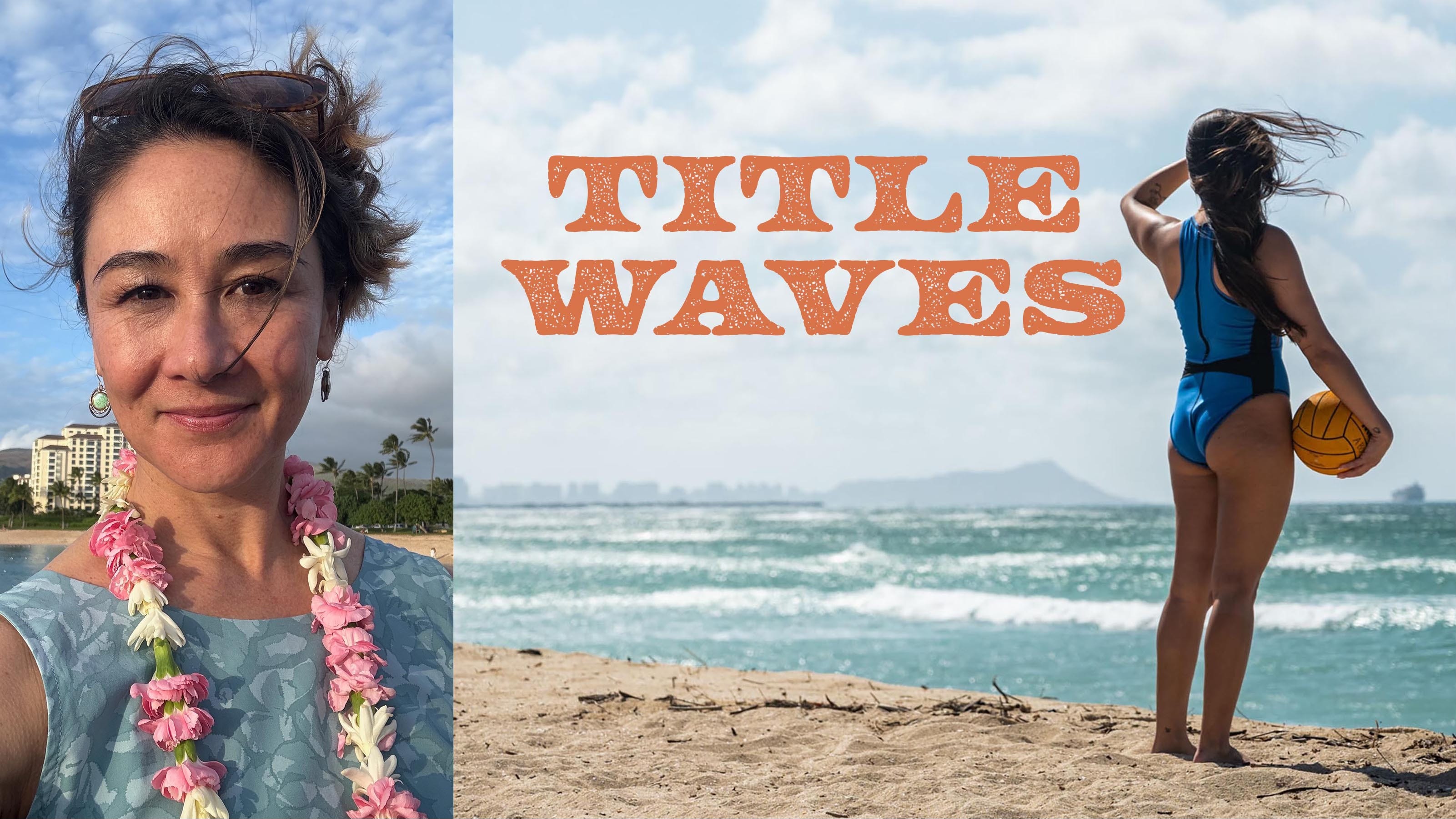
Left: Photo courtesy of Kim Cross. Right: Photo by Jenny Sathngam
For weeks in February 2018, the James Campbell High School girls water polo team practiced in the Pacific Ocean. The biggest public high school in Hawaii, it hadn’t booked the team a pool. Or hired them a head coach. They even overlooked scheduling tryouts. So a few blocks away from their school at Ewa Beach, the team’s 18 girls swam out past where the waves were breaking, kept clear of the coral, and tried to practice their sport without any goals or boundaries.
The first game of the season was less than two weeks out.
That’s where Kim Cross opens Title Waves, the latest feature published by Long Lead. It’s the story of high school athlete Ashley Badis and A.B. v. Hawaii State Department of Education, the landmark Title IX class action lawsuit the girls filed, and what came of it.
But the story extends far beyond the bounds of that beach. The piece braids in the history of Hawaii congresswoman Patsy Mink authoring Title IX in 1971, and how the law was nearly gutted years later by a single House vote. From there, Cross tracks a generation of women athletes who had to battle just to keep the law enforced. That work isn’t done. The settlement for the 2018 case in Hawaii finally came down in March 2024, and its impact has rippled across the country ever since.
Cross was featured in our Depth Perception newsletter last May, speaking with Jenna Schnuer at the time about In Light of All Darkness, her book on the kidnapping and murder of Polly Klaas. Title Waves is a different kind of story, but Cross’s empathy for her subjects connects them both. This interview has been edited for clarity and length.—Parker Molloy
Learn from top longform journalists and find the best in-depth reporting. Subscribe to Depth Perception:
How did this piece come to be? Hawaii isn’t a place you’ve worked before, and Title IX isn’t a beat you’d built. So how did this story end up on your desk?
I’ve got to give props to my editors. David Wolman lives in Hawaii, and he’s a legendary spotter of great stories. He saw it and smartly realized, “This is a great story, and we should have a woman report it.” So he took it to John Patrick Pullen at Long Lead, and they decided we needed to find the right female writer to do this.
I knew Long Lead because I’d been interviewed by Emily Sohn, who wrote The Catch. She interviewed me about what it’s like to be a woman of color in the very white-male-dominated sports writing world. … Until they reached out, it hadn’t occurred to me, but people keep coming to me with these stories — probably because I’m an athlete and a long-form narrative writer. I’ve written about the fight for a women’s Tour de France, the fight for a women’s big-wave surfing category at Mavericks. And recently I wrote a story called “The Alchemists” about teenage girls who fought for the right to ride bikes in Afghanistan, where they had to convince their culture to change its mind. So they probably looked at that and probably had a recommendation from my friend Glenn Stout, who’s edited for Long Lead. That’s how it got on my radar.
You’ve said that before writing this story, you were pretty ignorant about the history of Title IX. That’s a sharp thing for a journalist who’s an athlete and a coach to state publicly. What was the moment when that ignorance actually broke for you?
The moment I realized the extent of my ignorance about Title IX was when I was reading about how girls didn’t have locker rooms at all of these high schools in Hawaii. It made me think back to high school. I was a soccer player, among other sports, and I got to thinking, “Did we have a locker room? I don’t remember.”
I went on Facebook and messaged my old teammates. The keeper of the team, Leslie, messaged back and said, “No, we only got to use the visiting football team’s locker room if it was raining or really, really cold.” I didn’t realize what the boys had. We never saw the field house. One day, I got to peek inside, and I had no idea this whole world existed. They had their own T-shirts. I think we had a jersey, and we had to buy our own shorts and everything else. The school supplied us with a jersey, which we had to return every year, and balls — and I think that’s it. I was shocked.
The latest from Long Lead:
Read Title Waves, the latest from Long Lead, at title-waves.longlead.com. Photo by Jenny Sathngam
In February 2018, a girls water polo team was practicing in the ocean, dodging coral and foot-high waves because their school couldn’t — or wouldn’t — get them pool time. Seeing the boys’ sports teams getting support they didn’t have, they complained to the school. When those pleas went ignored, they did something that ultimately changed the lives of women across the U.S.: They sued.
In Title Waves, the latest feature from Long Lead, Kim Cross tells the stories of Patsy Mink, the trailblazing congresswoman who authored Title IX in 1971, and Ashley Badis, a water polo player with a rocket arm who simply wanted her school to play by the rules. Fifty years apart, these two courageous Hawaiian women leveled the playing field for women in education across the U.S. With photos by Jenny Sathngam and video by Vincent Ricafort, it’s a stirring braided narrative about the fight for gender equality in the Civil Rights Era and the continuing need for vigilance today.
Of the federal laws protecting women’s rights, Title IX is one of the strongest and most enduring. Told at a time when the political tide has turned against this landmark law, Title Waves is a reminder of the sacrifices and gains made by generations of tenacious women. As one of Badis’s classmates says, “This is not just for us…. It’s for the girls behind us.” Read Title Waves, today.
The settlement for this case was just in March 2024 but your piece extends into news from earlier this year. How long were you actually reporting and writing it? And what did the marinade phase look like?
This was warp speed, compounded with some major pressure and life issues. I started reporting in the fall of 2025. During the reporting, I lost my mother, who should have been a Title IX athlete. She was one of those women who grew up wanting to climb trees and play sports, and she was forced to play the violin. So when I came along, she put me in all the sports.
She died in a sudden and traumatic way in December. I had a reporting trip to Hawaii booked in early January, and I had about a week to think — do I postpone this? Then I decided, ”There’s no point. It’s not going to hurt less. And maybe getting to Hawaii and diving into my purpose will make me feel better.” I dedicated my reporting to her, since she would have loved the story. She knew about it before she died and was really excited.
I got to Hawaii in January and had done a lot of pre-reporting. Before I land on the ground anywhere to start the real in-depth immersion reporting, I do a ton of background research. I researched the history of Title IX. I knew it was written and championed by Patsy Mink, a congresswoman from Hawaii. I didn’t know until researching the story that Patsy Mink was the first woman of color ever elected to Congress. She was an American born to Japanese parents. I’m Japanese American, so that felt pretty exciting to me.
Then I started looking at the patterns that were developing over time — the fight for codification and enforcement and vigilance, and how without constant vigilance and a fight to enforce this law, we backslide. Over the years, women fight for these rights, and they get codified into law, but enforcement is totally a different story.
I’d grown up taking a lot of my rights as a female athlete for granted. I grew up water skiing on a catfish pond in Alabama with three boys who felt like big brothers. We roughhoused. They would slam-dunk me in the pond. It wasn’t abuse; it was just that they treated me like one of the boys. Because of them, I grew up moving through the world behaving like an average male athlete, and that was a gift. So learning all of this history made me feel a debt of gratitude for the women who paved the way and fought the fights to change the world I inherited.
“Learning all of this history made me feel a debt of gratitude for the women who paved the way and fought the fights to change the world I inherited.” —Kim Cross
[I had] interesting conversations with Ginny Gilder, who was one of the women on the first Title IX crew team at Yale. She recounted a time she went into the locker room to lift weights with her team captain, and the men’s crew captain came over and said, “What are you doing here, girls? This is our equipment, not for girls.” Ginny was a freshman, and her captain said, “ First of all, we’re women, but OK, boys. I guess you pay more tuition than we do, right?”
I talked a lot with Ginny because I wanted to know what I might be missing. How should I think about this? What parts of Title IX history ought to be reflected in the story of this generation’s fight? She helped me think about that a lot. She went on to be part of the Title IX strip protest, which I think is one of the most interesting stories I’d never heard of.
They were fed up. Like the girls in this story, they tried petitioning the administration — “can we get a locker room?” After a bunch of empty promises, they realized it wasn’t going anywhere, so they decided to pull a publicity stunt. They recruited a photographer from the Yale paper, who was also a stringer for The New York Times, and a writer. They brought them along when they marched into the office of the female athletics director and stripped down naked. They had “Title IX” written across their bare chests and backs. “These are the bodies you’re exploiting. We’re doing this because you’re not listening to us otherwise, and this is what we have to do to be heard.” A great headline ran in The Times: “Yale Women Strip to Protest a Lack of Crew’s Showers.” A week later: “Yale Women’s Crew to Get Locker Room.”
Another thing that didn’t make it into the story that I loved: Wookie Kim, who was one of the lawyers for the ACLU who fought for Ashley and the other plaintiffs, had actually been a coxswain at Yale. He was like, “Oh, I didn’t know that story — I’ve actually been in the Gilder Boathouse,” which Ginny Gilder and her family built years later. It’s funny how all of these things connect, and often we don’t know about them.
You said that after your mom died, you decided to go through with the trip because it wasn’t going to hurt less, and maybe it would help. Did it help?
I have a great story about this. After my mom died, a week before Christmas, I’d been learning to river surf in Idaho, where we have a man-made wave. I went to the river to feel better on the day of her cremation. Then I picked up her ashes. When I went to Hawaii, I took a little Aspirin bottle of her ashes. I thought, “I’m going to spread them in the sea somewhere.”
Ashley and her family are surfers. My editor said, “You know, they’re surfers — you should surf with them. It would be a good way to get to know them and see them in their element.” I said, “I could do that. I’ll take one for the team.” On the last night I was there, I surfed with them a couple of times. And on that last night, I said, “Do you mind if I spread some of my mom’s ashes? Would that be weird?” They said, “Oh no, it’s called a paddle out. We do this all the time.”
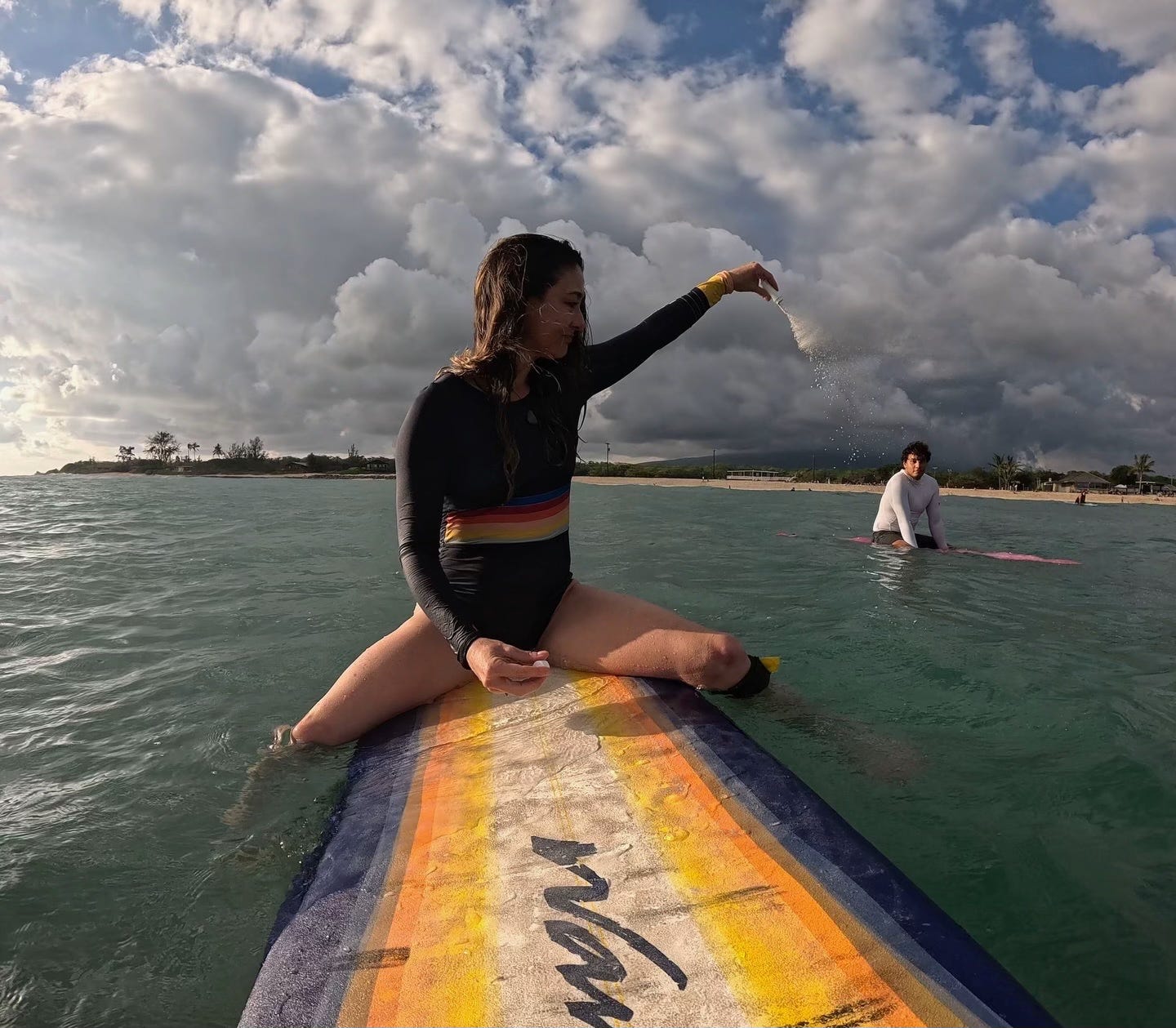
So we paddled out beyond the break. It was just Ashley and her boyfriend and me. I said a couple of words — I said goodbye to my mom and said I missed her — and I sprinkled her ashes in the surf. Right then, I had time to shed exactly one tear, and a little rogue wave came up and bopped me and made me giggle. It felt like my mom, because she was a practical joker. Ashley said, “Here we call it mana. Your mom is with you now — her spirit is with you, and you’re going to have a great day surfing. She’s going to surf with you.”
And I kid you not, I went out and I had the best surf of my life. I caught almost every wave, which never happens. Even the Hawaiians were like, “That’s kind of weird.” It was really special. As we were suiting up to paddle out, I realized that when my mom lost her mother years ago, she used the little bit of money she inherited to take us on a family trip. It was my dad, my husband, and me at the time, and she took us to Hawaii. So it felt like this surprisingly wonderful, perfect moment. It made me feel a lot better.
On assignment in Hawaii, Kim Cross pauses to spread her mother’s ashes. Photo courtesy of Kim Cross
In the story itself, the Hawaii Department of Education refused to comment. The principal and the athletic director didn’t answer questions. The superintendent ignored calls from the parents. In a piece where institutional bureaucracy is the antagonist — I think that’s a fair way to put it — what changes about how you approach it as a journalist when many of the major players give you nothing? This has to be a different kind of structural problem than you had in In Light of All Darkness, where the FBI cooperated with you.
I try to start at a place of empathy. I try to put myself in the point of view of all of the players. I’ve been an athlete, I’ve also been a coach, and I’m married to essentially an athletic director — a league director of a major sport. I listen to him deal with the complications of parents and athletes and rules and regulations. So I feel like I can naturally empathize with all of those roles.
To a certain extent, the bad actor in this whole thing is the system. There are systemic inequities and systemic problems that keep going. For the most part, you can have good actors in a system that’s set up not to succeed. I wanted to approach them and say, “Look, I realize this is complicated, and often things are really highly nuanced. I want to start by just offering to listen to your point of view. We don’t even have to go on the record. I can just listen. You can decide if you want to talk to me and go on the record.” In most cases, people are willing to at least meet me and hear me out, and help me understand.
I had one person representing the other side who said, “I don’t want to be quoted. You can interview me, you can record it for fact-checking, but I don’t want to be quoted, and I don’t want to be celebrated.” This person, actually, I thought was an example of someone who was on the other side of the lawsuit but did a lot of work in a good way, and might ought to be celebrated. They said, “This might actually make my job more difficult. In this culture, it would be like, ‘Why is this person standing up and saying, look what a great job I did?’ It could make my job more difficult.” I said, “I can respect that.”
For people who didn’t respond, I just try to give them an opportunity for agency. I had a lot of documents that gave them a voice without them being required to talk to me. There were some passages I didn’t use that could have made them look like jerks — but without getting to know them, I didn’t want to do that. There’s a way to represent, based on reporting through documents, what was said in recorded verbatim dialogue, and the actions that were done. Through that, readers can draw their own conclusions about what kind of person they are.
This case ended with a massive settlement, but you don’t end on that note. That felt like a deliberate move away from a triumphant ending, which would have been the obvious choice for a lot of writers. Can you walk me through that decision?
Absolutely. I’m a structure geek. I think a lot about structure. I study it in movies and songs. And I think a lot about endings, because I don’t like to sit down and start writing a story until I know the ending. This had many possible endings. There were two more that ended up in the first draft and got cut.
One of the themes of this whole story is that the girls who have the courage to stand up and fight, often, if they do win relief, it doesn’t happen until they’ve graduated. So they really are doing the ultimate act of a teammate — they’re taking one for the team. And it comes at great cost. It is emotionally exhausting to go through these lawsuits.
I thought that the quieter moments also acknowledge that there’s no final victory — you have to keep fighting.
Spending years reporting and writing a true crime book was not part of Kim Cross’ plans. Before she really dug in on the case that would become In Light of All Darkness, Cross didn’t listen to true crime. She didn’t read true crime. She didn’t think about true crime. Well, mostly. It just wasn’t her genre of cho…
Finally, the last thing I wanted to ask: Title IX was a lifelong passion for Patsy Mink. For Ashley, it may yet become a defining moment in her life. What did reporting this huge feature mean to you, and what do you hope the impact will be?
First, I’m so grateful that they found me and thought to bring this to me, because I don’t think it would have occurred to me to do this story. I don’t have a good reason why.
But it’s made me realize that because of my background — because I know so many different sports and have competed as an athlete in a lot of male-dominated sports, and I was the head coach of my son’s co-ed mountain bike high school team, and I had a transgender athlete on that team, and I’m married to this league director and can see the challenges he faces on a daily basis, year-round — I feel like I have the ability to understand and think about things like this that someone who hasn’t had those experiences might not, in the same way. As a woman who does believe we should be treated fairly, I feel now like I have some knowledge to share with other girls and women, to empower them to understand their rights and how to fight for them.
I would love to see it turn into a speaking platform. I’d love to pull together a panel of some of the incredible first-generation, second-generation Title IX athletes. I’d love to introduce them to Ashley. One thing I learned is that there’s this underground network of women who have gone through this, and they talk to each other, and they help each other. A lot of them have gone on, not only to continue advocating for women’s rights inside and outside of athletics, but they go out of their way to help other women. They went out of their way to help me. A lot of these women are CEOs who probably didn’t have time to talk with the likes of me for something in which they might not be quoted — but they did. They bent over backwards to help me.
So I’d like to be part of that network — a connector. I’d love to bring Ashley in and connect her with some of these women. Who knows what could happen?



LOL! Some guys out West want to take away women's right to vote! We had better pay attention!