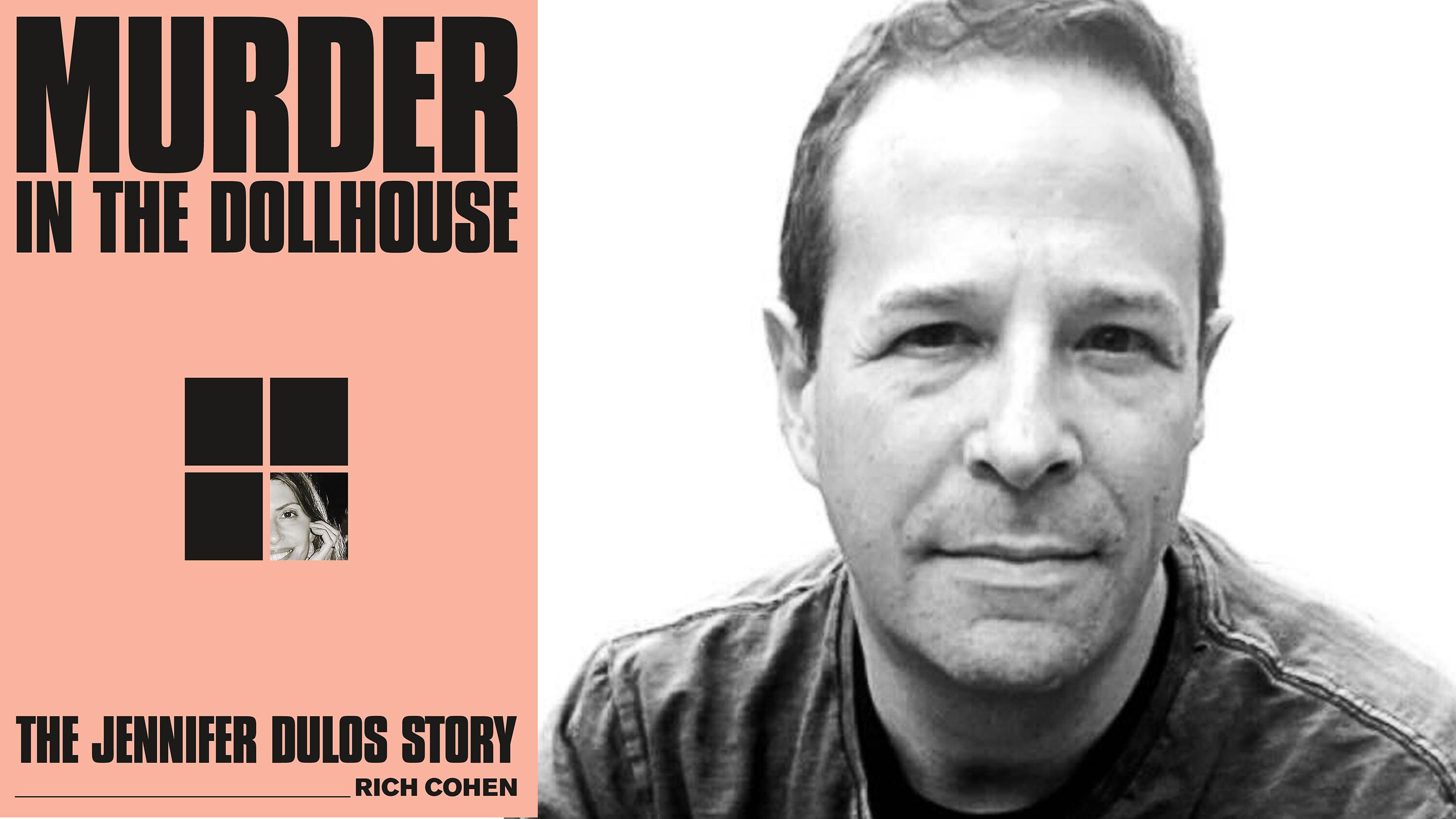
Book cover courtesy of Farrar, Straus and Giroux; Photo courtesy of Rich Cohen
Jennifer Dulos was last seen on May 24, 2019 after dropping her children off at school in New Canaan, Connecticut. She had been in the middle of a horrendously nasty divorce, which caused suspicion to turn to her estranged husband, Fotis Dulos. Surveillance footage appeared to have caught him dumping bloody trash in a nearby town, leading to his and his new girlfriend’s arrests in connection with Jennifer’s disappearance.
Legendary editor Graydon Carter, wanted to cover the ordeal in his splashy, new weekly journal Air Mail, and reached out to veteran journalist and author Rich Cohen, who has written everything from Jewish gangsters to pee-wee hockey dads and just so happened to live near Jennifer’s town. Cohen turned him down.
Jennifer’s story had drawn extensive coverage across the United States, which some criticized on the basis of “missing white woman syndrome.” While victims from less elite socioeconomic and other racial backgrounds stirred little interest, a wealthy suburbanite created a media obsession. Besides, Cohen had never written true crime before.
Learn from top longform journalists and find the best in-depth reporting. Subscribe to Depth Perception:
But Cohen had first heard about Jennifer’s story from other parents and changed his mind about Carter’s proposal when he began to see an uncanny overlap between her story and his own friends’ lives. “Her background was so close to my own,” says Cohen. “I felt like I understood her. I felt that despite being covered, she was not really covered.”
Cohen’s approach to covering Jennifer’s story was to steer his readers away from the tabloid headlines and instead focus on the tragic disintegration of a marriage and the privileged and troubled life she led before meeting her husband.
Fotis died by suicide on the day he was supposed to report to court, on January 30, 2020. Cohen’s Air Mail story — or at least the first of its whopping six parts — published just over a week later.
This edition of Depth Perception explores how Cohen, despite not being a crime writer, took on this story, which is now the subject of his 14th book, Murder In the Dollhouse: The Jennifer Dulos Story. —Brin-Jonathan Butler
This is a book where, I think for the first time, anyone I’ve recommended it to has ripped through it in a few days. They’re all hooked. Granted, I don’t live far from the town where this story takes place and the people I’ve recommended it to have mostly lived in Fairfield county. What have you made of the response so far?
Overall, it’s gotten really positive reviews. I don’t think of myself as existing in any genre. I write a story. Some people who are into true crime expect certain conventions. One is a lot about murder itself, a lot about the blood and the gore. I’m not really interested in that. I’m interested in Jennifer Farber Dulos as a person and how she got herself in this situation where she was basically at the mercy of a psychopath.
You make the point in your introduction about “missing white woman syndrome” and the conventions of the true crime genre. Your approach reminded me a great deal about how David Lynch explored the genre in “Twin Peaks.” “Twin Peaks” didn’t center around who killedLaura Palmer so much as who wasLaura Palmer and what has her loss inflicted on her friends and family and community. Her identity is explored through grief. As someone who isn’t a crime writer, how did you calibrate your approach to telling this story?
When I think about true crime, I think about great books that are later called true crime. The genre right now hasn’t done so well in the last few years in a lot of areas. It’s not quality writing. When I think about true crime, I think about great novels like Crime and Punishment or obviously Truman Capote with In Cold Blood.
But it’s weird, In Cold Blood might not satisfy a lot of people right now because it’s really about the family and the whole beginning of the book is making those people, the Clutter family, real. It’s about the last day of their lives, about their dreams, their lives, and where they came from. For me, that’s the only way that the murders register as the sort of horrible, horrible evils that they are. You have to know who the people are. You have to take something that is just a prop in a newspaper story or a dead woman in a photograph from a crime scene and make these people real again.
Coming soon: Long Lead presents its latest feature
To date, Long Lead features have also roused critics. In the four years since our launch, our work has won an Edward R. Murrow Award, a RFK Human Rights Journalism prize, a Peabody Award nomination, two National Magazine Award nods, and plenty of other honors, including seven Webby Awards.
Later this month, the latest Long Lead feature — a rare tale of community and togetherness in these divisive times — will be released. Be the first to experience it by subscribing to the Long Lead newsletter here:
One element of the story you focused on that I found fascinating was how, with all the money Jennifer Dulos had and the protection it offered, ultimately she was still terribly exposed to her estranged husband. The money itself not only failed to protect her, it actually put a target on her back and endangered her.
One of the tragedies of this case, and what interested me a great deal, was how you can see it coming from a million miles away. It’s an avoidable tragedy. And yet nobody can seem to stop it. A lot of our lives and a lot of things that happen are like that. It’s very stoppable but no one can figure out how. Tom Wolfe wrote about the idea that everything was about status. I think there’s a lot of truth to that with everyone either moving up or moving down. Everybody’s worried about what’s going to happen and are they going to move up or fall down. I think it’s a projection of anxiety. We end up fighting for things that don’t really matter, missing the big picture, getting caught up in petty fights that become the whole world when you really should just move on.
Right now, sometimes it unfortunately seems like a zero-sum game in America where somebody wins and somebody has to lose. For me to have more, someone else has to have less and that just creates a tremendous amount of anxiety. You saw that in the marriage between Jennifer and her husband.
How did you begin to identify with Jennifer learning about her case?
Her background was so close to my own. She had a lot more money than I did. But where she grew up, her age, how she was created culturally by pop culture, and her dreams of being a writer too. She was a very good playwright. I felt like I understood her. I felt that despite being covered, she was not really covered. Then I discovered that we overlapped a lot in our friendships. That was just because we did come from the same early ‘90s New York writer’s world.
One aspect of the story I found particularly fascinating was how Jennifer navigated her Jewish identity throughout her life. You provided such a nuanced context to that situation generationally in American life. Can you speak to how you dealt with that in her story?
When you’re Jewish — and it’s not just Jews, it’s a lot of people — a lot of people think they know you. They have preconceived notions of what a Jewish person is like, even if they’ve never met a Jewish person. And that is a horrible way to sort of go through life to be judged in that way. So I think there can be a strong desire to escape from that unless you’re a really religious person. You don’t want to be ghettoized. I think Jennifer idealized a kind of waspy ideal. I think Jennifer was very much a product of her time of wanting to be judged on her own merits and not on her religion. She saw it as something to escape, like a lot of us did.
Okay, let’s change gears. Occasionally we ask experienced journalists a range of questions to see what gems they have to share. First up: What’s the purpose of journalism?
To let you know what’s really going on and deepen your sense of the world as you make your way, slowly or quickly, toward the big black void.
What’s one app/tool/service you cannot do your work without?
I believe, if forced to, a writer can always work as long as he or she has access to paper and pen. See [Aleksandr] Solzhenitsyn.
Which story of yours are you the proudest?
Maybe a humor piece I wrote for the Believer called, “The Gospel According to His Good Friend Dennis.”
Which story of yours do you most regret?
The same. It really hurt Dennis’s feelings.
What’s the best journalistic career advice you ever received?
“Sit down and write the story as if you were writing a letter to me.” That was from my friend Alec Wilkinson when I was in my early 20s.
What’s the worst journalistic career advice you ever received?
“Do it this way and you’ll make serious bank.”
Journalism school: yea or nay?
Not for me. But there are at least a dozen paths to the waterfall.
“I believe, if forced to, a writer can always work as long as he or she has access to paper and pen.” — Rich Cohen
What’s your worst writing habit?
Making my family listen to everything I write before it’s finished.
What makes you hopeful for the future of journalism?
The Seabreeze, a paper my kids and their friends and their friends’ friends revived in Northport, Maine — it went under in, like, 1899. They have now published five issues and it has been devoured by the local community, which shows the never-ending hunger for hyper-local news.
What makes you think journalism is doomed?
The fact that so many people comment on a story without reading it — not good.
What’s the best media party you ever attended?
The best media event for me was probably The Forward newspaper’s Christmas party at Mo Pitkin’s in the East Village in 2005 or so. I spotted a picture of my parents in a group shot at a wedding outside the bathroom and discovered that the real Mo Pitkin was my great great uncle — that’s why the name resonated when I saw the invite — and that the owner, Jesse Hartman, was my second cousin.
Which of your articles should be made into a movie?
“The Gospel According to His Good Friend Dennis.”
Why did you become a journalist?
Junior year in high school as a reporter for the New Trier News in Winnetka, Illinois. The HAM radio club was my first beat.
Who should we talk to next? Who do you want to answer these questions?
David Lipsky, Rolling Stone reporter, partner on the old time RS HOT LIST, and author of many excellent books, including, most recently, The Parrot and the Igloo. Though played by Jesse Eisenberg in the movie “The End of the Tour,” Lipsky is, in fact, much better looking. It’s a rare instance of the real person being more physically attractive than the avatar.
What is a story/book/movie/podcast that you wish you created or wrote?
“Apollo 10 ½.” Richard Linklater gets every memory of my childhood in there.
What longform nonfiction writer do you envy the most?
I envy no man for I do not know the hard truth of any other life. I admire many, including David Lipsky, Darin Straus, Jamaica Kincaid, Alec Wilkinson, Lili Anolik, Dani Shapiro, and Ian Frazier.
What would you do if you didn’t have this career?
Make millions on Wall Street.
Do you have a favorite internet rabbit hole that is NOT part of your beat?
Regarding the topic of the article, it's insightful how Rich Cohen’s personal connection became the key to covering Jennifer Dulos's narrative. Does such an approach diverge from his methodology in previous, less personal jurnalistic endeavors?






Regarding the topic of the article, it's insightful how Rich Cohen’s personal connection became the key to covering Jennifer Dulos's narrative. Does such an approach diverge from his methodology in previous, less personal jurnalistic endeavors?