

Cracking the bro code: Jasper Craven on how toxic masculinity propels America’s military academies
His new book, “God Forgives, Brothers Don’t,” explores the role military education plays in stoking America’s lust for war.

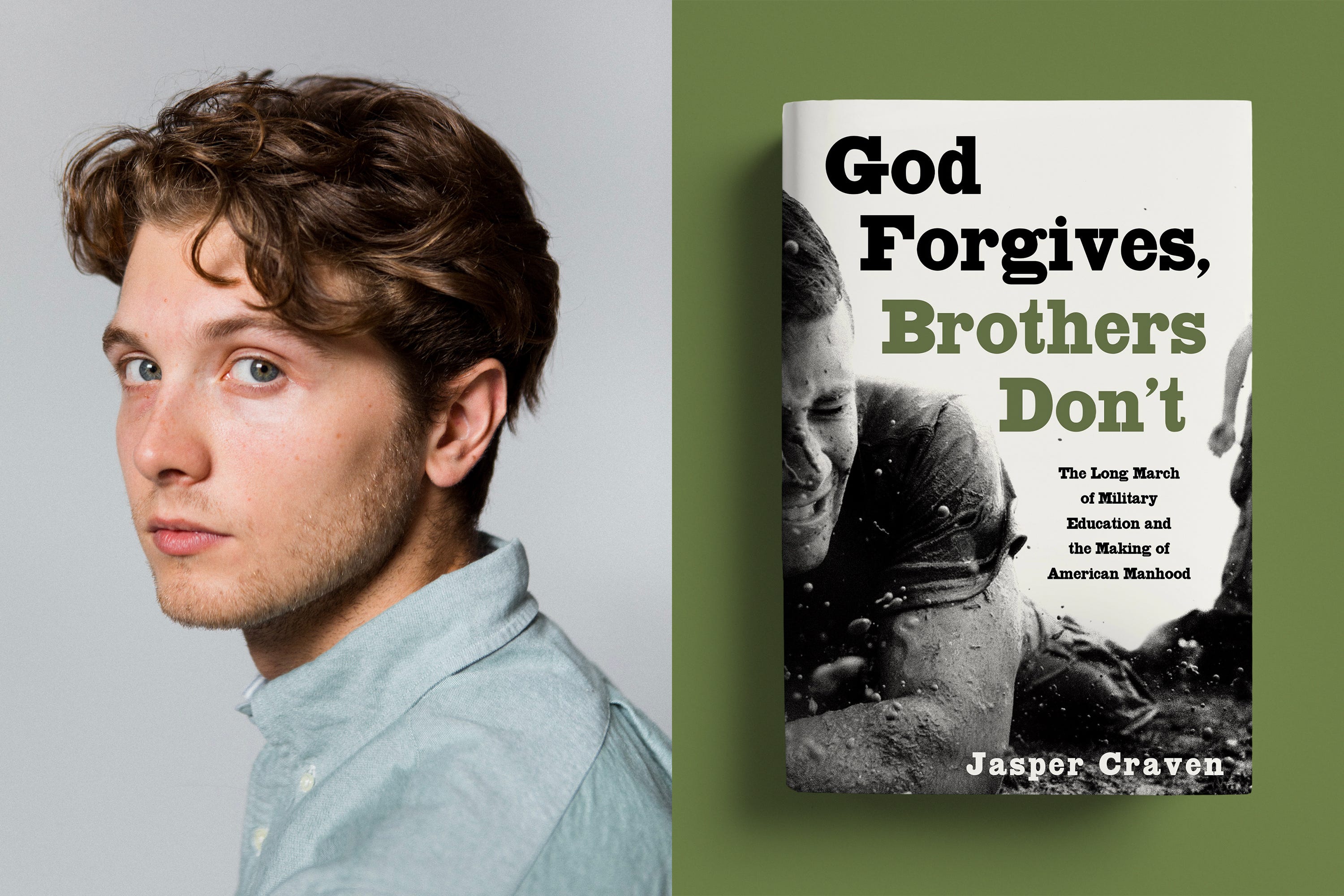
Jasper Craven’s journalism beat, which he describes in driest of verbiage as “veterans’ issues in the age of forever wars,” has evolved over recent years from the fringe of U.S. politics to the central animating threat of American culture. That’s due, he says, to a sprawling crisis in masculinity that’s fueling an interconnected toxic stew of misogyny, internet culture, gambling, and violence. Pair that with the endless pictures coming from the front lines of the Global War on Terror, which depict heavily-armed, camouflaged government forces in the center of major American cities like Minneapolis and Chicago, and it feels as though that evolution was inevitable.
His new book, God Forgives, Brothers Don’t: The Long March of Military Education and the Making of American Manhood, publishing in May, builds on his past reporting for Mother Jones where he covered scandals at the elite Pennsylvania Valley Forge Military Academy to examine the full sweep of how America trains and shapes its warriors in a moment of great transition. Following in the writing tradition set by Sebastian Junger’s Tribe and Chris Hedges’ War Is a Force that Gives Us Meaning, Craven’s book is less about war itself and more about why and how men — and they’re still usually men — fight. He also explores the modern culture of war fighting and how the “forever wars” overseas have influenced an increasingly volatile strain of American masculinity here at home.
Craven has carved out a niche as a freelance reporter covering the military and veterans’ issues, writing over the years for WIRED, Harper’s, POLITICO, The Intercept, The Boston Globe, and The New York Times, among others, and he was one of the lead reporters on Long Lead’s own award-winning 2024 work about the crisis of veterans’ health care and housing in the United States, Home of the Brave.
In this edition of Depth Perception, Craven discusses how he came to focus on the home front of the forever wars and the current relationship between the military and education, as well as how modern journalism undervalues undercover reporting. —Garrett M. Graff
[Editor’s note: The following conversation predated the U.S. attack on Iran.]
You and I are talking in mid-February, as Defense Secretary Pete Hegseth is working to cut off basically all advanced military training and graduate program access to most of the top universities in the country. It seems we are living through this weird moment where the actual act of fighting a war is ever more technological — based in cyber weapons and drones and AI — and at the same time, we have a military leadership prioritizing how many kettlebell lifts you can do. How did you get interested in the question of military education?
My father was pretty involved in the anti-war movement during Vietnam, and much of that activism played out on college campuses. Something that really spooked the right from those days — and the military, frankly, as well — was [how] the humanities, and liberal arts more generally, created this space that cultivated zealous, intense, anti-war activism. My father was living proof of that. Howard Zinn was at Boston University during his time there, and really took him under his wing, exposed my father to his People’s History of the United States, and radicalized him in a way that dictated in some profound sense the rest of his life and his political worldview.
The strange echo with my father’s life is that he almost went to Valley Forge Military Academy — I wouldn’t find this out until I began investigating the school for Mother Jones a couple of years back. He grew up just outside of Philadelphia, [was] raised in an unstable family, and from an early age wanted to get out. Back then, and today as well, the most well-promoted path for young boys looking for a new community or an escape or many other things, is the military. Valley Forge was just down the road and he almost took that path.
As I was writing about Valley Forge a couple years ago and the issues plaguing this military academy, I started thinking more universally. I connected the dots of my father’s life about how profound education is in general, and just how significant the military’s influence over education and the rearing of American boys is — whether that’s through military schools, Valley Forge or West Point, or via Pentagon grants, ROTC, [the] Boy Scouts, or all these other avenues.
What has always been interesting to me about your work is that you have made a career out of covering the military without ever actually covering combat. You’re interested, it seems, in the questions of before combat and after combat, the training of our military in the case of this book or, in a lot of your other work, veterans when they come home. How did that career interest develop and unfold?
It happened purely by chance. I graduated from college in 2015 [and] by that time the appetite and resources for embedding overseas covering conflict had essentially dried up. That’s obviously painting in broad strokes — there were many great war reporters in Iraq and Afghanistan there till the very end — but I basically experienced the war through other people’s writing.
Where I saw the story as I graduated was in the lives of veterans returning home, in the myriad offices of the military-industrial complex, and then also the Department of Veterans Affairs. The Defense Department and VA are the two largest federal agencies, and I figured that there was a lot to explore. Plus the other crucial thing is that being in Vermont as a stringer around that time, I came to cover Bernie Sanders as chairman of the Senate Veterans Affairs Committee. When I landed in D.C. the summer of 2014, there was this massive wait time scandal at a Veterans Affairs hospital in Phoenix [and] very quickly, I just fell into this. From there, this larger world expanded out — one, frankly, that I felt was under covered. There seemed no shortage of different avenues to explore.
Inside the U.S. military veterans’ fight for housing

Jasper Craven was a contributor to Home of the Brave, Long Lead’s award-winning multimedia feature on West LA’s unhoused veteran’s crisis. Chronicling a land grab dating back to the U.S. Civil War, this multi-part report is a tale that overflows with government malfeasance, neglect, graft, and even death. At its core, the it seeks to answer the simple question: Why are veterans living in the street?
The answer may be found in the courts. In the waning days of the Long Lead investigation, a group of veterans filed Powers v. McDonough, a class action lawsuit between the federal government and disabled vets seeking permanent housing on the 388-acre West LA VA campus. Long Lead and Craven have been covering this lawsuit and the veterans’ continued fight for housing. Follow along by subscribing to the Home of the Brave newsletter here:

What have you learned about America in the 2020s through this lens of the inputs and outputs of what you generally refer to as the “forever wars” or more broadly, the “Global War on Terror”?
One of the core contradictions of this moment is that Americans, by and large, are skeptical and scarred by forever wars and leery of international conflicts. There’s a bone-deep feeling in America that the unprecedented outlays of taxpayer dollars into the Pentagon has deprived America of other domestic priorities. What I’ve come to understand is if you go to war for 20 years, there is just a tremendous amount of blowback domestically and scarring that happens at home, even if the battle itself is thousands of miles away. There’s a realization that these wars have really scarred this country in a pretty profound way.
But at the same time … there remains this stubborn germ where war feels like all America knows. It feels [like] the only thing we’re still “good” at is fighting. We know how to build weapons, we know how to sell weapons, and there is some resilient urge in many Americans to win — this thirst for triumphalism.
President Trump honestly understands that and is a very keen observer of all of these conflicting tensions. His foreign policy has been marked by these short blasts of military activity that don’t require the intense deployment and the forward operating bases and all of this stuff, but still scratch this itch that a lot of Americans still want this muscle on the world stage.
The Venezuela operation is a perfect example of that.
Absolutely.
What do you make of the moment that we are in right now, with the military’s renewed focus under Pete Hegseth on masculinity as the defining core competency of the military, which you wrote about for Baffler in September? Your book talks about two very different inputs to the military’s education system: how the military academies try to elevate fighters into gentlemen of class and distinction and knowledge, and then the private military schools that try to inculcate into students the masculinity necessary to be warriors.
The concept of masculinity itself has changed and warped over conflicts and generations, but what I see distinctly in Hegseth’s push is a campaign that I feel mirrors the POW/MIA movement that emerged after Vietnam. One of the main “coping mechanisms” after America’s loss in Vietnam by a certain class of reactionary politicians and certain Vietnam veterans was to find some way to scapegoat the loss and preserve the country’s prestige. The POW/MIA movement emerged to basically conjure this myth that America didn’t basically go hard enough in Vietnam — that we should have stayed there longer, that all these spineless politicians didn’t properly support the troops, [and that they] didn’t even bother to recover many of who remained imprisoned by America’s enemies.
Today, I argue Hegseth is elevating this very virile masculinity as the prime factor for military success, and stem[ming] from [that is] the fact that he has conveniently scapegoated women and minorities as the reasons why America lost the forever wars.
Post-9/11, women and people of color really were elevated in significant ways for the first time in the military and they, by all accounts, excelled. Hegseth, whose own masculinity and identity is tied to his military service, found it easy to point to them as the reasons for failure, rather than to interrogate his own behavior, his own training, and the military’s broader tactical missteps.
“There remains this stubborn germ where war feels like all America knows.… We know how to build weapons, we know how to sell weapons, and there is some resilient urge in many Americans to win — this thirst for triumphalism.” —Jasper Craven
What did you learn about the military in the course of writing the book that you did not understand when you started?
There was a lot of really fascinating archival material that I stumbled upon. Anytime you’re pitching a magazine article or a book, you make certain assumptions and hope that once you really dig into things, they bear out. My working thesis — based largely on reporting on a single school, Valley Forge — was that the entire enterprise of military training had fundamentally been formed around a core idea of American masculinity.
Just looking at the life and methods of West Point’s godfather, Sylvanus Thayer, who really influenced not only West Point’s curriculum to this day, but virtually every other military school that’s been formed in its wake. He was a figure who had daddy issues and who, as a boy, became romantically entranced by the idea of a uniform. It was striking to see even at the dawn of America, how this allure of military service to boys featured the same beats that I and countless other American boys feel at some point in our childhood.
You have this new article out in Harper’s this month on sports gambling. Tell me a little bit about it — the problem of the sports betting and gambling epidemic in America feels very much the same story of the crisis in masculinity and young men in America as much of your other reporting on the military.
That is dead on. I’m trying to slightly reconceive of my repertorial focus as men’s issues, masculinity, and the military. I do see them all as very closely intertwined. Sports gambling is yet another red flashing warning sign about the profound sense of isolation and hopelessness that American men have. Some of that energy is misogynistic and reactionary and racist, xenophobic. … I really see the rise of sports gambling as a symptom that applies universally to men and women — a world, or at least a country, whose politics are seemingly stagnant and corrupted, where the economy feels rigged, and all of these traditional avenues for meaning and economic security and identity feel closed off.
Gambling offers this new opportunity to form an identity, to become an expert. There are many men who really pride themselves on knowing a team, the stats, and predicting the outcomes. There can be a lot of ego built into this practice. … When everything else feels rotten and there’s nothing to hang on to, there’s this energy to try to profit off of that cultural and political decline.

What story of yours are you proudest of?
My story about the security guard industry in America. I worked for six months part-time as a security guard at a bank in Manhattan. [I’d] mostly covered military and veterans’ issues exclusively for about 10 years, and that was my first movement out of that specific beat and into something that felt interconnected, but distinct. Covering the security industry and being a security guard really helped illuminate some of the military ideas and themes that have spilled into the cultural groundwater and are animating masculinity today. That was very helpful for me to connect these two worlds.
What is the best or most helpful journalistic career advice you’ve ever received?
Buy LinkedIn Premium and use it as a tool for source development. This doesn’t apply to every beat, I suppose, but for most reporters out there, LinkedIn can be a really vital reporting tool — [for] both finding people and searching for people who work or have worked in specific industries, government agencies, corporations, or nonprofits.
When I get a juicy tip that feels promising, my first stop will be LinkedIn. I will try to gut-check the tip and corroborate it by connecting to relevant people in an industry or at the relevant company. It’s really great for building out a network of sources.
What is a widely accepted journalistic rule or norm that you hate?
The practice of reporting undercover is generally looked down upon in polite journalistic circles these days. I can certainly understand some of that concern — I don’t think a journalist should ever lie about themselves or dupe a person they’re interacting with — but there is a long and proud tradition of reporters working in some undercover capacity to expose wrongdoing, going all the way back to Ida B. Wells.
I found working as a security guard for six months quasi-undercover that there was just much more nuance that I was able to glean than if I had just interviewed two dozen security guards.
What led you to journalism in the first place?
It’s a boring answer, but the movie All the President’s Men. Robert Redford, man, sexy as hell, cool as hell, Dustin Hoffman. It was that simple. My folks are filmmakers. They showed me a lot of movies when I was a kid, and that one just completely lit up my mind. I’ve always been curious, and I view a journalist’s role to some extent as similar to a private investigator or a detective in some sense. We certainly watched a bunch of old film noir with my folks as well, and surfacing new information was presented to me as a kid in such romantic ways with these movies. It was that simple.
Do you have hope or fear or both for journalism right now and why?
I am hopeful, but it’s a qualified answer. I feel very worried about the young crop of journalists coming up below me. As I look to the internships and infrastructure that helped me get a foothold in this industry, I see a lot of degradation and outlets shuttering. AI is wiping away many entry-level jobs in media and other industries.
At the same time — and maybe this is less hopeful and more delusional — I do believe in the public’s undying thirst for information with integrity, and I do foresee a backlash to AI and the junk information that it presents. I’m hopeful that there will be a backlash and that there will be newfound energy for information with integrity.
Plus, I just can’t see how any of these AI programs could effectively report out a story and surface new information. They’re entirely predicated on just chewing over what already exists. I have to believe that journalism will remain crucial to surfacing new information.
Further reading from Jasper Craven:
“On Tilt: America’s Gambling Epidemic” (Harper’s Magazine, February 2026)
“Hazing, Fighting, Sexual Assaults: How Valley Forge Military Academy Devolved into ‘Lord of the Flies’” (Mother Jones, April 2022)
“Home of the Brave” (Long Lead, June 2024)
“The Thin Purple Line” (Harper’s Magazine, September 2024)
“Battle of the Sexes” (The Baffler, September 2025)