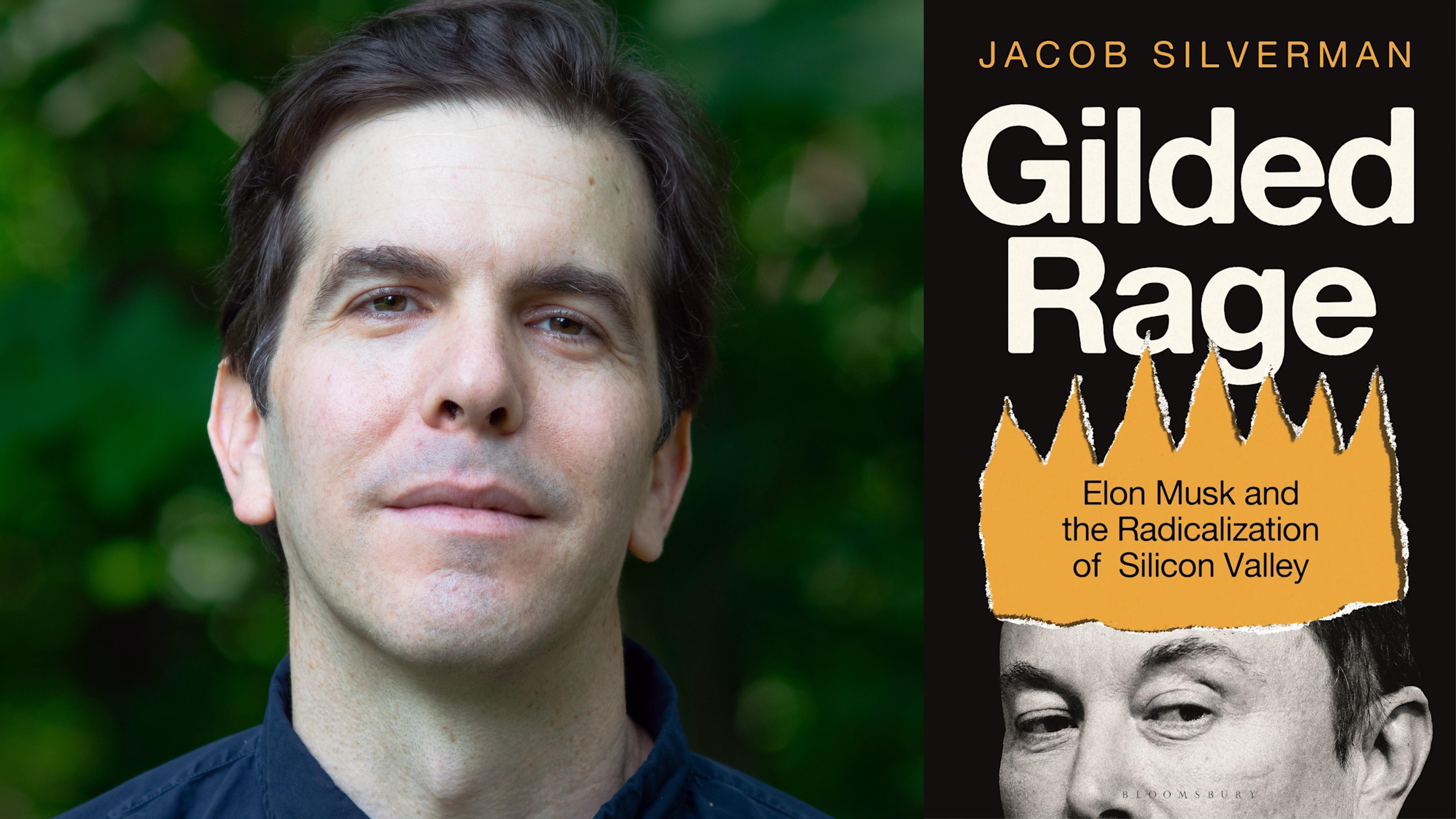
Photo credit Robin Kaiser-Schatzlein; cover courtesy Bloomsbury Publishing
Jacob Silverman started covering the tech industry a few years after the 2008 financial crisis. In the nearly two decades since, he’s held a front-row seat to what he considers to be one of the most important stories out there.
Take Elon Musk, who has far and away become the richest person in history, while simultaneously becoming more politically active and extreme. He’s not alone. Silverman’s reporting follows many tech elites who have aligned themselves with the right and the Trump administration as they gain status in Silicon Valley.
“What I keep finding, especially with Musk and his peers, is this kind of paranoid removal from society and common experience that they seem to embody,” Silverman says, adding this is a toxic relationship that is having profound impacts on our society.
At the center of Silverman’s reporting focus, he’s published multiple notable books on the tech industry, including his most recent: a critical book on Elon Musk titled Gilded Rage.
In this edition of Depth Perception, we ask Silverman how he got into journalism, what stories he thinks are most important to cover and where independent journalism is heading. —Thor Benson
Learn from top longform journalists and find the best in-depth reporting. Subscribe to Depth Perception:
What got you into journalism, and how has the arc of your career looked?
Well, it’s definitely not an arc. It’s sort of a jagged path that I’ve accidentally followed somehow. I’m 41. I graduated from college in 2006, and I did not really intend to go into journalism.
I was a humanities and English guy. I liked writing, but I did not study journalism. I would say the main thing that sent me on this path was the 2008 recession. I had some jobs after college — nothing that I really liked that much — and also traveled some. When I came back, the economy was crashing.
I started doing things like book reviews and a little bit of cultural reporting, [which] was one of the few things that felt available to me in between applying for all kinds of service and manual labor jobs. Now, it took me a long time to really think of myself as a journalist. I just sort of thought I was a writer who was doing freelance journalism work ... And then it was in about 2012 that I started writing more about tech and started doing actual reporting.
What made you decide to start focusing on some of these big issues that you’re looking at, from crypto to Elon Musk?
I think I have this allergy to hype and fads and whatever is sort of promoted at the moment, especially promoted by the forces of consumerism or by powerful people. That’s, I think, what I’ve responded to a lot as a tech journalist over the last 14 years or so, which is that I’ve just taken a look at what’s ascendant. Whether it was social media or crypto, and then now the tech oligarchs.
I tried to call bullshit on some of those things or examine the downsides and the negative externalities. I also think, frankly, I was responding to some deficiencies that I saw in tech journalism. I think there are a lot of great people on this beat, and more now than before, even if the institutions often let us down. But when I was writing about social media in 2012, people thought that Facebook and Mark Zuckerberg could do no wrong. Or at least he was sort of this benign nerd.
At the same time, I was talking to academics, activists and others who saw a whole other side of things. I think that’s what attracted me. There seemed to be this other story to be told — other criticisms and analytical power to be brought to the situation that people at TheNew York Times or elsewhere were ignoring.
Looking at your most recent book, what did you know about Elon Musk going into it? And then what was your biggest insight from writing the book?
When I was working on the book, I was also working on a podcast for the Canadian Broadcasting Corporation (CBC), four episodes, about Musk’s childhood and political formation.
I think a couple of things that I found notable were when he was in high school, he didn’t really stick out very much. I mean, he was just another nerd. Granted, [he was] living in this very unusual setting of apartheid South Africa where he was part of the dominant majority, albeit English-descended and not Afrikaners, but certainly part of the ruling white overclass. What I think he’s taken away from his own upbringing is a constant sense of superiority. In any room, [feeling] his inherent superiority and right to rule.
I think the other thing is that we have to take him at his word. When he talks about something like the “woke mind virus,” there is a ridiculousness to Musk, but fascism is ridiculous and over the top: Hitler giving his sweaty speeches while his minions marched in Hugo Boss-designed uniforms. However, Musk, I think, believes a lot of things he says.
The “woke mind virus” stuff came from, by his own account, his daughter coming out as trans. She changed her name and said in her name change application that she didn’t want to be associated with her father, and she later said that her father had bullied her for being queer.
Musk has, in interviews, spun it very differently and said, “the ‘woke mind virus’ killed my son.” I think that was sort of eye-opening for me. We imagine some of this stuff is a certain degree of kayfabe or there’s some play here. What I keep finding, especially with Musk and his peers, is this kind of paranoid removal from society and common experience that they seem to embody. Particularly in Musk’s case, he seems to take from science fiction not any sense of allegory or criticism for the way we might live, but a blueprint. It’s a blueprint for how he wants to live.
Musk and these other guys, especially people like Marc Andreessen or Peter Thiel, inhabit a much different psychological space than we do. That can be hard to suss out, but at the same time, I think they mean it when they have these ridiculous tweets about how migrants are going to overrun the land, or Marc Andreessen saying that introspection is a sign of weakness. There’s a performative nature to it, but also that is who they are and they are different from a lot of us.
The audacity of Elon Musk
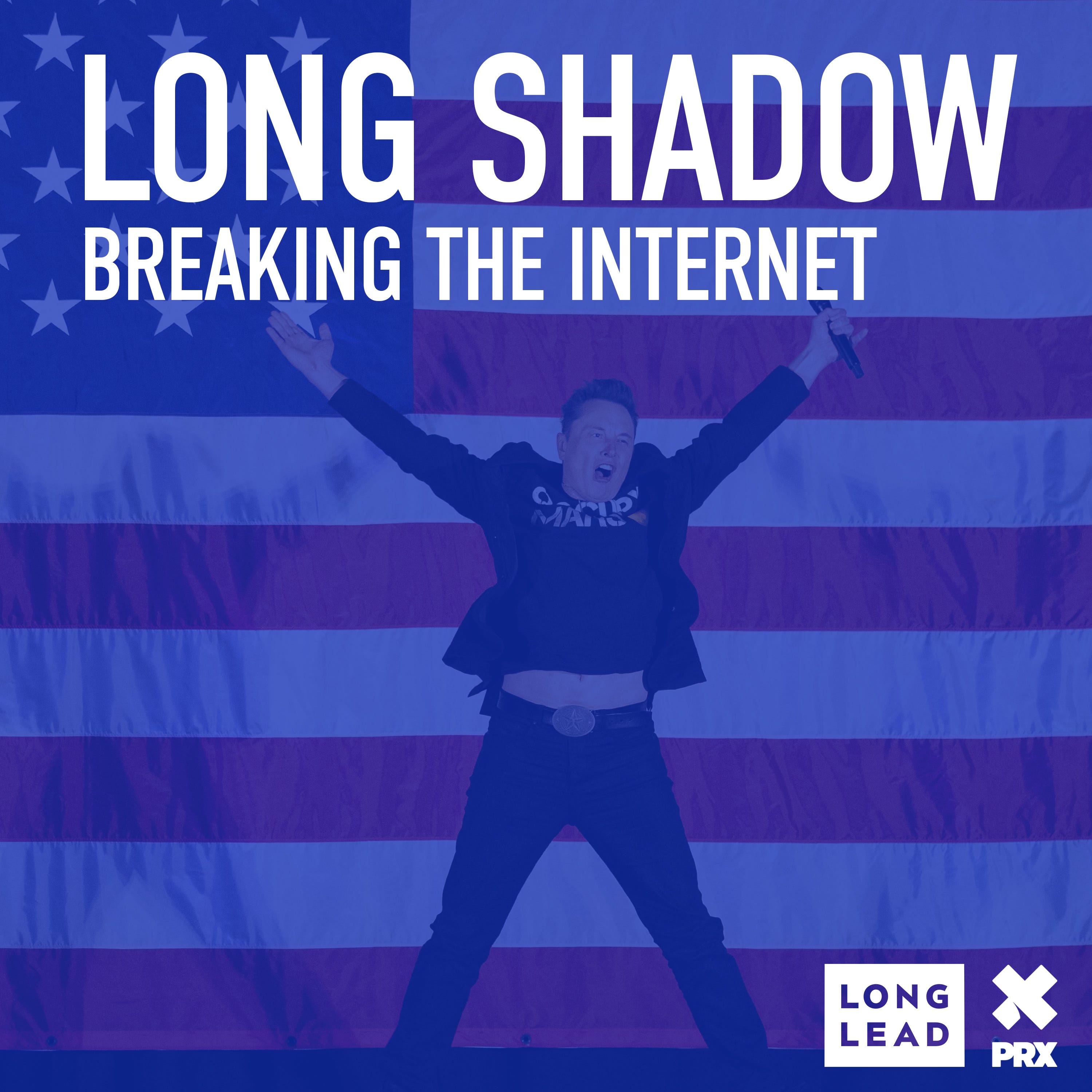
The story of the internet — and how it’s been broken — is very much the story of Elon Musk. In 1999, the then 28-year-old South African tech mogul had thinning hair, a baby face, and a little over $300 million in his pocket, which he scored after selling his software company, Zip2, to Compaq computers. “I think the internet is the, the super-set of all media,” he told a reporter around that time. “It allows consumers to choose what they want to see, when they want to see it.”
Nearly 25 years later, in October 2022, he’d buy Twitter for $44 billion and rename it X.com, in a bid to control that super-set he had prophesized decades before. “Feeds were quickly inundated with some of the darkest videos to ever grace the internet,” says Garrett Graff reports in Long Shadow: Breaking the Internet. “Videos of real murders, of violent porn, of animals getting hurt and people fighting. Racist rhetoric, misogyny, deepfakes, and viral conspiracy thrived — and Musk was one of the biggest consumers of the content there.”
Chronicling innovations, revolutions, cyber attacks, and meltdowns, this podcast untangles the web in a way you’ve never considered before. Across seven episodes, it retraces 30 years of web history — a tangle of GIFs, blogs, apps, and hashtags — to answer the bewildering question many ask when they go online today: “How did we get here?”
Yeah. Obviously, Musk just became a trillionaire. He’s become even more extreme lately. What do you think about how he’s changed in recent years, especially since your book was completed?
I think, unfortunately, we have to be kind of attentive to what is occupying Elon Musk. I’m not saying that everyone has to be on X or anything, but we are subjected to his interests and whims. When he decides to foment racist violence somewhere, it’s just one small piece of what Musk has been agitating for a while now.
I mean, I’ve certainly been paying attention. When he spoke at a Tommy Robinson rally via video link, he was saying that people in the UK need to be ready for violence. Violence was coming to them, whether they liked it or not. He was specific that this was going to come from migrants. So I think it’s very grim. It’s very dark. We have to pay attention through the election, through the midterms. While he can’t really maintain focus and interest long enough to, say, have his own political party, I think we need to understand that he is going to be this messy, influential force in our politics for the foreseeable future.
We have to be watching where his money is going. But I expect him to be a MAGA loyalist going into the midterms.
What keeps you up at night? What do you think about a lot and you’re like, “Oh, this is the thing that could really screw us?”
That’s a good question. Right now, I worry about this fusion of corporate and government power. On one side, Silicon Valley has made this bargain for its own power and for money. So they’re not regulated. They can have tons of government contracts. Trump will subsidize the AI boom.
The bargain that they’ve made is that if they even care, they’ll tolerate basically unlimited corruption from Trump, his family, and his cronies. That clearly doesn’t bother them. It’s something also that they’re willing to facilitate through Trump’s crypto businesses and things like that. So it’s that partnership, I think, that disturbs me.
I worry not only about how do we have any checks on the power of some of these individuals, like Musk, but what do we do when the load-bearing institutions of civil society, weak as they were, have just been knocked over. Crime is basically legal if you’re in power or closely connected to power. I really think this is unprecedented, at least for our country.
What do you think about the future of the journalism industry? Are you worried? Hopeful?
In general, a dominant feeling is that the news industry or the media industry continues to be in a downward spiral. Journalism can’t just survive on TheNew York Times and NPR or whatever. I think that just the simple fact that there are many fewer people working in journalism now than there were, even when I started as a freelancer in 2008, is deeply depressing. That’s not the sign of a healthy society.
On the other hand, there are so many people doing amazing work, and some people on an individual basis are able to make it work with newsletters or having a very specialized beat or publication. There are people who have been building some new publications like Zeteo or Dropsite.
I am very heartened anytime I see that someone is actually able to surmount the tremendous number of obstacles that are there to not just succeeding as an individual on Substack or wherever else, but to actually create something new that might employ a number of people. I guess my experience has been that it’s hard to make money. I’m happy with the work I’ve done. I’ve been really fortunate to write and publish some books, but the agony for me over the years has been financial.
That’s also required me to decouple my sense of what is good work from what makes me money. That’s been something I’ve struggled with on my own side. How do I get satisfaction from this stuff by doing work that feels good or worthwhile or representative of what I want to do while also being able to pay bills? I think that’s what I worry about for myself and for other writers. On a mass scale, we’re just not there.
I love people’s creativity, whether they’re doing a YouTube show or some other video project or actually publishing really interesting or aggressive stuff on Substack or another newsletter platform, but not everyone can be that entrepreneurial. We do need institutions.
It can be great to be a freelancer. You don’t necessarily have to answer to the same people, but sometimes you also need support. You need resources or you need lawyers or you need editors who have your back. That can be helpful. It can be very exciting to do things on your own, but sometimes you lose out by not having those things or not having that supportive institution behind you.
“Not everyone has to be so courageous or anything like that, but we do have to try to do what’s right and not preemptively concede. I think preemptively conceding to power is one of the worst things you can do as a journalist.” —Jacob Silverman
What do you want to do next? What are you focused on?
I think political corruption, especially as enabled by crypto and the tech industries, is deeply important right now — and illicit finance. This is maybe a little bit more of an answer to the last question, but in some ways, what also worries me, or one thing I’m thinking about a lot, is how the media can succeed amidst these difficulties and this kind of broader corruption.
One of the things we’ve seen is that people are afraid or don’t want to cover serious issues that might get them sued, or might get them attacked by the Trump administration. It has been a problem for me sometimes that I can’t get certain things published because some media organizations don’t want to take on the risks, even if they know the work is true.
That’s something I think about on a personal level. How am I going to get XYZ published? Not everyone has to be so courageous or anything like that, but we do have to try to do what’s right and not preemptively concede. I think preemptively conceding to power is one of the worst things you can do as a journalist.