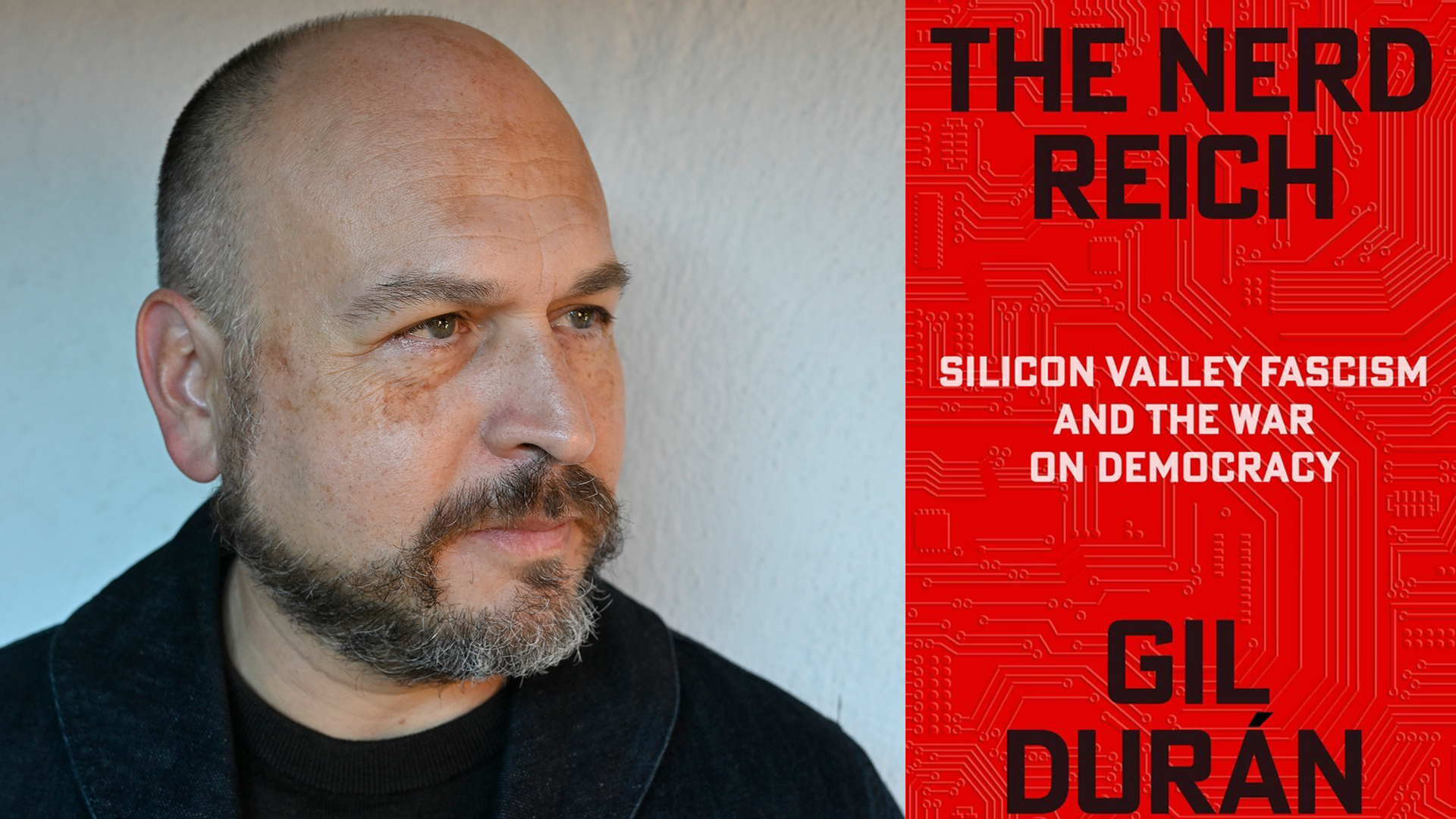
“It's all AI and bots and space travel — and people don't have jobs.” Gil Durán’s new book explores big tech’s democracy haters
Pulling from his careers in politics and journalism, Durán wants the public to understand the dystopian influence of Silicon Valley’s billionaires on global politics.
Photo by David Fenton; book cover courtesy of Avid Reader Press / Simon & Schuster
The billionaire tech moguls have a plan for our future, and it’s probably not one you’re excited about. They want to automate everything and make us reliant on their products — they’re doing it right now. And as we’ve come to learn in recent years, they’re also not fans of democracy.
That’s what Gil Durán’s reporting is focused on. He’s a California-based independent journalist who writes about tech oligarchs and something called the “network state.” That’s a concept he says these billionaires are obsessed with. It’s essentially a way to run a tech-saturated country like a corporation and is a model supported by influential Silicon Valley figures like Peter Thiel and Marc Andreessen.
Durán’s career spans both journalism and politics. He was a journalist in the late 1990s and early 2000s, before working in California politics for many years. Then in 2018, he went back to journalism. While in the political world, he helped run communications for some of the country’s leading Democrats, including former U.S. Senator Dianne Feinstein and former Vice President Kamala Harris.
Learn from top longform journalists and find the best in-depth reporting. Subscribe to Depth Perception:
Published this week, Durán’s book, The Nerd Reich: Silicon Valley Fascism and the War on Democracy, explores these billionaires’ plans to dismantle democracy and replace it with the network state. It’s gotten a lot of attention as the vision of what these tech leaders are trying to do to the country becomes clearer.
“Thiel has been leaving a trail of breadcrumbs in public for decades now. All my book does is show people that there’s a trail of breadcrumbs, what those breadcrumbs are, what they mean, and where they are intended to lead to,” Durán says.
In this edition of Depth Perception, we talk to Durán about how he got into journalism, how he ended up writing about the tech oligarchs, and what he thinks the future might look like. —Thor Benson
What was the start of your career like, and how did it evolve over time?
I got my first byline in the fifth grade when I won the “My Mom is the Best” contest in my local newspaper, the Tulare Advance-Register in Tulare, California. It was just a little short essay every kid had to do. I won a $25 brunch certificate, which was big in 1987.
That was a lot of money. I got flowers and a microwave, a brand-new gadget back then, which was amazing because we were actually homeless at the time. We sold the microwave to my grandma, I think. But I got a taste of what it was like to be a writer. They ran a little feature on my family.
I was like, “Holy crap, when you’re in the newspaper, suddenly everybody knows who you are.” And from that moment on, I became fixated on newspapers and journals. I read the newspaper every day. I would sometimes hammer out a slug just to be the shape of a quarter, because I couldn’t afford the paper.
Anyway, that was the start of it. And then I was on the newspaper in middle school, where I wrote an editorial that got me kicked out of school for criticizing the principal. That’s where it all started.
I went to the San Jose Mercury News in 1998, and that was the beginning of my journalism career. I wrote for them mostly between 1998 and 2001, with a little break to travel around and stuff because I was young and itching to travel. But then the whole tech thing hit, and the ad revenue [dried up]. I ended up working blue-collar jobs for two years until I met [former California Governor] Jerry Brown when [my job] was literally mopping floors at a building in West Oakland.
I went into politics for 17 years until I got a call in 2018 from someone at the Sacramento Bee who said, “This is a crazy idea, but what would you think of coming back to journalism as the editorial page editor?” It was a massive, massive pay cut. I was literally chilling in Paris for a month, because things get slow in consulting in December, so you’ve got to go somewhere else for a while.
I got on a plane, flew straight to Sacramento, and cut my own damn legs off to go back to journalism. That’s what I’ve been doing since. I was there for a few years. I went to the Examiner, which a rich guy bought. We had a good year where there was investment, and then it all started to slide. I went on my own, which turned out to be the only place I could do the work that I needed to do.
How has independent journalism been for you? What’s that experience been like?
Well, the independent side is pretty scary, because it largely meant supporting myself in order to try to do work on spec that no one was interested in. Even if someone gets interested, you’re talking about a few hundred bucks for potentially months of work. It can be really hard to thread the needle on doing the work you want to do and getting paid to do it. That’s not really what happened in my case.
I made a tremendous investment of my own money to do the work that eventually became my book. There were moments when I thought, “Am I making a really stupid mistake here?” And I’ll be honest, there are days when you’re like, “Let’s just drop this and look for a damn job right now.” I was in politics. I could go make hundreds of thousands of dollars to advise people on what to say in a press release. Journalism is what I want to do, but there are moments where you think, “Is this just a dead end? Am I having a midlife crisis by trying to be an independent journalist?” That’s what it could seem like. But I persevered through that and got some pieces published. Those got a bigger reaction than almost anything else I had even published in a newspaper.
I ended up winding my way back to the whole tech/politics thing. That had troubled me when I was observing it in San Francisco during the recall elections in 2021 [and] 2022. There was something there that I couldn’t quite figure out. Why are these guys so right-wing? Why are they pouring so much money into polarizing the city’s politics?
I ended up circling back to that, and that actually became my focus. I had to give myself the time to find that. That kind of freedom can be a bit uncomfortable. I’m the kind of person who, if I’m relaxing, I feel anxious because I should be doing something. My political and newspaper [lives] taught me to be a workaholic. That’s the meaning of life: to be chasing something always, whether it’s a campaign or an issue or beating someone to the punch on a story.
I’m glad I did it. It all looks great now that I got a book deal and an audience, but there was a lot of trepidation and a lot of uncertainty and a few moments of serious doubt. It’s not easy. I had to be crazy to be an independent journalist. I will say, though, that the newsletter economy has changed things a bit. I’m not making millions of dollars like some people, but I don’t have to rush out and get a job immediately.
The audacity of Elon Musk
The story of the internet — and how it’s been broken — is very much the story of Elon Musk. In 1999, the then 28-year-old South African tech mogul had thinning hair, a baby face, and a little over $300 million in his pocket, which he scored after selling his software company, Zip2, to Compaq computers. “I think the internet is the, the super-set of all media,” he told a reporter around that time. “It allows consumers to choose what they want to see, when they want to see it.”
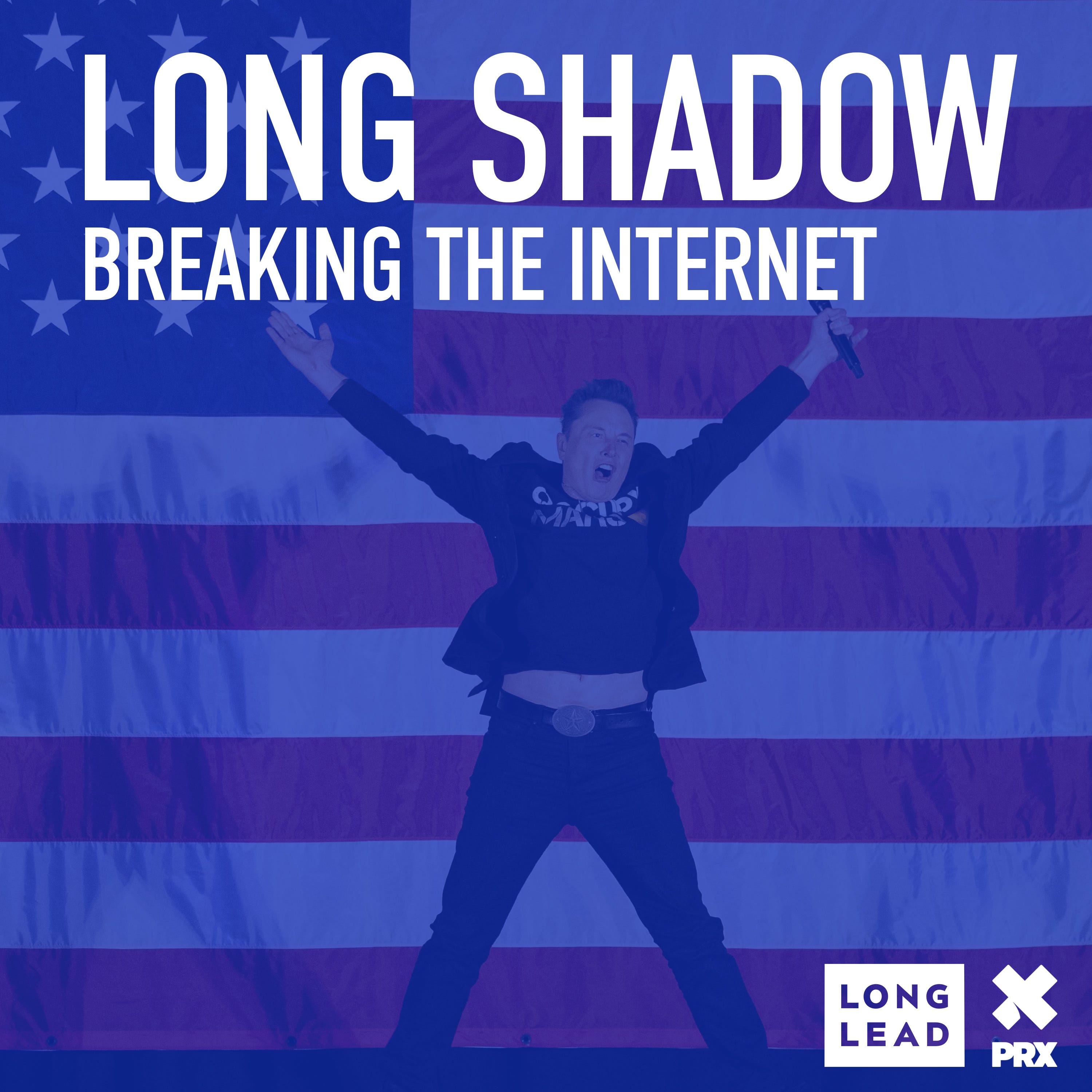
Nearly 25 years later, in October 2022, he’d buy Twitter for $44 billion and rename it X.com, in a bid to control that super-set he had prophesized decades before. “Feeds were quickly inundated with some of the darkest videos to ever grace the internet,” says Garrett Graff reports in Long Shadow: Breaking the Internet. “Videos of real murders, of violent porn, of animals getting hurt and people fighting. Racist rhetoric, misogyny, deepfakes, and viral conspiracy thrived — and Musk was one of the biggest consumers of the content there.”
Chronicling innovations, revolutions, cyber attacks, and meltdowns, this podcast untangles the web in a way you’ve never considered before. Across seven episodes, it retraces 30 years of web history — a tangle of GIFs, blogs, apps, and hashtags — to answer the bewildering question many ask when they go online today: “How did we get here?”
What brought you to the network state/tech oligarch subject matter?
As an expert in California politics, there are very few people with my level of knowledge and the experiences that I’ve had working for Feinstein, Brown, and Kamala Harris. For the first time in San Francisco, I saw something I did not understand, and I was like, “What the hell is that? Where is this coming from?”
That was what it really was for me. I found something I didn’t fully understand. I wanted to understand it, and it took some time, and I can understand why a lot of people want to avoid it. It’s complicated. It’s unusual, but it’s new. I ended up being way ahead of something that a lot more people can see now.
I believe it’s becoming one of the defining stories of American history — the effort by Silicon Valley venture capitalists to seize control of the nation and essentially roll back democracy. But it started with a much simpler question. When I first heard about the network state, there was a woman named Emily Mills, who was a sort of Twitter investigator who kept tweeting these long threads about it.
I thought it seemed a little weird. We’re taught to stay away from things that seem weird. Unfortunately, weird is the times we live in now. I ended up running across a [review of a] book by Quinn Slobodian, a historian, and I didn’t even finish it. I ran upstairs and ordered the book immediately. I read it in a day. It talks about the network state, and that’s not the main portion of the book, but I was like, “Holy shit, it’s real.” I just went on a deep dive and became more and more concerned that these tech oligarchs had been spelling out in public for a long time what they wanted and what they intended to do.
As far as I could tell, nobody was trying to tell that story in a way that would reach a mass audience. After I did a little research for a month, I wrote [to] a bunch of editors and only one got back to me — Jason Linkins at The New Republic. He said, “When can you have this first story? That ended up becoming a five-part series. A lot of it I was learning as I went along.
JD Vance suddenly came into the picture. I’m like, “Holy crap, he’s one of them.” When I started writing about it, I thought this was going to be a bigger concern for everybody in maybe five to 10 years. But when Vance got on the 2024 ticket, it suddenly became relevant.
How was writing the book? How did it develop over the period that you were writing it?
You’re trying to watch what’s happening with one eye and then be in the past and deep reading and writing a book with the other. I had a very tight deadline, like 10 months, which is crazy for a book. I’d never written a book before this. It’s hard.
I mean, it took a lot out of me. My beard is almost all white now. Part of that was good, though, because when I started writing, I [was] like, “Where does this book end?” I had an outline, but I knew that things didn’t necessarily end there.
I took it chronologically in the second draft, and fortunately, Peter Thiel starts talking about the Antichrist nonstop while I’m heading toward the last part of the book. That really gave me a direction to move toward. It really tied it together. My last chapter is called “Antichrist,” and it’s where everything comes together.
[Thiel’s] end phase here is the Antichrist. At the moment he arrives at the height of his power with his protege a heartbeat away from the presidency, with his cronies throughout high levels of government, he starts preaching nonstop about the Antichrist.
“I point the finger at these evil oligarchs, but we’re complicit in that. We’re giving them all of our attention and our money. Everywhere you look, it seems like we can’t make a move without somehow paying a billionaire. We have to rethink how everything has been structured around us. We deserve technology. It’s something we, I think, have a right to. ” —Gil Durán
As you said before, even when you looked at this stuff at first, you were like, “This is kind of weird. I don’t know about this.” How do you deal with readers who are new to you, maybe having the same feeling?
I’m sure there’s some of that when people aren’t familiar at the beginning. There used to be a lot more doubt. Now, I find it’s the opposite. People feel like they understand what’s going on. People are looking for an explanation for why this is happening.
The main message of Silicon Valley is we’re going to take all of your jobs. They’ve done it to themselves. Once we’re at that point, people see it. A lot of what my book focuses on is this prophecy that Thiel embraced a long time ago: that AI and crypto were going to fundamentally restructure the country, and that savvy investors who understood what was coming could reap the benefits.
That’s the core of my book, and I think that matches what a lot of people are seeing as AI and crypto suddenly come out of nowhere to become the biggest monster donors in our political system. The people who are poo-pooing it now are people from the tech right who know it’s all true but are acting like I don’t know what I’m talking about.
That’s part of their PR game. They tried to attack me early on and then suddenly they all went quiet. They got me kicked off of X permanently for no reason, for tweeting about fascism. So I’m not there anymore to make trouble. I think the biggest obstacle so far has been the establishment media that refuses to really discuss these issues. There have been little peaks here and there. The New York Times did an interview with Curtis Yarvin, like seven months after the election. My argument was that people should have known it before.
So it’s left to independent journalists and newsletter writers and others to challenge power because the establishment has a huge moat against challenging billionaire power. If we still had the alt-weeklies, I think the alt-weeklies would have seen this.
What are your feelings about the future of journalism? It sounds like you’re seeing some areas of atrophy but also some areas of growth.
I fear for the future of journalism. I like the newsletter thing. There are good journalists doing newsletters, but there’s a lot of slop out there. There’s also a lot of chasing whatever’s hot right now without any regard for standards, for ethics.
It’s not a panacea. There’s that problem where you have people who can get a big audience but aren’t necessarily doing journalism. They’re just doing sort of attention Olympics. At the same time, I think local newspapers are dying.
It does seem like the billionaires, and that’s part of my book, are seeking to capture as much of the legacy media as they can. Because they want to, basically, kill it. Look what Bari Weiss is doing to CBS. She’s hiring up a bunch of right-wing pundits and chasing out the real journalists. And that’s what they plan to do to CNN.
[The tech oligarchs are] starting their own little media companies now. A16Z, Andreessen Horowitz, has its own little media outlets. OpenAI bought its own little media outlet. I don’t think that stuff will really flourish, but the goal is just to undermine the establishment media’s credibility, buy off the chunks of media you can catch and kill, and then siphon their most devoted followers away from all truth into their own private, corporate-owned and controlled media silos.
Are you at all optimistic or hopeful when it comes to the future of tech?
I think we’re in a phase right now where we need to make people aware of exactly what’s happening and why it’s happening. In my book, I point the finger at these evil oligarchs, but we’re complicit in that. We’re giving them all of our attention and our money. Everywhere you look, it seems like we can’t make a move without somehow paying a billionaire.
We have to rethink how everything has been structured around us. We deserve technology. It’s something we, I think, have a right to. But right now, it’s being controlled by a smaller and smaller group of people who have the worst ideas for the future, who see a dystopian future. It’s all AI and bots and space travel — and people don’t have jobs. I think the national movement against data centers is something that gives me hope.