

Genius or hubris? Faiz Siddiqui on unraveling the mythology of Elon Musk
In his book about the world’s wealthiest man, the Washington Post reporter explores how an air of brilliance has both aided and worked against President Trump’s “first buddy.”


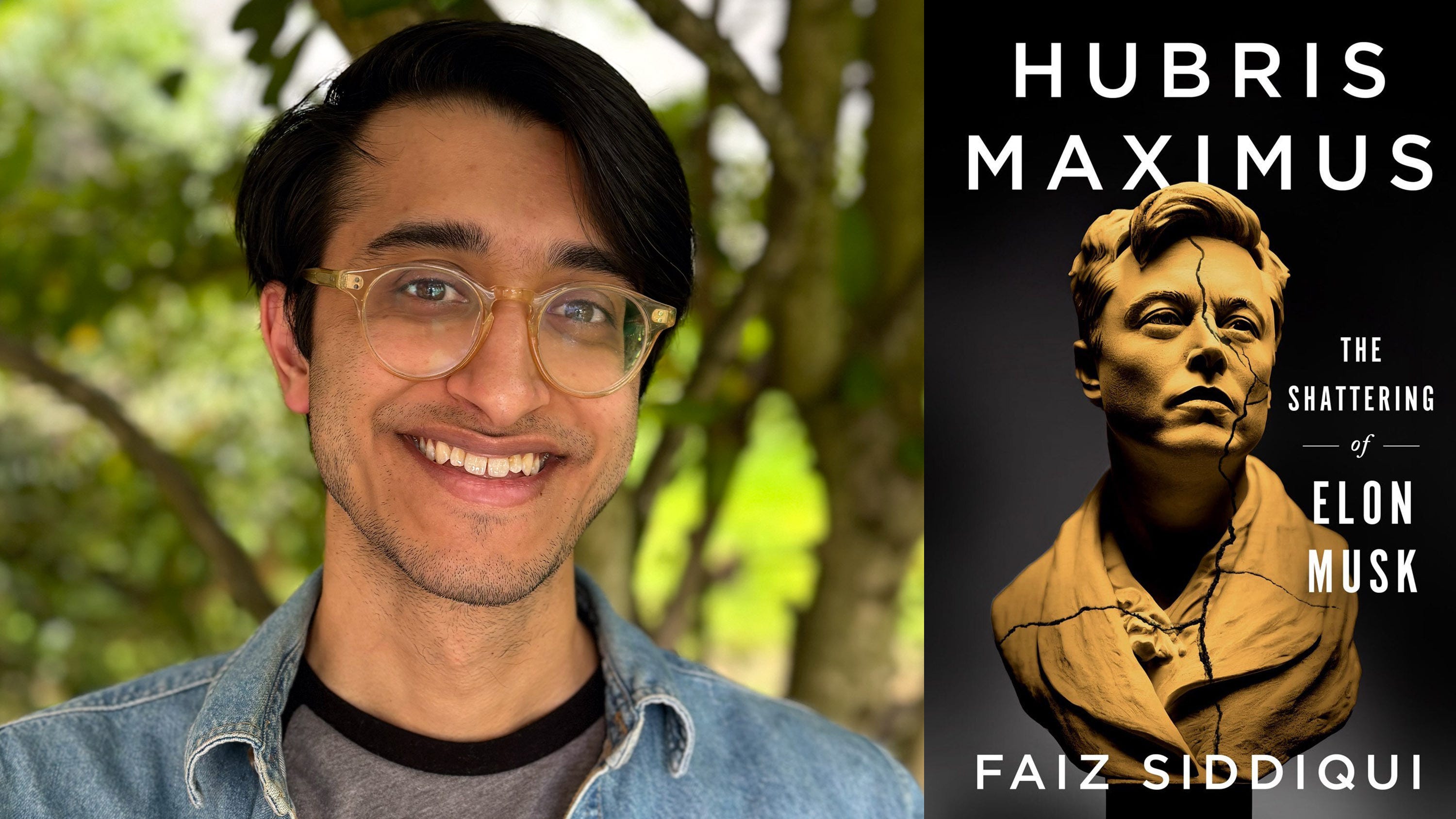
Faiz Siddiqui remembers being “fascinated by power” when he was a teen. He devoured all the big biographies about “often shady, contemptible characters” operating on the “edges of legal, moral, and ethical responsibility,” like Chicago Mayor Richard Daly and New York’s city planner Robert Moses. Now he’s written one of those biographies himself, demythologizing a man who’d rather remain a Randian hero, revered as a “genius,” the “technoking,” and — as Siddiqui’s reporting reveals — the “reincarnation” of Alexander the Great.
“I found that society was wrapped up in the myth of Elon more so than the reality,” Siddiqui says. “I just wanted to tell the story of the reality, which includes the reality faced by those who worked for him, those who bought his products, and those who are otherwise impacted by his actions.”
“Hubris Maximus: The Shattering of Elon Musk” is a gripping reconstruction of the events that led to Musk becoming not only the world’s wealthiest man, but the “first buddy” of President Donald Trump. Along the way, the reader meets those Musk left in the wake of his ambition: families who lost loved ones in Tesla crashes, workers made to toil in his factories during a global pandemic, and once-devoted loyalists whose encounters with the billionaire upended their lives.
Taken together, their experiences lend a sense of foreboding to Siddiqui’s book, which was reported before Musk ascended to the helm of DOGE, a historic and arguably authoritarian project to dismantle the United States government as we know it. From this position of power, every American was pulled into Musk’s orbit and at the mercy of his whims, fancies, and hissy fits.
In this edition of Depth Perception, we speak with Siddiqui, a tech reporter at The Washington Post, about the myths manufactured about Musk, those salutes he made on Inauguration Day, and which journalists actually deserve to be hailed as heroes. This interview has been edited and condensed for clarity. —Christopher Mathias
Part of that prevailing narrative about Musk was this idea of him as a “genius.” How did reporting and researching this book maybe complicate your notion of “genius” itself?
I'm naturally skeptical as a reporter… What I found reporting the book, and also in discussing the book, is that there is a huge appetite for geniuses in society. People need somebody to look up to or model themselves after. I found that there's just a strong appetite for declaring Elon a genius, and in some ways it potentially undercuts some of his achievements, which were done through either hard work or through innovative management methods — also through the hard work of people working beneath Elon [at] his companies. So I just found that there was no need to attribute any of this to genius, necessarily, so much as examine the business practices that led to some of Elon's achievements.
But Musk certainly embraced that label. And do you think there was a utility for him in doing that?
Absolutely. Just from a pure marketing standpoint. I think even Musk, at times, does recognize the folly of his ways. If you are a full-time genius, it's hard to see how you can err in some of the ways that Elon has, as the book demonstrates. Embracing the title comes with the scrutiny that it demands. We've seen the ways that maybe the idea of Elon as a genius has worked against him, because there's this expectation that you know you can't be flawed, you can do no wrong, and everything you touch turns to gold. The book lays out that that's simply not the case with Elon Musk.
Can you talk a little bit about your personal interactions with Musk?
So I talk in the book about reporting on Musk for The Washington Post, where I'm a tech journalist or a business reporter generally. And I've reached out to Musk many times, and when he’s responded, I've received a version of this very similar refrain, which is: “Give my regards to your puppet master.”
One time he said “For the hundredth time, give my regards to your puppet master.” I found it a little strange, or, like, detached, this idea that a reporter living in San Francisco and eating ramen noodles on that particular night — like I have no interest in being in the middle of a spat between billionaires. And clearly, what Elon is implying is that my work is influenced by the ownership of The Washington Post, and Jeff Bezos is the owner of the Post, and that implication is obviously absurd. Absurd to me, personally. I talk in the book about shouting questions in his direction outside of court, and being shushed by one of his security guards — the takeaway being that it felt like Elon was very insulated from potentially critical questioning.
Long Shadow podcast: Faiz Siddiqui shines a light on the dark side of Elon Musk
The final episode of Long Shadow: Breaking the Internet Faiz Siddiqui illuminates how Elon Musk, enraged by the COVID shutdowns, became radicalized by his own Twitter feed. A habitual user of social media, he becomes convinced that the systemic suppression of speech that he sees on Twitter is inhibiting humanity — and it's crucial that he step in to buy the site in order to save mankind.
It’s a wild finale that explores how a toxic army of trolls goes after women in the gaming industry, giving birth to an online movement of disaffected men. This "manosphere" (and Musk’s support) contributes to the resurgence of Donald Trump and a constitutional crisis that holds American democracy in the balance.
Long Shadow: Breaking the Internet retraces 30 years of web history — a tangle of GIFs, blogs, apps, and hashtags — to answer the bewildering question many ask when they go online today: “How did we get here?” The full season is out now. Listen and subscribe wherever you get your podcasts.
There's an interesting moment in the book when Tesla and Musk get snubbed from a meeting at the White House with Biden, and you pinpoint that as maybe one of the moments that begins his rightward lurch and embrace of the GOP. When you look at Musk's politics now, do you think he has some sincerely held political beliefs? Or is he more drawn to like what's politically expedient and gives him more power? Or maybe that's a distinction without a difference.
Certainly there's an air of opportunism that reflects across his actions over the years. And politically, Musk seemed to be somebody who was uninterested in the day-to-day of politics, other than if it impacted what he wanted to do with Tesla and SpaceX. So there is a sort of consistency in his views, which is that suddenly he finds that the politics of the country are getting in the way of his ambitions.
Could you say that you know his hard line immigration stances are anything but sincere? It doesn't seem to me that they necessarily serve him all the time, right? Like some of the same people who might share those hard line immigration views are also like, “Oh, let's look into Elon's immigration record.” So what I would suggest is that Elon has been invested in politics at times when it could serve him, his empire, his broader ambitions, but he's also been apolitical at times when politics felt like a necessary fact of American life. He has jumped back into the fray here at a time when he feels like maybe his business prospects and his ambitions of taking human beings to Mars are threatened by the state of the country.
There was an interview he gave with Tucker Carlson where I believe Musk said, “I'm fucked” if Harris wins. And so to go back to your Biden example of the Tesla snub, you look at those examples, and sort of ask yourself, “Is this a man with a personal stake in the state of the country right now?” And it becomes pretty clear why he becomes invested.
“I've reached out to Musk many times, and when he’s responded, I've received a version of this very similar refrain, which is: ‘Give my regards to your puppet master.’” — Faiz Siddiqui
I was hoping maybe you could just describe what it was like — after having spent so much time thinking about Musk, researching him — to suddenly see him on stage, on national television, give what many people said looked like a Nazi salute?
I've watched it so many times, and I go back to your genius question. Like, the thought that strikes me is — if somebody is so brilliant and has plotted out so many potential products and outcomes and ideas for humanity in general — if somebody is so clever, how has it not occurred to them not to make that particular hand motion?
What is Musk's calculation here? Is it the troll thing? Like people often ascribe to him,“Oh, he's just a troll. He's out to incite people.” Or is it genuine in some way? Or is he just not as smart as we describe him to be? Of course if it did occur to him, then that feels like a whole other question. Every time I answer this question, I'm like, “I'm sorry that might feel like a cop out,” but a theme throughout the book is this idea of humility versus hubris, so I’ll very humbly say: I don't have the answer for you.
I will say I've observed him on stage at so many of these events. I've watched the videos and he can be an awkward presenter. He can gesticulate wildly. So there are two possibilities, and neither of them are particularly good.
I thought it was really touching and interesting that you dedicated the book to journalists, and especially those in Gaza, risking their lives during, as you put it, “a singularly deadly, deadly time to be a reporter.” Can you talk a little bit about why you felt compelled to make that dedication?
I think sometimes, especially during the past few presidential administrations, there is this tendency to describe the work of journalists in these grand terms about being on the front lines, and ascribing heroism to work that I fundamentally believe is a trade. It's a service that we provide to people, but it is the expectation of our profession. And I do think any journalist working under the threat of prosecution or the threat of retribution in any kind of way, is doing really critical and important work.
But I firmly believe that it’s an entirely different calculation from the one faced by those who are in the midst of just utter destruction, and who are under threat to their lives every single day, and who seemingly are targeted for the very work that they do. It’s a very different calculus. There's so much said about the media and the sort of right-wing attacks on the media, but they are nothing compared to what the journalists are going through in Gaza.

Let’s change gears and dig into a collection of recurring queries we ask a lot. First: What is a widely accepted journalistic rule or norm that you hate?
I don't like courtesy titles. [Laughs]
Go on!
Sorry, New York Times, is anyone else using them? I don't find that they level the playing field. I find that they actually create distance between the average reader and what they're reading, and that really grates on me.
Another example of that is million-dollar words. I like for what we write to be accessible. I want anyone to be able to, for example— in my book, I'm not sure I do a great job of this — I want anyone to be able to pick it up and say, “Yeah, I read and understood every word of that.”
What makes you hopeful for the future of journalism?
I do think that — again going back to accessibility — the profession has never been more accessible. Maybe this is short sighted and wrong of me, but it really doesn't upset me when people pick up a microphone and start recording and proclaim themselves to be journalists.
When I was in [journalism] school there was this idea that papers were dying and thus, journalism was going down with it. No, journalism is more alive than ever. Obviously, it's going to be delivered to people in a lot more and different venues, and I think as we get to this environment of over-saturation, I would hope that people become more discerning or more educated in what constitutes good journalism or good reporting. But on the whole, I'm glad to see people embracing the craft.
Further reading from Faiz Siddiqui
“Tesla earnings show ongoing fallout from Musk’s broken alliance with Trump” (The Washington Post, July 23, 2025)
“Elon Musk had the government in his grasp. Then it unraveled.” (The Washington Post, April 24, 2025)
“Inside Elon Musk’s Grievance-Fueled MAGA-morphosis: ‘“What the F--k Is Wrong With Your Boss?’” (Vanity Fair, April 21, 2025)
“What’s next for Elon Musk?” (The Prospect Podcast, July 2, 2025)
“Musk’s fury over a Tesla investigation foreshadowed his war on Washington.” (The Washington Post, April 17, 2025)
 | A guest post by
|