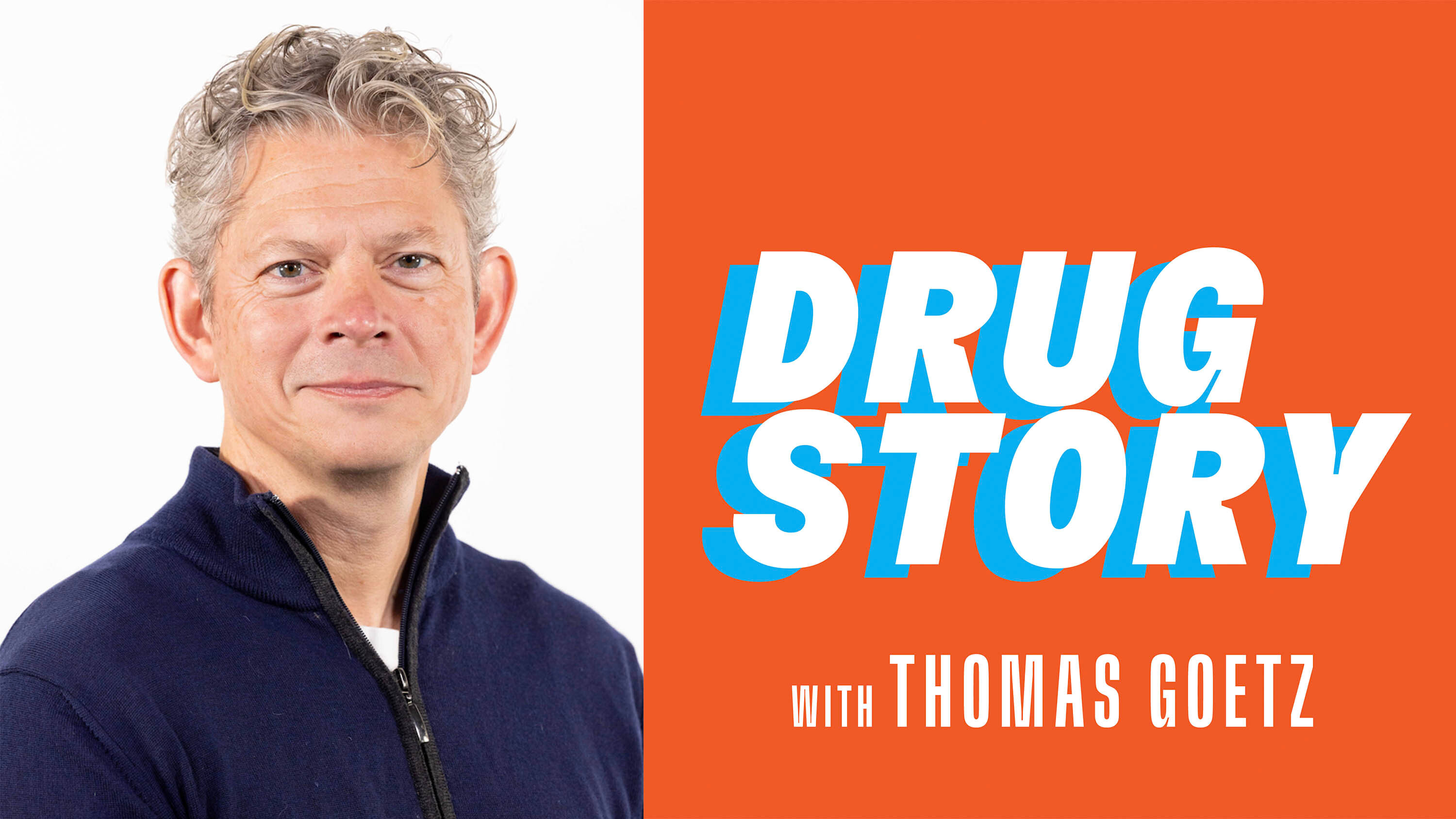
Thomas Goetz rarely makes things easy for himself. Nobody would have quibbled had Goetz continued on with his career as a (mostly) general interest magazine editor and writer known for driving innovation and, at Wired, winning a slew of National Magazine Awards for the results.
But Goetz felt somewhat untethered. “It was evident to me that the journalists who had sustained careers had some level of expertise [in a specific topic]. I was craving that. I had a Master’s in American literature from UVA, which was not expertise in any way,” says Goetz. “It was a winding road.”
So, while still the executive editor of Wired, Goetz went back to school for a Master’s in Public Health from the University of California, Berkeley. The degree set him on a completely nontraditional career path driven by his love of “learning as I’m making things.”
Learn from top longform journalists and find the best in-depth reporting. Subscribe to Depth Perception:
In recent years, anchored by his focus on health, Goetz has worked as both a journalist and an entrepreneur, co-founding Iodine, a consumer-facing information service about medication, and Building H, a nonprofit research group that looks into the impact of products and services on people’s health. He was also the Robert Wood Johnson Foundation’s first entrepreneur-in-residence. His most recent venture is “Drug Story,” a narrative podcast that covers the world of health one drug at a time.
In this edition of Depth Perception, Goetz talks about his shift to audio, why he chose drugs as his entry point to health stories, and some of the high points from his life in print (and early web) journalism. This interview has been edited and condensed for clarity. —Jenna Schnuer
When you decided it was time to focus your career on a specific beat, why did you choose health? And how did it lead toward a more entrepreneurial life for you?
I come from a medical family. I have a great passion for public health and for understanding the larger social and commercial structures that manifest into our health.
After [I earned my Master’s in Public Health], I was still at Wired but I started to write much more about biotechnologies, public health epidemics, epidemic modeling — stuff that years later turned out to be dead on with COVID epidemiology. Then I wrote a book, The Decision Tree, about the future of data-driven medicine. It became a very persuasive idea to me. Being that I’m in San Francisco, I started thinking about launching a company [in that space].
I left Wired and started a company called Iodine. I had a key partner in my friend Matt Mohebbi, who was a data scientist at Google. We wanted to model and suck up data based on real world experiences. We started with drugs, because there was a lot of search activity on drugs. We created this consumer website that tried to explain the difference between efficacy and effectiveness, which is really the difference between what happens with a medicine in the laboratory versus in the real world. That led me on this 10-year journey of entrepreneurship and innovation, where we created some really neat tools — a lot of data-driven tools — but eventually ended up selling that company to GoodRx. Then I created this data science team inside GoodRx. I was there for seven years, but ultimately I left because I was kind of done with that chapter.
Why did you decide to go back to journalism after Iodine?
I’ve always taken pride in the job of a journalist. I really think the word “journalist” captures most of what I try to do, which is to learn about something and then tell the story about that thing in a way that hopefully helps the audience understand it. [While launching Iodine,] I kept my foot in journalism. I was a columnist at Inc. Magazine, [where I wrote] about the startup life and startup world in Silicon Valley.
Once I left GoodRx, it was really cool for me to think about, “Oh, I can actually go back. I can do something journalistically, but do it in my own way.”
Confronting the cause — and effect — of COVID misinformation
Illustration by Jun Cen
In August 2020, nearly 40,000 demonstrators gathered in Berlin at a rally organized by Querdenken, a fast-growing group leading Germany’s COVID-skeptic movement. Not far from the event, a group of protesters tried to break into Germany’s parliament. Taking place four months before the U.S. Capitol insurrection on January 6, 2021, this incident was eerily prescient — if only Americans had been watching.
The story of that day and its consequences — told through Darren Loucaides’ immersive reporting, hauntingly illustrated by Jun Cen, and presented in a captivating 3-D design — is a true tale of misinformation, its causes and its effects. Read it today at querdenken.longlead.com.
What’s the origin story of “Drug Story”? The sound design and storytelling remind me of Avery Truffleman’s “Articles of Interest,” which is one of my favorite shows.
I basically cooked up this idea to use a drug to tell these larger stories [about health]. Why are there high rates of depression in the United States? Why do we have high rates of anxiety? Why do we have high rates of obesity? These are all what are often called “diseases of civilization.” It seems obvious but, for me, it was an epiphany that we’re not biologically predetermined to die of heart disease. That is the result of the world we built.
My goal was to use the drugs to talk about how we’re treating these much larger problems. I came up with this structure that lets me go a lot of places, but has enough boundaries and framing so that I could take a leap from place to place. “Articles of Interest” and “99% Invisible” are key influences.
When I started Iodine we were building these new kinds of websites. And at Wired, we were intensely creative. We were largely print, but we were creative about how we used two-dimensional space and we won a lot of awards for that. So I was very curious about how I could develop something in the audio space that would be narratively compelling and not just conversational.
I did talk to a lot of people who were way more [experienced] than me in podcasting. A lot of the guidance I got was, “Well, what works is conversational interview podcasts. Probably with video and once-a-week in perpetuity.” I thought about that and I was like, “Well, I’m not going to do that.”
What have you learned about the differences in reporting for audio versus print?
In science and medical journalism, you have to prove your points. I had to learn how to be very selective with the use of data and numbers because it’s very hard to parse numbers aurally.
I’m very fortunate to have an old Wired colleague, Rachel Swaby, who is my producer. She taught me the art of audio. I learned things like using short sentences and [not using] too many numbers. And then, thankfully, [Swaby is] a genius at sound production.
We did things like find audio of old commercials, which, I think, is part of the story of drugs in the United States. We found a lot of ways to use audio in fun ways. That’s what we were trying to do, ultimately, was create a fun hour of audio.
“In science and medical journalism, you have to prove your points. I had to learn how to be very selective with the use of data and numbers [in podcasting] because it’s very hard to parse numbers aurally.” —Thomas Goetz
How are you paying for this independence?
I signed up GoodRx as my sole sponsor for that first season, which helped me cover much of my production costs. They got a very good deal, because the show got like 10 times the audience I was hoping for.
Any other revenue streams? No stickers or other traditional podcast merch?
No stickers. Maybe season two I should do merch.
For the second season, I’m trying to do flat-fee sponsors again. These are companies that get the podcast, want to be part of it, and understand [that the listeners include] a pretty sophisticated audience of doctors and pharmacists and people who really care about medicine and care about their health. That’s a good audience. We get an average of somewhere between 50,000 and 75,000 downloads per episode. It’s very healthy.
How long did it take to finish the first season?
It took me a year to do those 10 episodes, which was longer than I had anticipated. There was a certain element of procrastination involved, because no one knew that I was doing this.
So now that it’s out and people know it exists, I have to be much more efficient with my time, but it is a long process. The last episode [of season one] went out March 31 and I’m aiming to have it start up again in six months, before Thanksgiving.
For season one of Evan Ratliff’s Shell Game, a “podcast about things that are not what they seem,” the veteran journalist created a voice clone of himself and connected it to ChatGPT. Over the course of the audacious and funny six-episode season, which concludes today, we hear AI Evan talk (sometimes convincingly, other times not) to…
The show is often quite a bit of fun but, obviously, there are some really serious parts and episodes that deal with big life challenges. How did you decide on the tone?
Whenever you have the chance — especially when you’re doing something [in the] sciences, [or in] health or medicine, which can be very grave, serious topics — to inject some levity, [you should]. Sound effects are a big part of that. It really does help [lighten] some of these very weighty subjects.
You don’t want to make light of some of these very serious diseases. Starting every episode with a patient’s story really sets the tone for the stakes involved. Even in cases where it’s like testosterone replacement, where the patient is just a guy who had some confidence problems [and] he was struggling with something. I think it’s important to give people a sense of the personal stakes involved but then, like with that episode on testosterone, there’s also this wacky world of Jose Canseco ads [where he’s] pitching herbal supplements.
What are your plans for the future? How long do you think you can keep “Drug Story” going?
In any pharmacy there are about 3,000 drugs behind the pharmacist’s counter. That’s a lot of drugs. Now, not all of those have a scintillating narrative history, but I have a list of another 50 or 60 drugs that have very compelling stories [associated with them]. There’s another five years of good drugs [for shows].
It’s hard to do health reporting these days without venturing into politics. How do you handle that?
I thought I could avoid it. And then the last two episodes, I decided to do episodes about ivermectin and fluoride, which is about how we take certain drugs and measures for granted. But even fluoride is now highly suspected by [Health and Human Services Secretary Robert F. Kennedy Jr.] and others. Anyway, I don’t think you can avoid politics, especially in these days when public health funding and scientific research is [going against] the basic principles of evidence and science. But, ultimately, I believe in science and rationality as a means of validation.
Further reading and listening from Thomas Goetz:
“Drug Story” (“Drug Story” on Substack, launched Jan. 6, 2026)