Elizabeth Flock never set out to write about complicated women beset by near-impossible challenges. But over the course of her career as an Emmy Award-winning journalist and author, that’s exactly the coherent thread that emerged from her coverage.
She has written about a young mother who claimed “stand your ground” after shooting and killing her husband, a 17-year-old who learned to wield a weapon the size of her torso to track down ISIS fighters in Syria, and two environmentalists who put the kibosh on pipeline infrastructure in the name of environmental urgency. These women, among others, and the stories that tumbled out of them, were defined above all by their formidable fight for justice by whatever means necessary.
“In my last book, women were fighting gender-based violence. In my first book, they were fighting for freedom within marriage,” Flock tells me. Her next book project, still in its research phase, is centered on the Polish biologist Simona Kossak and her battle to save one of Europe’s last old-growth forests. At least, that’s what it seems to be on the surface.
Learn from top longform journalists and find the best in-depth reporting. Subscribe to Depth Perception:
But it’s shaping up to be much more than that: Kossak died in 2007 and discovering her legacy has come at a time when Flock herself is navigating new motherhood after giving birth to her son in 2023. The experience sharpened her attention to questions of wisdom, care, and responsibility at the planetary scale, and how they work in concert to broaden the fight for justice.
“It’s weird to be on the trail of someone’s ghost. I just so desperately want to meet her, but I can’t. I just feel like I’m always just out of reach,” she says.
In this edition of Depth Perception, Flock reflects on how motherhood has reframed her understanding of the stories she pursues, and how tracing Kossak’s legacy is an entry point to interrogating what it truly means to nurture life in a world under threat. — Kelly Kimball
Let’s talk about your upcoming book and “The Migrants in the Ancient Forest,” your latest feature in The New Yorker that published earlier this week. They’re both centered on the Białowieża Forest, an ancient woodland along the Poland-Belarus border. What fascinated you about it?
When people write books, they usually have some burning question they’re desperate to answer. With this book project, I was postpartum in a swallowing Chicago winter, freezing, alone, feeling very lonely and desolate about the world. I came across the story of Simona Kossak, a Polish biologist who raised, nurtured, and studied wild animals in the Białowieża Forest.
There were all these photos of her taken by her lover, who was a photographer. Both the photos and the writing about her life immediately fascinated me. At that point, the burning question I had was: What is motherhood, and what is missing from that conversation? As a new mother, so much of what I was seeing online was very domestic — about buying things and presenting a certain way. It didn’t resonate with me at all. I was looking for a different model. Even though Simona wasn’t a biological mother of humans, there was something about her story I held onto immediately. There was something about her model of nurture that blended science and intuition, modern thinking and ancient ways of being. It felt like an answer to something I was missing more broadly, in how we’re living in a time of fear and instability.
So I followed a gut instinct, started researching her, and that became this larger book project.
Does this work also relate to current Poland-Belarus tensions, or is it more retrospective?
It’s mostly the story of Simona, but it’s also the story of this place. When I started reading about how much had happened there, I was shocked. Białowieża isn’t a forest I’d heard of before, but it’s as precious as the Amazon. It’s an ancient, primeval forest — one of the last wild places left in Europe, if not the world.
Despite minimal human intervention, so many things have happened there. The Nazis hunted Jewish people there. The Soviet Union was dissolved there. There have been major logging efforts that students and activists literally chained themselves to machines to stop. And now there’s a refugee crisis unfolding in the forest at the border.
Lifting Ukraine: One woman’s fight for her country’s survival
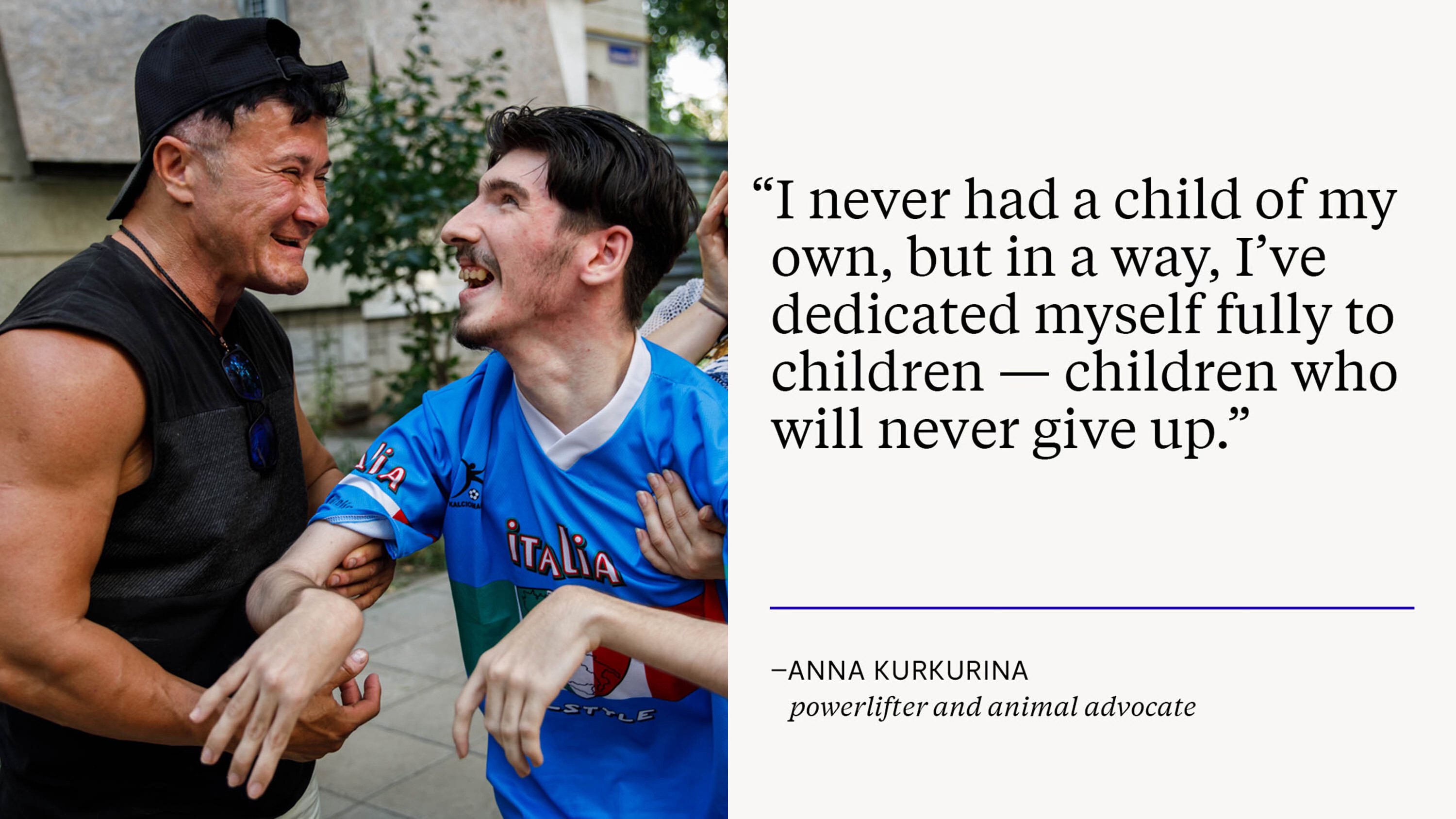
Anna Kurkurina shares a moment with Bogdan Popov, whom she has helped with strength training to counteract his cerebral palsy. Photo by Maranie Staab
February 24 marks the fourth anniversary of Russia’s invasion of Ukraine. Since that day, Ukraine’s “volonteri,” a loose network of civilian helpers central to the country’s fight for freedom, has bolstered its battle-worn government across the country.
In the Webby Award-winning Long Lead photo essay, Lifting Ukraine, photojournalist Maranie Staab presents a striking profile of one volunteer, world-record-setting powerlifter Anna Kurkurina, who has fought the Russian invasion in her own way by keeping her community active and fit, and by rescuing and rehoming animals orphaned by the war. In her country’s fight for independence, Kurkurina has an inspiring mission to ensure that more than just the strong will survive.
This is probably the world’s only artificially created migration route. After a sham election in Belarus in 2020, the EU condemned the president [Alexander Lukashenko], and he retaliated by flooding the EU’s borders with migrants. He recruited people from unstable regions across the Middle East and Africa, literally placing ads saying, “Come to Belarus. We’ll get you safe passage into the EU.”
Thousands came, only to be beaten by both Belarusian and Polish border guards. People arrived from places like Somalia and Afghanistan, paid for a tour package, reached the border, and realized it was nearly impossible to cross. Poland and the EU have responded with a “borders-first” mindset, building a wall similar to the U.S.-Mexico border.
My [recent] New Yorker story looks at how this has evolved over four years. To me, this is huge. Asylum is a precious global institution and it’s being dismantled.
You’ve mentioned before that stories of nurturing and ancient wisdom are missing from the world and that your book hopes to resurrect it. Can you elaborate?
We are all aware that there are things that are not going well within our society, whether it’s teen suicide on the rise, or anxiety rates on the rise, or people’s dissatisfaction with economic instability. I think a lot of these things are linked.
As a person, as a journalist, and as a mom who’s raising a kid, I’m really searching for, “What is it that’s missing?” I’m not saying we should live like hunter-gatherers, but there are things we can learn from that time period. … As an editor, as a journalist, as a reader, you’re often feeling like, “OK, I get it. We have a climate crisis. It’s bad. What can I really do about it? Isn’t it up to other people to do something?” But I think on a deeper, more profound level, there is a disconnection from the natural world that is leading to all of this exploitation.
In the book Braiding Sweetgrass that Robin Wall Kimmerer wrote, she talks about something as simple as planting a garden: When you plant a garden in your backyard, even if you live in a city, you start to feel a connection to your food, and you start to think about where your food comes from. It’s not anything revolutionary, but it honestly starts to feel [that way], because it’s so different to eat something that you grew [yourself], as opposed to going to a grocery store [and buying] something that has probably a bunch of pesticides on it that maybe came from a plane ride away.
And so, to me, everything starts with reconnecting to the natural world and nurturing each other and our children and thinking seven generations ahead, [much like] Indigenous wisdom, which Simona incorporated into her work as well.
“Before [I had my kid], as an investigative journalist, I was chasing the problems … Now, I have made that shift towards solutions and wisdom, taking a step back, looking at the bigger picture.” —Elizabeth Flock
Your experience with motherhood was a guiding force in this book. Can you talk more about that?
The first story I did after giving birth was about women giving birth in Gaza, for Marie Claire. I could have done that story before, but it wouldn’t have had the same resonance. I wouldn’t have been able to ask the same questions. I think there’s so much that, until you have a kid, doesn’t make sense in the world; even really small things suddenly have clicked for me. I think motherhood [forces you] to face your demons, or your shadow work, or whatever it is, and that’s come through in my work as well.
Before [I had my kid], as an investigative journalist, I was chasing the problems: “How can I point them out? How can I shout from the rooftops?” Now, I have made that shift towards solutions and wisdom, taking a step back, looking at the bigger picture.
How does Simona embody this same ethos, even though she wasn’t a mother?
She was a scientist. People compared her to Jane Goodall. She was fiercely protective of the forest, often getting into brutal fights with humans.
At one point, [hunters] were trying to wipe out the deer population [in the Białowieża Forest] because they claimed it was hurting the forest. But really it was because they wanted to hunt them. Simona fiercely fought against that: She painstakingly, meticulously studied what deer eat over 10 years to show that they weren’t actually eating the trees.
Over the course of her life, she learned that fiercely battling against people wasn’t necessarily going to get her what she wanted. She made allies by the end with hunters and foresters — people you would not think she would make friends with. I interviewed some of those guys, and they’re the kind of guys that you wouldn’t expect an environmentalist to be friends with. She wouldn’t even call herself an environmentalist because she didn’t want to be put in that category.
Further reading and listening from Elizabeth Flock:



This was a great read -- am a big admirer of Elizabeth's work.