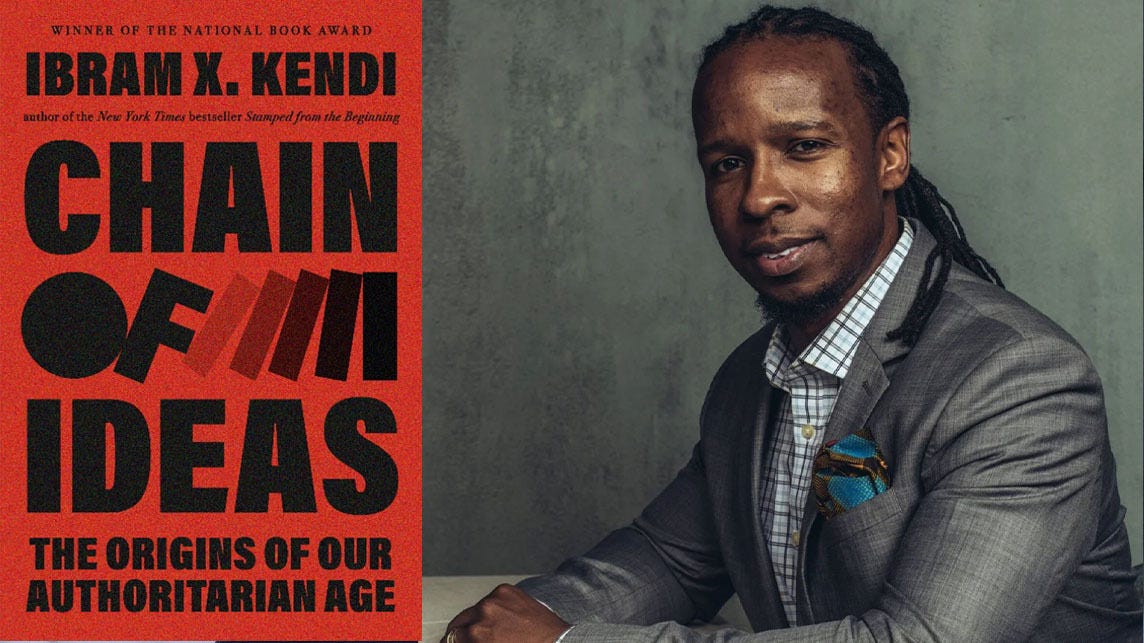
Ibram X. Kendi has chronicled the history of America's racist ideas. Here's why he's still "uncommonly hopeful."
A scholar with journalism roots, Kendi seeks to explain why people worldwide are embracing racist conspiracy theories and authoritarianism in his latest book.
Cover courtesy of One World, photo by Stephen Voss
At 32 years old, Dr. Ibram X. Kendi’s literary influence was solidified when his second nonfiction book, Stamped from the Beginning, burst upon the scene. The 600-page work chronicling the history of racist ideas in America won the National Book Award for Nonfiction and was swiftly named one of the best books of 2016 by The Washington Post. From there, Kendi would go on to author or co-author another 15 titles, including a handful of children’s books designed to help families start the conversation about institutional racism accessibly, cementing himself as one of the most widely read historians of his generation.
Why children’s books? Kendi maintains that so much of the racial violence seen not only in the United States, but abroad is underscored by the insidious grip of racist misinformation. Through this, he turns toward the high-profile mass shootings in recent years that this misinformation has inspired: “in Buffalo, Charleston, Christchurch in New Zealand, Munich, El Paso,” he lists off to me.
“In many cases, the perpetrators … were young, in certain cases just 18 years old, literally fresh from school. When I think about that, I always think about what would have happened to that young person if they had been exposed to a book like How to Raise an Antiracist or something like Stamped. Potentially lives could have been saved,” he says.
Learn from top longform journalists and find the best in-depth reporting. Subscribe to Depth Perception:
Enter his newest book, released March 17. Chain of Ideas: The Origins of Our Authoritarian Age picks up where Stamped left off, looking beyond the stories racism tells and into the deeper, structural roots of racism’s beginnings. In other words, it traces the long historical thread of the so-called Great Replacement Theory from its place in the margins of society to what Kendi calls one of the most dominant political theories of today.
Throughout his body of work, and particularly in his most recent project, Kendi proves time and again that racism is not history we look back upon with wiser eyes, but a force that continues to mutate, alive and deeply ingrained within the most powerful political institutions here in the U.S. and elsewhere.
Wouldn’t it be easy, then, to despair? A half-decade ago, a profile in TheWashington Post described Kendi as “uncommonly hopeful,” a label that raised my eyebrows and, given everything that has unfolded in the years since, begged revisiting. When I asked him for the latest edition of Depth Perception whether that description still fit, he didn’t hesitate. — Kelly Kimball
Some time ago, you had a profile in The Washington Post in which the writer described you as “uncommonly hopeful.” That was around 2019. Now, in 2026, do you still feel uncommonly hopeful?
I feel just as hopeful, but my hope is largely derived from a philosophical belief that we have to be hopeful in order to bring about change. I really admire the people who are able to get up every day and work hard to bring about change they don’t believe is going to happen. I’m not one of those people. I have to actually believe that the impossible is possible in order to fuel myself. That philosophical belief fuels me, and I think it always will, no matter the current state of society.
You rightly describe yourself as a scholar. But early on in your life you studied journalism. What changed along the way? Does journalism undergird some of the ways you think and write about racism?
I decided towards the end of my years in college at FAMU [Florida A&M University] that I … specifically wanted to report on the Black American community. I decided to get my Master’s in African American Studies with the intention of using that degree to be a race and ethnicity reporter. When I arrived in graduate school, I was in a program where I was sitting next to PhD students, and the graduate program was largely geared towards PhD students and students who were interested in becoming academics. So I had the opportunity to really compare the freedom of a scholar versus the freedom of a journalist, and I found that scholars had more freedom to really discern what they wanted to ultimately write about. I think it was that freedom that really drove me to academia.
I think that has helped me when I’m producing scholarship: I know how to write it both for academics and for the general public. Usually academics are not trained in graduate school how to write for the general public, and I felt like I had that training because of my journalism background.
In your new book, Chain of Ideas, you follow the historical thread of the Great Replacement Theory. Why were you drawn to this specific theory? And do you see it as a natural continuation of your previous work or a departure?
I see it as a continuation … of Stamped from the Beginning, which was a history of racist ideas that ends largely in 2008. Chain of Ideas begins its narrative in 2008. What drew me to this book was really curiosity and a desire to understand what was causing more and more people to empower elected officials who were undermining their own livelihoods. It wasn’t enough to simply answer that by saying “racist ideas” — I needed to ask what specific racist ideas were operating in this moment. The more I explored that question, the more I arrived at Great Replacement Theory, and once I arrived there, the research took me around the world.
The Webby Awards: Long Lead needs you!
Every year, the Webby Awards are important message internet users get to send about what matters to them online. And over the past four years, Long Lead has been honored with seven Webby Awards. This year the stakes are especially high, and we need your help, again. We need your votes!
The Age of Incarceration, our portrait and interview feature with some of the last survivors of the U.S. Japanese detention camps, was nominated for “Best Individual Editorial Feature,” a prize Long Lead has won the past three years. That alone is an incredible honor, but winning four straight would cement our small studio as a force in the journalism industry. Please vote for The Age of Incarceration in the Webby Awards here.
Lastly, Twins Fest, the documentary short film that accompanies our photo feature Double Meaning, has been named an Webby Awards Honoree for “Best Documentary Storytelling.” It’s a wonderful piece and the perfect palette cleanser for the current news cycle. You can watch Twins Fest inside Double Meaning or at Long Lead’s YouTube page — but please vote first!
You talk about how this theory is both a political and cultural phenomenon — present in policy, but also in mainstream media. Can you tell us more about what you mean and the specific racist ideas you were able to trace in this book?
Let me first say there are four major protagonists in Chain of Ideas. What I mean by “protagonist” is the individuals who have largely powered the movement that has spread Great Replacement Theory. Great Replacement Theory is this political theory that suggests powerful elites are enabling peoples of color to displace the lives and livelihoods of white people. When we hear phrases like, “immigrants are invading the nation,” that’s an example of Great Replacement Theory. When we hear notions like the white race, with their low birth rates, are dying out, that’s an example. When we hear terms like “Clash of Civilizations” between Christianity and Islam, that’s an example. Two of the major progenitors of Great Replacement Theory have been politicians and theorists — people who can be journalists, writers, or academics — non-elected officials with seismic platforms they use to spread these ideas.
You mentioned that coming from journalism helped you write for everyday people, not just academics. I’m curious why you have adopted so much of your work for children and families. Can you talk more about why that was a big motivation for you?
Writing Chain of Ideas reinforced a decision I made some time ago to also develop anti-racist literature and books on Black history for young people. …because they’re consuming these ideas just as adults are. And as adults, we know how hard it is to unlearn these ideas. It’s actually easier to learn anti-racist ideas than it is to unlearn racist ones. That’s why I’ve become so committed to creating literature for young people.
This idea of Great Replacement Theory, as you’ve rightly noted, is global. I’m wondering if, through your research, there is a meaningful difference between the way it behaves in, say, Europe, and how it behaves in the United States. And since the beginning of Trump’s second term, has it continued to behave differently here versus everywhere else?
It behaves both differently and similarly at the same time. The similarities across nations are that there are three groups: the powerful elites who are apparently facilitating the replacement, the “replacers,” and the group imagined to be replaced. Who those elites are, who those replacers are, and who is being replaced differs across racial, ethnic, and religious contexts. In the United States, the replacers could be immigrants of color, Black people, or Muslims. In Hungary, they could be Muslims, the Roma, or Eastern Europeans. In India, the population imagined to be replaced is the majority Hindu ethnic group, while the Muslim minority are cast as the replacers. That flexibility is what has allowed this theory to spread globally: It can be applied to virtually any national context, because every nation typically has a group in a position of privilege or majority, and all you have to do is argue that group is being replaced.
I think the way it may be different in the United States is that there isn’t one dominant group of replacers. In almost every other country, there’s a primary group imagined to be replacing the so-called privileged group. In the United States, depending on the political moment, it could be African Americans, immigrants from Latin America, immigrants from Asia, Native people, or Muslims. And it has mutated further in the U.S. context: The replacers could also be queer people, trans people, or women. In many ways, the U.S. becomes a melting pot for the many different forms Great Replacement Theory has taken around the world.
How did we get here?
The Ruby Ridge raid, the Waco siege at the Branch Davidian compound, the Oklahoma City bombing, the January 6 insurrection… all explosive moments in recent U.S. history. But connect the dots between these — and other — seemingly disparate, violent events, and you’ll answer some of the most existential questions facing the U.S. today: How did America get the far right so wrong? What will it take now to get it right?
The second season of Long Shadow, the limited series podcast produced by Long Lead and hosted by Garrett Graff, explores how the modern domestic extremist movement grew from a fatal shootout on a mountain top in Idaho and led to a riot on the steps of the U.S. Capitol in Washington, D.C. Crackling with rich archival sound and riveting interviews, this seven-episode limited series examines a thread of history that’s vitally relevant to our current political climate. Listen to Long Shadow wherever you get your podcasts.
You’ve said before that your education in journalism has allowed you to make your work as a scholar more accessible to the masses. Did journalism help you with your latest book, too?
Chain of Ideas would not have been possible without the work of journalists, particularly investigative journalists around the world. To give one example, each section of the book is set in a different country and organized around a particular scene. The scene I chose for Germany — one of the more pivotal countries in the book, because one of the things I show is that Great Replacement Theory is in many ways a neo-Nazi idea — was based on an investigative report by an outlet called Correctiv. They essentially attended a secret meeting in Germany that included major figures from the Great Replacement party, the AfD, in which those gathered discussed what they called “remigration” — what in the U.S.context is called mass deportation. They met to discuss a plan to mass deport immigrants of color, as well as any German they deemed had not successfully assimilated. The story was broken by Correctiv and became a huge story in Germany. It led to debates in Parliament and demonstrations around the country because people were outraged that these individuals were gathering secretly to plan the removal of a large segment of the population.
I’m mentioning this because I would not have been able to write that section without investigative journalism, and that section is critical, because as we’re seeing in the U.S. context, “remigration” is now being considered a solution to the Great Replacement. In this moment, the work of scholars and investigative journalists becomes that much more important in ensuring that democracy can still stand.