


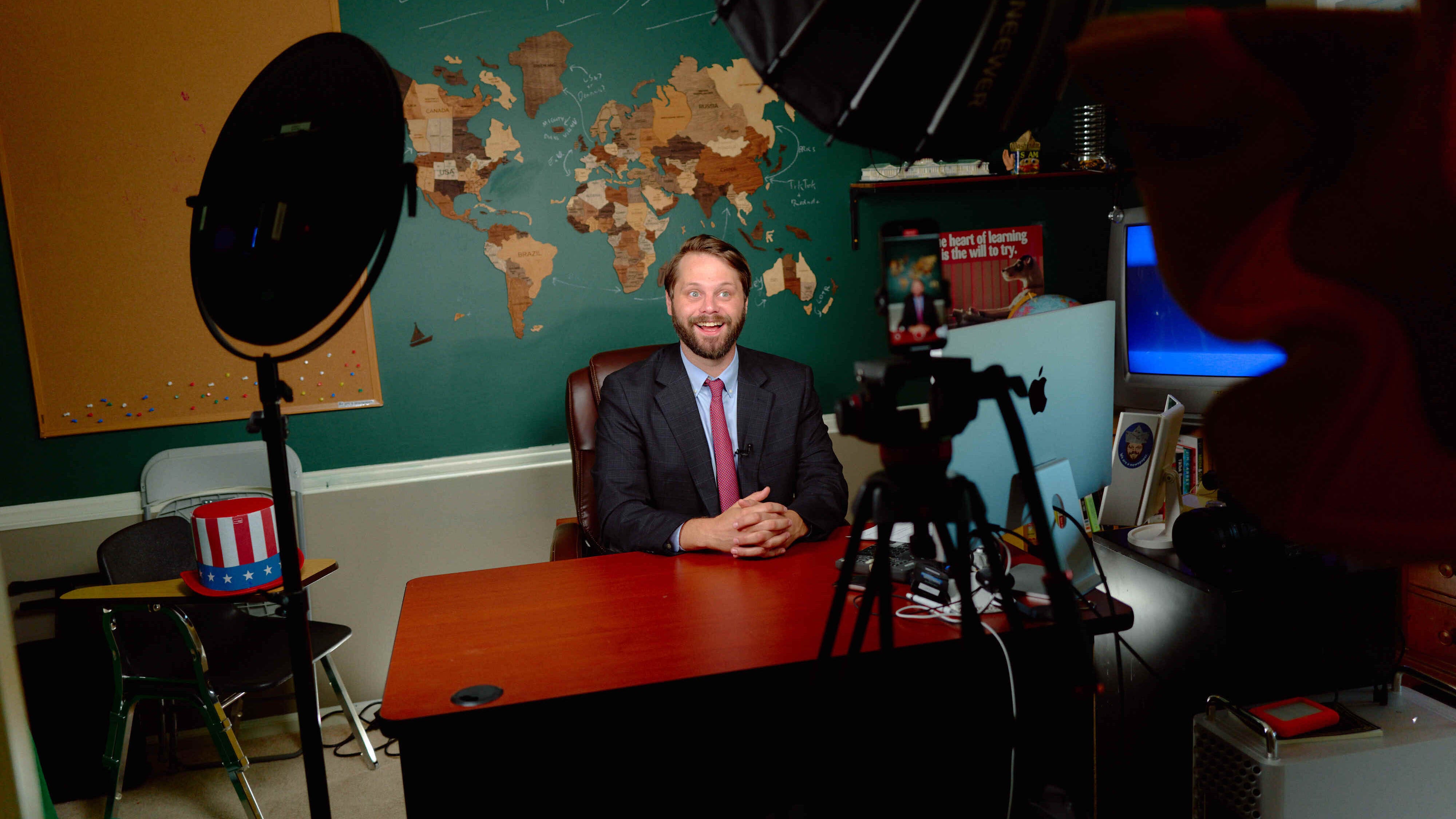
When Dave Jorgenson launched The Washington Post’s TikTok account in 2019, the platform was still widely dismissed as a place for teenagers to lip-sync and dance. Six years later, after amassing nearly 2 million followers and racking up over 1 billion views, Jorgenson did something that would have seemed unthinkable to an earlier generation of journalists: He walked away from one of the most prestigious newspapers in the country to start his own thing.
That “thing” is Local News International, a social-first media company Jorgenson co-founded this past summer with two of his former colleagues — Micah Gelman, The Post‘s former director of video, and Lauren Saks, who edited and approved Jorgenson’s TikToks. Their pitch is straightforward: build a modern version of what “The Daily Show” was in the mid-2000s, but for the YouTube Shorts and TikTok generation.
It’s a bold bet that personal brand and authentic voice can compete with institutional authority, especially at a moment when traditional news outlets are hemorrhaging both audiences and credibility. Jorgenson’s approach — using humor and accessible explanations to cut through the noise of breaking news — has already proven it can work at scale. The question now is whether it can work without The Washington Post‘s name attached.
From his home base in Kansas City, Missouri (after years of filming in a one-bedroom apartment in Washington, D.C.), Jorgenson spoke with Depth Perception about his new venture and how he is testing whether the industry’s anxiety about letting journalists build their own audiences was justified all along. If he succeeds, Local News International could become a template for how independent media ventures actually work in 2025. —Parker Molloy
Can you tell me a bit about why you became a journalist?
I would argue I kind of fell into it backwards. I basically chose the college I went to because they had this list of internships through this group called Media Fellows. And that list was “The Colbert Report” and “The Daily Show” and shows I really wanted to work on because I wanted to be a writer. I wanted to be a TV writer. So I was like, “I’m going to apply to this so I can get into this program and hopefully get an internship.” And all that actually happened, which is crazy in hindsight. I mean, I ended up getting an internship at “The Colbert Report” through this program.
But that was during the 2012 election year, and I found myself very infatuated or excited about the applications of journalism, even at “The Colbert Report,” and how you could use humor and comedy, which makes sense given what I do today. And because I joined this Media Fellows program, as part of the requirement I had to participate in the newspaper and radio journalism and everything. So I ended up graduating college with not literally a degree in journalism, but a really good understanding of journalism. And then everything just kind of led to another world. I kept ending up at places that covered the news and/or were The Washington Post. So it was kind of a happy accident, but it was something that happened over time as I grew to love the world of journalism.
Before Local News International, you were The Washington Post TikTok guy. Was that a role you pitched? Did it find you? How did that come about?
I think the most important part of that — because [The Post] was really big on Twitter initially. So everyone on Twitter kind of knew about how it was growing, especially in 2019. And then the rest of the world, as the pandemic happened, got on TikTok and it became even bigger. But it wasn’t as if The Post hired me to do that. I was already at The Washington Post and I’d been there for two years starting in 2017. And I was making a YouTube channel that was getting no views. I was doing all these videos that were taking weeks to post that got 900 views or something.
And so when I read about TikTok — I think it was a Taylor Lorenz article for The Atlantic or something in 2018 — I was like, this is interesting. So I downloaded the app and then just convinced them to let me make TikToks. In fact, one of my co-founders, Micah — he was the head of video — said I could do it. And then my other co-founder, Lauren, was my editor who approved every single video from the get-go.
So “the TikTok guy” thing just happened as TikTok launched and was successful. But I do think that if it weren’t successful from the jump, none of this would have happened, at least in the same way. Because the success, especially on Twitter and in the D.C. high school that it is, sort of catapulted it. And I think as other people and other publications talked about it, it made it more palatable to the people inside The Post that we were doing this TikTok thing.
Long Lead, short videos. Follow us on TikTok and YouTube:
@long_leadThe internet, mankind’s greatest invention, promised to unite people across the globe. This is the story of how — driven by profits and power — it tore the world apart instead. Long Lead's Edward R. Murrow award-winning podcast LONG SHADOW is back for a fourth season: BREAKING THE INTERNET answering the question, “How did we get here?” The first episode is out now and episode two drops next week. Find it where you get your podcasts. #podcast #longshadow #internet #socialmedia #worldnews #internetculture #historypodcastTiktok failed to load.
Enable 3rd party cookies or use another browserLong Lead is much more than longform journalism — follow us on TikTok, YouTube, and Instagram to catch our rich, visual features in motion. Including second-looks, alternate takes, and behind the scenes footage, our videos are a great way to get more informed on our award-winning features.
You were creating content on a platform that’s fundamentally about entertainment and virality for an institution built on serious journalism. How did you navigate that tension?
I hope this doesn’t seem like a cop-out answer, but, to me, the tension made it good. I liked that. I liked going up to the line as much as I could. And that is what made it good and fun for me and also for the audience from the “I can’t believe they let him do that” kind of thing. So I thought the tension actually helped.
I also was mostly shielded from anything. Most of the negative feedback I found out way after the fact. Even now, I’m just starting to hear about people who weren’t into it. But I was just so happy on my own making it. And again, it was the success. You couldn’t argue against the numbers, which wasn’t what I was necessarily consciously thinking about when it was coming out. But it makes sense that if there was any tension, it didn’t really matter.
And the other thing that’s really important — and this is something I learned from “The Colbert Report” — is the more buy-in you can get from up top, the more everyone else gets into it. So I put Marty Baron in a TikTok very early on and his participation made it very easy for me to go, “Hey, David Fahrenthold, you want to be in this TikTok? Hey, Carlos Lozada.” And, “Well, Marty did it last week.” So that helped to ease it a little bit.
So then you left one of the most prestigious newspapers in the country to start Local News International. What was the calculus there and what could you do with LNI that you couldn’t do at The Post?
It had been really percolating for a long time. Not as a result of going back to the office necessarily, but around that time is when I started thinking, “I could do this on my own.” Because it went from, The Post was helping me [and] I was getting attention because I work for The Washington Post. And I felt like it started to go the other way around where it was like, “I think The Post needs me more than I need The Post.”
And there is nothing necessarily wrong with that relationship. It was just that with a combination of, “I think I want to do more here that I no longer can do. It was basically just a hamster wheel at that point of, “Let’s keep putting out content that we know is working.” But what else, what other goals can we achieve? And I think I basically achieved all those goals.
They allowed me to launch my own YouTube channel at the beginning of the year. And I was working on that on the side while working on The Post stuff. I got to a point where I’d rather just work on my channel. And then with everything else happening both internally and externally, including that they offered everyone on video a buyout, I was like, “Great, this is my time to exit. I’m happy to do it and I’ll do it as gracefully as I can.” But I’m ready to go.
Can you tell me a little bit about what Local News International is? What do you do?
For people who aren’t familiar, the big clear offering right now is daily short-form videos. We took everything from TikTok and YouTube Shorts and Reels where we post as well. Those are through all of my personal channels that are sometimes called Local News International, sometimes called just @DaveJorgenson.
The main concept or the main argument for what we’re doing is that a lot of it is around misinformation and what people are getting wrong in the news. So I don’t necessarily make videos about breaking news — today’s a perfect example. [Editor’s note: This interview took place on November 13, 2025.] I’m still kind of waiting out what’s the fallout of the end of the government shutdown and the Epstein emails coming out. I’m definitely going to cover it. But I feel like right now, as you and I are talking, we’re sort of seeing how Republicans and Democrats are reacting. So I’d much rather wait a day to then recap it basically versus ongoing coverage because everyone’s doing that anyway.
So a lot of it is kind of correcting the record after the fact, but also a bit more of an explainer for people that feel like they’re out of the loop. And obviously there’s a comedic lens to it, which borderlines on commentary sometimes. But I think really the point is I’m just trying to find a funny way into something that might otherwise be either a very depressing topic or, in the case of anything Trump-related, extraordinarily depressing. So I really try to make it palatable. I don’t care if I had the same sort of take as someone else. I just want to make it feel fresh enough that you’re not going to immediately scroll away because you’re like, “Okay, I’m interested in this.” I’m trying to build people’s curiosity.
You’re building LNI with a social-first approach rather than trying to replicate the traditional newspaper model. What does that mean practically and how do you guard against the critique that social-first journalism optimizes engagement over importance?
I don’t want to sound like I’m just being like, “Well, it’s both.” But it is — it’s engagement and it’s important. And I think there’s also something about the way that people take in content. I don’t believe that younger people have shorter attention spans compared to older people. I think we all are getting shorter attention spans maybe, but it’s not a generational thing necessarily. I think overall what’s happening is that people are just getting their media in different ways. Maybe young people aren’t watching cable, but they are watching three-hour podcasts, right? Or listening to them.
And so that’s more of our approach. We are going to have a podcast as well as a newsletter that we’ve been doing. And the newsletter actually dives deeper into those stories. So there’s five short videos a week. And then every Thursday or Friday, depending on if you’re a paid subscriber, my colleague Chris Vasquez, writes a recap newsletter that dives deeper into all the subjects.
So for me, it’s really about get[ting] people to know about these stories, because I think a lot of our audience is — well, I know — it’s very young people. And on YouTube, it’s almost entirely men. And so in one way, we’re sort of this antidote to the Joe Rogan and Andrew Tate world. We’re kind of like this life raft of, “Here’s what’s going on over here in a more reasonable way, a rational way.” And then once we have them hooked there, we can be like, “Here’s a newsletter that gives you more information.” And then, hopefully at the beginning of next year, when we have a podcast out, there’s also a longer form that gets them in the weeds on this stuff in a way that’s not just about social-first and a quick 60-second grab and nothing else.
“We’re sort of this antidote to the Joe Rogan and Andrew Tate world. We’re kind of like this life raft of, ‘Here’s what’s going on over here in a more reasonable way, a rational way.’” — Dave Jorgenson
What’s the best journalistic career advice you’ve ever received?
I don’t know if I ever got this explicitly, but I saw it in their actions. I think the best journalists are generous journalists. And that can mean a lot of different things. That can just mean that they’ll find the time to talk to you if you need advice on something, but also they’re generous in their time and help with projects.
If I’m being a generous video journalist, for example, I will help a colleague out on a shoot where it might just be I’m helping them make sure the lighting’s good or helping the set or helping call ahead to make sure that we have the space that we need. Because in video journalism especially, there’s so many things that can happen at once, and if someone’s a head of a project and it’s not my project, but I can help out, I will. And I do think that paid off huge for me when TikTok launched — being generous — because all those people then gave back to me in different ways and helped the TikTok channel launch.
And the more current example of that is when I went independent, or was thinking about it, I reached out to all kinds of people like Cleo Abram, who gave me way too much of her time to talk about it. And Kara Swisher was extraordinarily generous in advice. So people I never would have thought would even want to talk to me, to be honest, just spent a lot of time giving me advice that was obviously very useful, but also just felt very thoughtful, like they really kind of cared about what was going on. That’s really nice to have.
What makes you hopeful about the future of journalism? Because it’s easy right now to feel kind of doom and gloom about things.
Right. Well, actually right there is something interesting because that sucks. I don’t want to sugarcoat that. But part of the Local News International concept is that every video — yesterday’s video, for example, I think I used six different sources. And I’m more of an explainer around video journalism. And at The Post, I could only really take sources from The Post. Most of the time that was fine, but sometimes I was like, “I really would like to pull from somewhere else when I’m talking about the story.” And so now I can do it from everywhere and all kinds of small, hyperlocal papers in some instances.
And so that gives me hope that journalism is still very effective worldwide. And hopefully I can use my sort of small social media perch over here to project some of what’s happening. And it’s that collaborative thing. Whether or not I’m working with them directly or not, we’re all kind of creating and explaining what’s happening in the world together. Journalism is still very powerful in that sense. So I’m hopeful in that way.
Obviously, there’s a lot of money flowing in different directions that can be a little bit scary in terms of journalism. But I feel like the other aspect, thinking of audience, my audience makes me feel more hope than any aspect of it. Just to get on my soapbox for just one second: When the Charlie Kirk killing, shooting, happened, I wrote in my newsletter about how there’s a lot of talk around young men and how unwell they are, which I think there’s a lot of evidence for. But I wrote in the newsletter, “I know a lot of you based off the stats that I get from YouTube and otherwise are young men. And my experience with the comment section is that you’re all very thoughtful people, at least the ones that comment. And that is something that I want to hear from you. Tell me how you’re doing.”
And I got hundreds of emails from people — from young men — and some of them were not doing well and they were very honest about it. And other ones were saying, “I’m not well, but I’m working on it or I’m seeing a therapist.” But there were a lot of different, more thoughtful comments and replies than I expected, even knowing the audience. And so that gave me hope, even as I felt sad for these people who are growing up in a world that was just very overwhelming and overstimulating. So the hope I get mostly is in the audience. And that’s really nice.
Further viewing from Dave Jorgenson:
“Good news about climate change and the solutions that are working” (YouTube, Nov. 12, 2025)
“Does the debt ceiling matter?” (YouTube, Feb. 4, 2025)
“Here’s what happens if TikTok is really banned.” (TikTok, Jan. 10, 2025)
“Washington state banned sales of assault weapons, including the AR-15.” (TikTok, Apr. 26, 2023)
“The same but different.” (TikTok, Jan. 4, 2021)