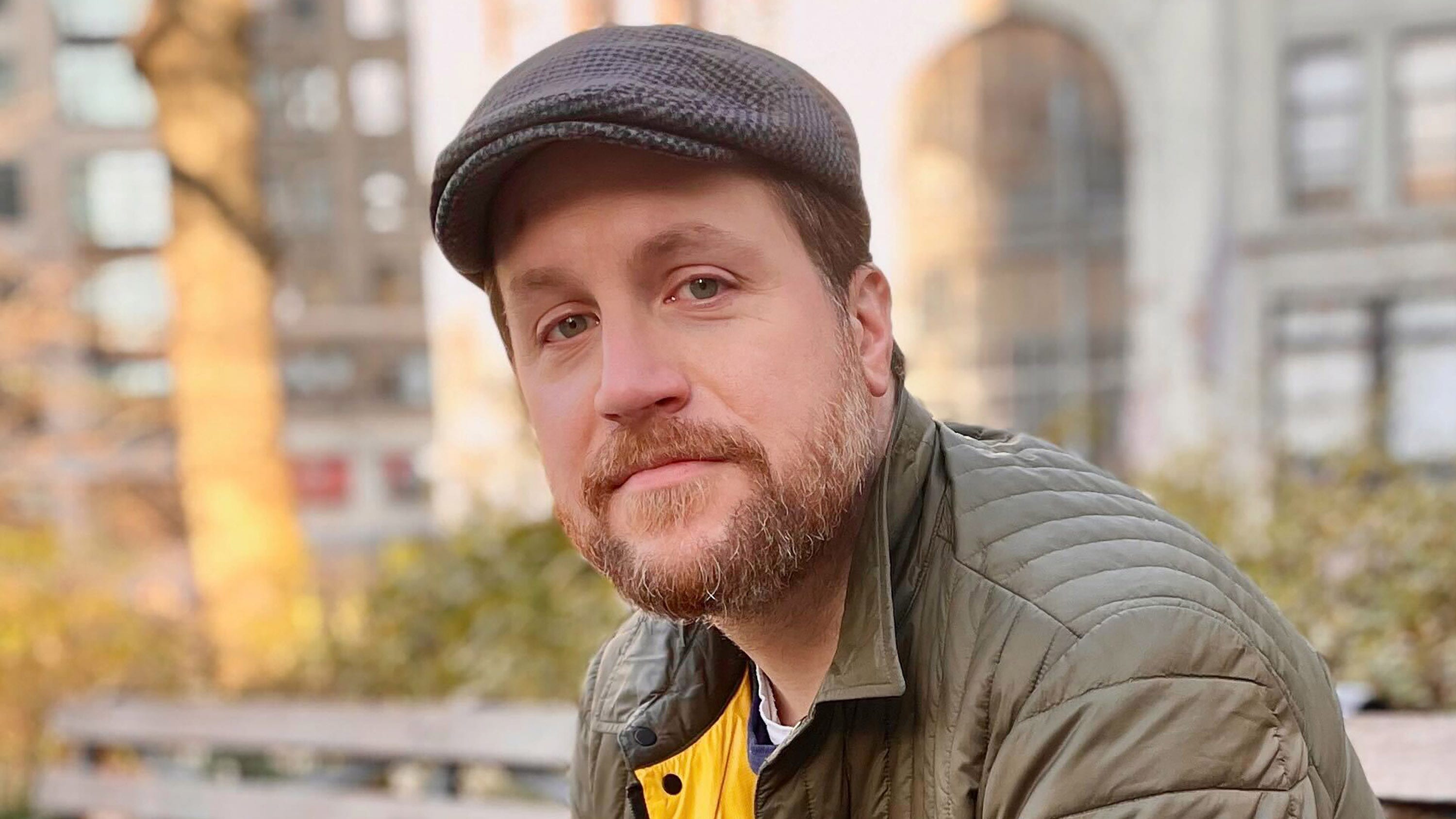
When documentary podcaster, writer, director, and producer Dan Taberski released Missing Richard Simmons in 2017, he broke open a new understanding of what great narrative podcasting could be. The show, which looked into the ‘80s fitness instructor Richard Simmons’ sudden retirement from public life, became a cultural lightning rod that spawned intense debates over celebrity privacy and the ethical limits of investigative reporting.
Despite the controversy (and the fact that I’ve long been podcast-averse), Missing was my first favorite podcast ever, because it wasn’t a show with the cleanest answers; it was a story with fuller, complicated questions.
Eight years later, it and every other podcast — or “audio documentary,” as Taberski likes to call them — that makes up his kaleidoscopic portfolio has demonstrated that great stories need not be driven by forensic fact-finding. “It was an emotional investigation that was the real motor,” Taberski says.
Taberski has since used the audio documentary form to interrogate many cultural phenomenons including: the Y2K conundrum, a Navy SEAL war crimes trial, TV’s longest-running reality show and its impact on law enforcement, the world after Sept. 11, and a mysterious illness that spread through a group of high school girls in Upstate New York in 2011. The latter, Taberski’s latest show, was named the Apple Podcast of the Year in 2024 and won the Ambie Award for Podcast of the Year in 2025.
Learn from top longform journalists and find the best in-depth reporting. Subscribe to Depth Perception:
Like many industries today, podcasting is undergoing a lot of hand wringing. But Taberski has kept working, with his seventh show slated to release next summer. Over his podcasting career, he says he’s become more comfortable with diving into a story before having absolute certainty about how it’s told.
“I think there’s a lot of storytelling that happens now where people are trying to use the story as a way to get listeners to feel something, or to believe something that you believe,” says Taberski. “For me, what makes the best story is actually having a storyteller who’s not sure either.”
In an era when creative industries feel compelled to bend toward predictability, or toward formats that are easy to market, adapt, or monetize, Taberski’s work feels like a reminder of what originally made podcasting exciting: its unruliness, its nuance, and its permission to go deep. In this edition of Depth Perception, he discusses what has stuck over the last eight years of making audio documentaries and why, despite a volatile business landscape, he still has hope for longform audio storytelling. — Kelly Kimball
When you begin a project like Missing Richard Simmons or Hysterical, how much of the narrative arc do you map out ahead of time, and how much emerges once you’re deep into the reporting?
I’m always thinking about [the narrative arc] from the very beginning, but it… evolves constantly. I’m always outlining and always restructuring and moving things around and trying to figure out… how the order with which you reveal information makes you hear things differently.
The planning that I do is more [about] trying to keep track of what I’m doing as I’m doing it. I’m always trying to see the whole project from as wide a view as possible, to get a sense of what it is I’m building, and how the different conversations I’m having are changing that 30,000-foot view.
When I’m having a conversation and somebody disabuses me of a notion that I have about their own story, or points me in a different direction, or surprises me — those are the things that I want to make room for. It always depends on what the people say. I always try to begin with the conversations that we’ve had and use the revelations and the emotional conversation — that’s how I structure the story. I’m backing into those things more often than I am backing into plot points.
“I found that confusion — being perplexed about how to react to a story — that’s the thing that gets me interested, and keeps me interested.” — Dan Taberski
In 2019, Vulturenamed your first podcast one of “the 10 nonfiction podcasts that changed everything.” It said the enduring legacy of Missing Richard Simmons is in the way it highlighted that “podcasting is still largely an undefined medium. Podcasting offers creators of all kinds… the opportunity to play with new, unexpected boundaries.” Do you agree with that assessment? Do you think the podcasting medium is still boundless today?
Absolutely. As an art form? For sure. Whether or not that’s what the market wants right now is probably a different answer. But I’m okay with that. Sometimes what you want to make is not what everybody else wants. That’s why I left television originally, because I just didn’t want to make what the market was wanting to make.
It’s harder to get boxed in a corner in something like podcasting because nobody’s told me the way it needs to be arranged. There’s no format I’m trying to fit into. It doesn’t have to be, like, 30 minutes to fit into a network news thing. It can be scary, but I like it.
Is there anything that you understand now about how to build an audio documentary that you didn’t know when you made your first show? Have you become a different kind of storyteller along the way?
I’m working on my seventh [podcast] right now, and it’s completely changed in terms of what I thought was possible.
I definitely learned that it’s less about the facts than I would have thought originally. What I learned [about] making Missing Richard Simmons is that… it was an emotional investigation that was the real motor for it. Now I approach every project with… a main factual question, and then an emotional question that I’m trying to answer.
With Hysterical, what happened to the 19 girls in Le Roy, New York, and what were they sick with, and how did they find out, and what are the facts of that story? That’s [all] really important. It moves [the story] along. But the more important investigative question was: What do you do when people tell you it’s all in your head? The “what did it feel like” questions end up having more to…investigate in terms of why we do things the way we do, and how we react to things. That’s the stuff I find appealing and the most meaty to explore, and I think the most satisfying to listen to.
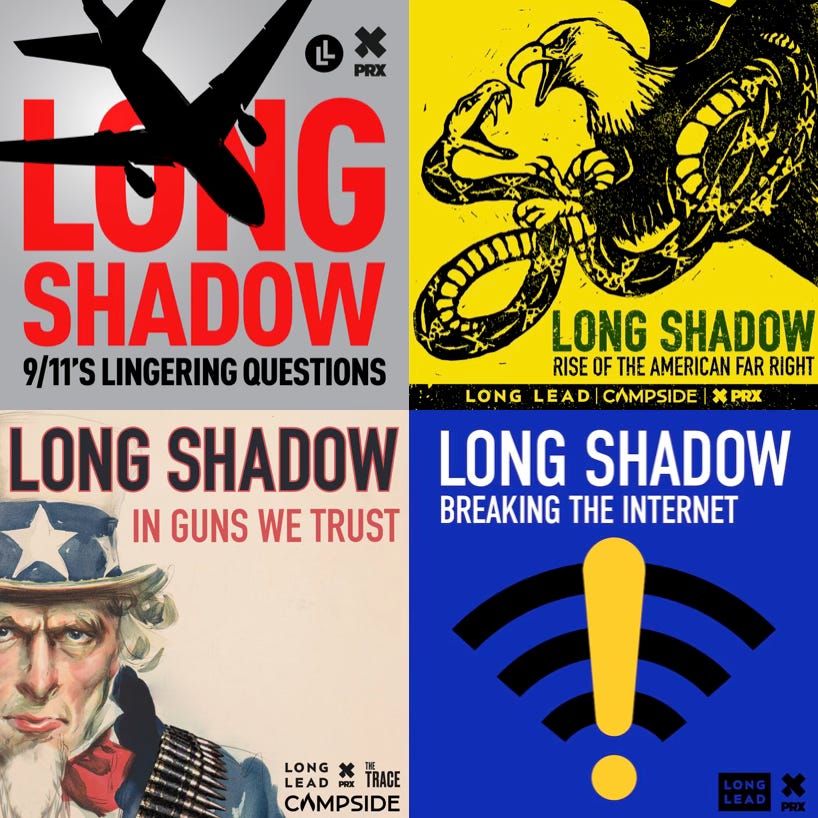
Long Shadow: “Rigorous, authoritative, and an electrifying listen.”
“How did we get here?” Through a series of riveting, complex narratives, Long Lead’s podcast Long Shadow makes sense of what people know — and what they thought they knew — about the most pivotal moments in U.S. history, including Waco, Columbine, Y2K, 9/11, COVID-19, January 6, and beyond.
Hosted by Pulitzer finalist, historian, author, and journalist Garrett Graff, this Peabody-nominated podcast has been called “rigorous, authoritative, and an electrifying listen” by the Financial Times and honored as one of the year’s best podcasts by The Atlantic, Audible, Mashable, Rolling Stone, and The Week. A winner of the Edward R. Murrow Award and the RFK Human Rights Journalism Award, it has also been honored with eight Signal Awards, including for Best History, Best Documentary, Best Technology, and Best Activism, Public Service, & Social Impact Podcast.
The second season of Long Shadow has been added to the history program at the University of Houston and the third season has been integrated into Harvard Law School’s curriculum on the Second Amendment.
How do you know when you’ve stumbled upon your next project? What elements need to be in place for you to dive right in?
I need to be confused by it. It needs to be a story that I don’t know how I feel about, or it needs to be a story that I am conflicted about how I feel about it.
I did a podcast on the war crimes trial of a Navy SEAL, and I really couldn’t decide how I felt about it as I went in. And I think most people wouldn’t approach it that way. I think there’s a lot of storytelling that happens now where people are trying to use the story as a way to get listeners to feel something or to believe something that you believe, and by the end of the story they’ll believe it too. I don’t necessarily know that that’s what makes for the best story. For me, what makes the best story is actually having a storyteller who’s not sure either, and… you can listen to the process of [that storyteller] trying to figure it out.
It can’t be [faked]. It has to be really something that you’re confused about. It was like that for me with the war crime story. It’s like, yes, I get that crossing the line in war is wrong, morally wrong. But also, what do you do when you’re a soldier in a place that’s halfway around the world, and the military is setting up all these ways for you to break the rules, and yet people back home don’t want you to break the rules? Like, who’s responsible here? I found that confusion — being perplexed about how to react to a story — that’s the thing that gets me interested, and keeps me interested.
You mentioned earlier that you left the TV industry [where you were once a producer on “The Daily Show”] because the market was saying one thing but your curiosities were saying another. Then you jumped into audio storytelling. Can you speak to how you toe the line of what you want to pursue, what the podcasting world wants, and what you ultimately end up doing?
The business side is really complicated. And the rate of change is so fucking fast. Thirty years ago, there were no such thing as podcasts, and now I’m making them. I think trying to chase the business side, for me, is a fool’s errand. I just try to focus on what I want to do, what I can do, and what I’m not done with yet.
For a while the industry was saying everything needs to be [intellectual property]. But I don’t think the way to make good IP is to focus on making good IP. I think the way to make good IP is to focus on making the best fucking story that you can make that’s incredibly compelling and demands that people listen to it, and is entertaining and fun and meaningful. And then it’s not my job to figure out how that becomes IP. That’s somebody else’s job. And I think that’s what makes the best IP — the most original, compelling thing you can make.
Are there any questions that I’m not asking, or anything else you want to mention?
I’m optimistic. I’m optimistic because there’s always stuff to make. People need a way of understanding what’s going on around them. I feel like the types of things that I make, the types of longer-form things, they’ll continue to be there. You just have to not be shaken when they start calling it something different, or there’s a different monetization model, or… you know what I mean? You just gotta focus on making.