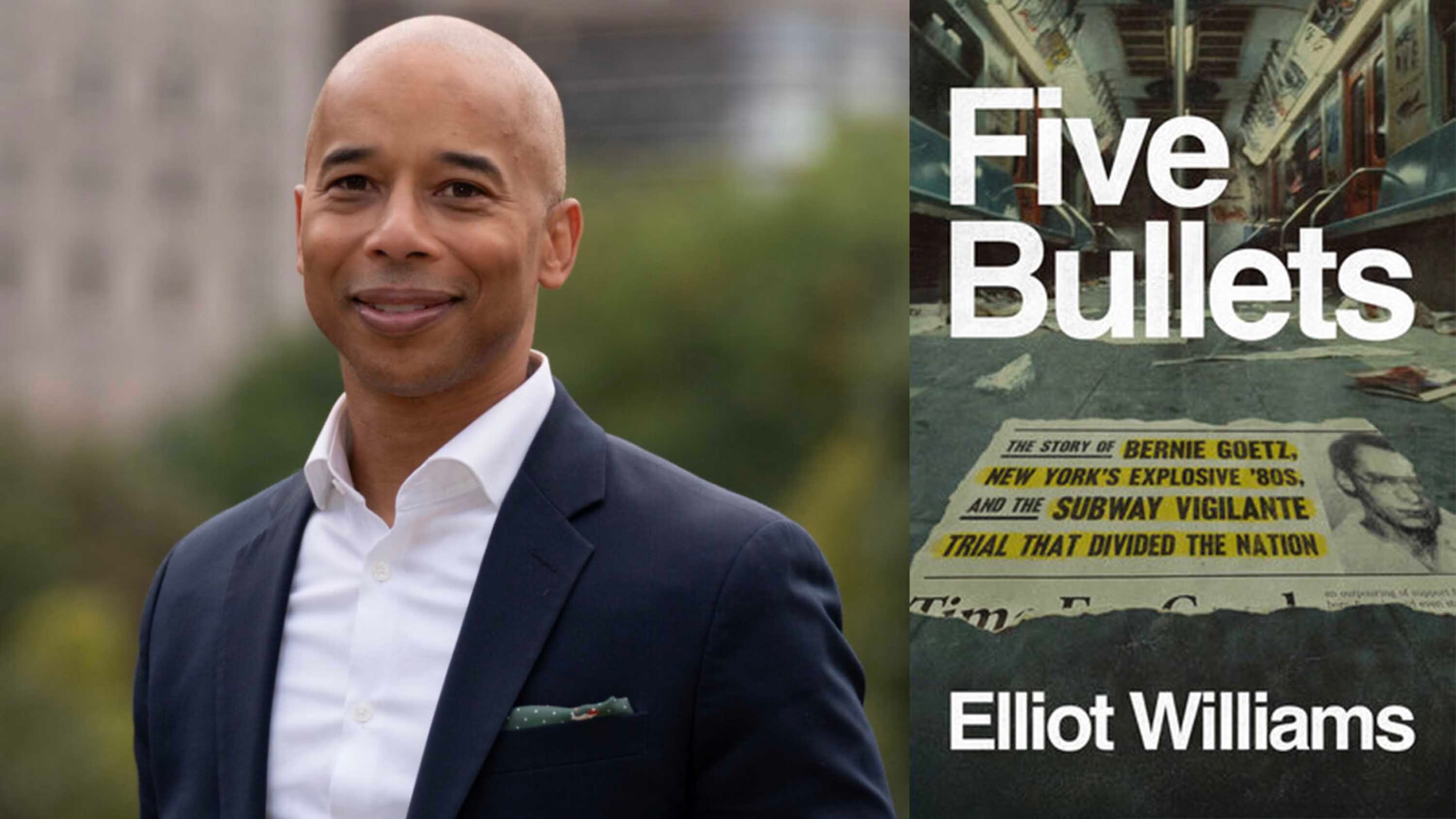
In reexamining “subway vigilante” Bernie Goetz, Elliot Williams shows how the tabloid playbook works, even today
The first book by the CNN legal analyst and former federal prosecutor explores the 1984 shooting that split New York — and turned fear into a winning financial strategy for the media.
Photo by Photo Kyo Morishima; book cover courtesy Penguin Press
I asked Elliot Williams what surprised him most about interviewing Bernhard Goetz, the man who shot four Black teenagers on a New York City subway in 1984 and became, depending on who you asked, either a folk hero or a symbol of racist violence. Williams told me he expected at least some self-reflection. Even if Goetz still believed the shootings were justified, Williams figured there’d be a “comma, however” in there somewhere — an acknowledgment that one of the victims, Darrell Cabey, ended up brain-damaged and paralyzed. Something. Instead, Goetz told Williams he believed the men needed to be shot. That it was, essentially, a public service.
Williams is a CNN legal analyst, a former federal prosecutor who spent nearly eight years as a senior official in the Obama administration, and a Brooklyn-born son of Jamaican immigrants. He’s also a first-time author whose book, Five Bullets: The Story of Bernie Goetz, New York’s Explosive ‘80s, and the Subway Vigilante Trial That Divided the Nation, was named a Most Anticipated Book of 2026 by both the New York Times and the Washington Post. It traces the Goetz case from the tabloid-fueled panic of 1980s New York through the criminal trial and into its long afterlife, drawing a line to Kyle Rittenhouse and Daniel Penny along the way. But the book is as much about the media ecosystem that turned Goetz into “the Subway Vigilante” as it is about the shooting itself. Williams dedicates an entire chapter to Rupert Murdoch’s takeover of the New York Post and the arms race of sensational crime coverage that followed. It’s a story about fear, but also about the people who figured out how to sell it.
In this edition of Depth Perception, we speak with Williams about the case, the book, what it was like to get Goetz on the phone, and why America keeps making heroes out of men with guns. This interview has been edited for length and clarity. —Parker Molloy
Learn from top longform journalists and find the best in-depth reporting. Subscribe to Depth Perception:
You’ve got an interesting career path. A law degree, a Master’s of Journalism from Columbia, a federal prosecutor, a senior official in the Department of Justice during the Obama administration, and now a legal analyst on CNN. How do you think about the relationship between these many careers, law, and journalism? Do they pull in the same sort of direction?
I would say oddly enough, law and journalism are all about distilling information and presenting it in a clear way. Now, of course, any lawyer or journalist has to tailor their approach to their audience. Communication isn’t one-size-fits-all. But I actually do think there’s a tremendous amount of overlap between the two. I don’t think it’s a surprise that there are a lot of journalists with law degrees or former journalists that go on to law school. And so the more I’ve combined it all through the years, the more I have found that at their core, both require distillation of information and presenting it in a clear and ideally unbiased manner to whoever the audience might be.
For people who weren’t alive in 1984, or who don’t know the case, can you walk us through what actually happened on the subway car and why it became the story that it became?
I’ve found in my informal focus grouping that pretty much anybody born before 1978 knows the story. Many, if not most, New Yorkers have at least heard of it. And then maybe like a third of law students know the story.
But in simplest form, Bernhard Goetz shot and seriously wounded four unarmed Black teenagers on the New York subway. He ultimately ended up getting acquitted of all violent crime charges and just convicted of a gun possession offense.
But the big thing in the case is that he really became almost a cause célèbre for public safety in New York. The city was very rough at the time with homicide and violent crime rates through the roof. It was fiscally mismanaged. It was broke and seeking bailouts from the federal government. It was just a rough time in New York City history. And many people saw Bernhard Goetz as a kind of avenging hero in the mold of the 1970s vigilante films like “Death Wish.” So he really became the face of a fed-up public, not universally, of course. And there was an unmistakable racial backdrop to the case wherein certainly civil rights leaders and many in the public recognized that if this were a Black man shooting white kids, the story would be totally different and the public reaction would have been totally different.
A lot of how this was framed had to do with the New York Post. They’re the ones who branded him as “The Subway Vigilante” and kind of kept the story alive. How much of what the public understood about the case was really a media construction?
To some extent, it was a media construction. I don’t entirely blame the New York Post for it. However, the New York Post played, let’s say, an invaluable role in shaping all coverage of crime and safety in New York at the time, [and] certainly around this case.
At the time that Rupert Murdoch purchased the Post, it actually had been a somewhat left-leaning publication. And he helped lead the Post into a more tabloid-style sense of sensation. It was under his leadership that Page Six, the gossip column, ultimately got added to the paper.
A lot of that extended to public safety and how the public felt. There were a lot of stories about crime and safety and “city under siege” and so on. Now, I say it wasn’t just the New York Post because the other tabloids also came along with the Post. And so as the Post got more salacious and focused on safety and crime and being under siege, the Daily News and Newsday and others did as well. And it ended up being a winning financial strategy for the papers. They reminded the public how scared the public was. The public then felt more scared, [and] turned to newspapers … just like today with the internet — people are motivated to seek out information that agitates them. And so it is impossible to decouple the media influence on this story from how the public saw Bernhard Goetz.
A nation of laws or a nation of guns?
America’s gun violence crisis isn’t a cultural inevitability — it’s the result of decades of legal and legislative choices. The Long Lead podcast Long Shadow: In Guns We Trust traces how lobbying power, court rulings, and strategic political maneuvering reshaped the Second Amendment into something far broader than its original intent, creating a framework in which meaningful regulation is nearly impossible.
Hosted by Pulitzer finalist and investigative reporter Garrett M. Graff and reported in collaboration with The Trace, the podcast explores the story of the people — some names you’ll know (like Goetz), some you won’t — who changed the way America relates to guns, for better or worse. By unpacking how lawmakers and judges expanded individual gun rights while weakening public-safety measures, the series reframes the debate: America doesn’t just have a gun problem; it also has a legal system that’s been engineered to protect guns over people.
Listen to the Peabody-nominated, RFK Human Rights Award-winner Long Shadow: In Guns We Trust wherever you get your podcasts.
If you take that to today, there’s a line between Goetz and Kyle Rittenhouse and Daniel Penny. What has changed when it comes to how these stories get out there and shape public opinion? With social media and the internet, it feels like there’s an opportunity to have a far larger impact than a newspaper could.
I have a two-part answer to that. I think it is remarkable that the support for Goetz was able to be as turbocharged as it was without social media. It should provide a window into how remarkably the public reacted to this story in an era that did not have 24-hour news cycles or Instagram or TikTok or whatever else. It was simply on the basis of newspapers, the public’s genuine agitation about public safety, and desire to elevate this white man into a hero role that created the myth of Bernhard Goetz.
Today, those kinds of stories are all the more common on account of social media … an entire world of communication exists that prioritizes the most sensational information and targets information to people who want it or are willing to keep viewing it and resharing it.
A point I raise in the book is almost an intellectual question of, what if Kyle Rittenhouse did not have TikTok and Instagram? Certainly he could turn on the news and see images of Kenosha, Wisconsin burning, but there’s [probably] something else about the continued feed of information he was receiving that helped contribute to his crossing over into Kenosha to take the actions he did.
And I think I would go even further and say, “How would the reaction to Luigi Mangione have been different without social media?” Certainly many people, millions of people across America, are dissatisfied with their health coverage. But the outpouring of support that he received, I think, would have been completely [different] — people wouldn’t have written letters to the editor heralding Luigi Mangione. Social media created a snowball effect around him. And so simply the existence of all of those forms of media have made the creation of heroes, for lack of a better term, much easier.
The big thing about your book is that you got Goetz for an interview. He doesn’t talk to many people. What was that like?
Well, he and I had emailed a bit. I told him I wished to speak for a book. I picked up the phone and called him at one point. He answered and he just talked for 45 minutes or so. It was a meandering series of thoughts that came out of him.
More than anything else, I was struck by how unrepentant he was. Even if he felt that his shootings were justified, I would have expected some level of self-reflection or analysis: “I felt scared and I was unsafe, comma, however, what happened was a profound tragedy. And I might have even done it again, however, the fact that there’s someone whose life is now irreparably altered by being brain-damaged and paralyzed from the chest down is a tragedy on a host of human levels.” And there was none of that.
I asked him at one point, “Do you believe you committed a public service with the shooting?” And he felt those guys needed to be shot. That was his view. I’m not saying I was surprised by it given how he has sort of approached all of this in the past. But it was still remarkably jarring to hear that come out of someone’s mouth.
"I don't think it's a surprise that there are a lot of journalists with law degrees or former journalists that go on to law school... both require distillation of information and presenting it in a clear and ideally unbiased manner to whoever the audience might be." —Elliot Williams
There was another book about this that just recently came out. I’ve heard people describe Heather Ann Thompson’s Fear and Fury as almost like an unintentional companion book in that it focused a lot on the teenagers who were shot, while your book includes the Goetz interview. Do you worry that some people might go into it thinking your book is the Goetz side of the story?
No, I think that is entirely a fair question. I will say a few things. One, no one can read my book and think that it legitimizes or platforms Bernhard Goetz, or even makes him at all remotely remarkable. Even where I say that we ought to extend some grace to Bernhard Goetz, there’s been a big “but” and several paragraphs after that [listing] all of the horrible things he said over the years — both to police in New Hampshire, to his neighbors, and then to me — about his unrepentance and bigotry, his use of ethnic slurs, his unlawful firearms possession and purchase, one of which he was ultimately convicted of. And so one cannot read my book and think it is in any way Bernhard Goetz’s side of the story.
To me, it is and was a three-dimensional journalistic look at a very fraught, very complex story, but in no way seeks to elevate someone who broke the law.
Were you aware that Thompson was writing on the same subject? Were you in contact?
No. We [have] communicated since. I found out probably a year into writing the book, and I [didn’t] know what Heather’s timeline was. Of course it’s frustrating as an author to hear initially that another credible, successful author is writing a book on the same subject matter. That said, I think it’s a very fraught, very complex story with many layers to it. And the fact that there are two different but still incredibly rich books on the subject shows that there are other angles to it. Multiple people can find 350 pages of thoughtful, thought-provoking books on the same subject matter. In the end, it’s actually a good thing that there are multiple works on the story.
You’ve written about the legal concept of reasonableness and whether Goetz’s fear was reasonable. As a former prosecutor, how do you think about the fact that reasonable fear so often tracks with racial bias?
I think it’s one of the great fantasies of our criminal justice system that people truly can apply facts to law without fear or favor and in a perfectly neutral manner. Of course they brought their biases into the courtroom. You can’t tell me they did not. The jurors are very defensive over the question of whether they did or didn’t.
But the defense wasn’t shy about stoking the racial biases of the jury by doing things like having big, [blown up] portraits of the four victims. Why [does] the defense [have] these large 24- by 36-[inch] photographs of these victims if not to remind the jury that they’re big, scary Black men? Why did the defense stage a reenactment of the shooting with actors that look nothing like Bernhard Goetz or the conductor, no other passengers in there, except for big, thuggy Black dudes beating up this white man in the court? Why did they do that if not to stoke the racial biases?
So the idea that the jury was somehow able to put this all outside and compartmentalize it in their brains is, I think, ludicrous. Now, in fairness to the jury, they all lived in New York City at the time and were all as scared of the subway as anybody else. And it was just a difficult, tough time. But the idea that they were acting without any sort of consideration, implicitly or in the back of their minds, about race, I think is silly.
What’s the best journalistic career advice you ever received?
From a professor at Columbia Journalism School: “drown your kittens.” Regular journalists call it “kill your darlings,” but “drown your kittens.” At some point, you get emotionally attached to things you create that are not the best work that you can put forward and being able to recognize that [is important]. That can apply to everything from paragraphs that you wrote in a book to social media posts that you think are cool. In a world of data that never gets deleted, sure, you can save it and put it somewhere else and admire it one day, but sometimes you just have to let go.
What story — not necessarily your own — are you proudest of having helped bring to the public’s attention?
There’s an anecdote toward the end of the book of him going on the Opie and Anthony show, this pretty vile shock jock show that got canceled for being so vulgar. And having unearthed that — yes, certainly it’s out there, people know it’s there — but I had not seen it reported or written about anywhere. And it’s a remarkable insight into, one, the future of Bernhard Goetz, who this guy became, and two, almost a meditation on notoriety. This is what happens when someone cannot shake his notorious past. It’s a really fascinating story, and I retell it toward the end of the book.
Right now is a pretty rough time for journalists, for people who do long-form reporting. The Cleveland Plain Dealer is encouraging their writers to not actually write their stories anymore, but to use AI to do the writing part. There’s a lot of reasons to feel scared about the future of journalism. Do you have any reason to feel hopeful?
We eventually probably need to make peace with the fact that local media is dying, and maybe not necessarily will die, but local media is struggling and will struggle. But I still think there are aspects of the journalistic process that just cannot be replaced by [AI] — that cannot replace the art and act of human conduct and human interaction.
Now, maybe one day we reach a point in which bots are so sophisticated that they can replace all of us, but there’s just something about talking to live humans that I think — human touch being one of them, shaking hands — is something bots cannot do, AI cannot do, even at its best.