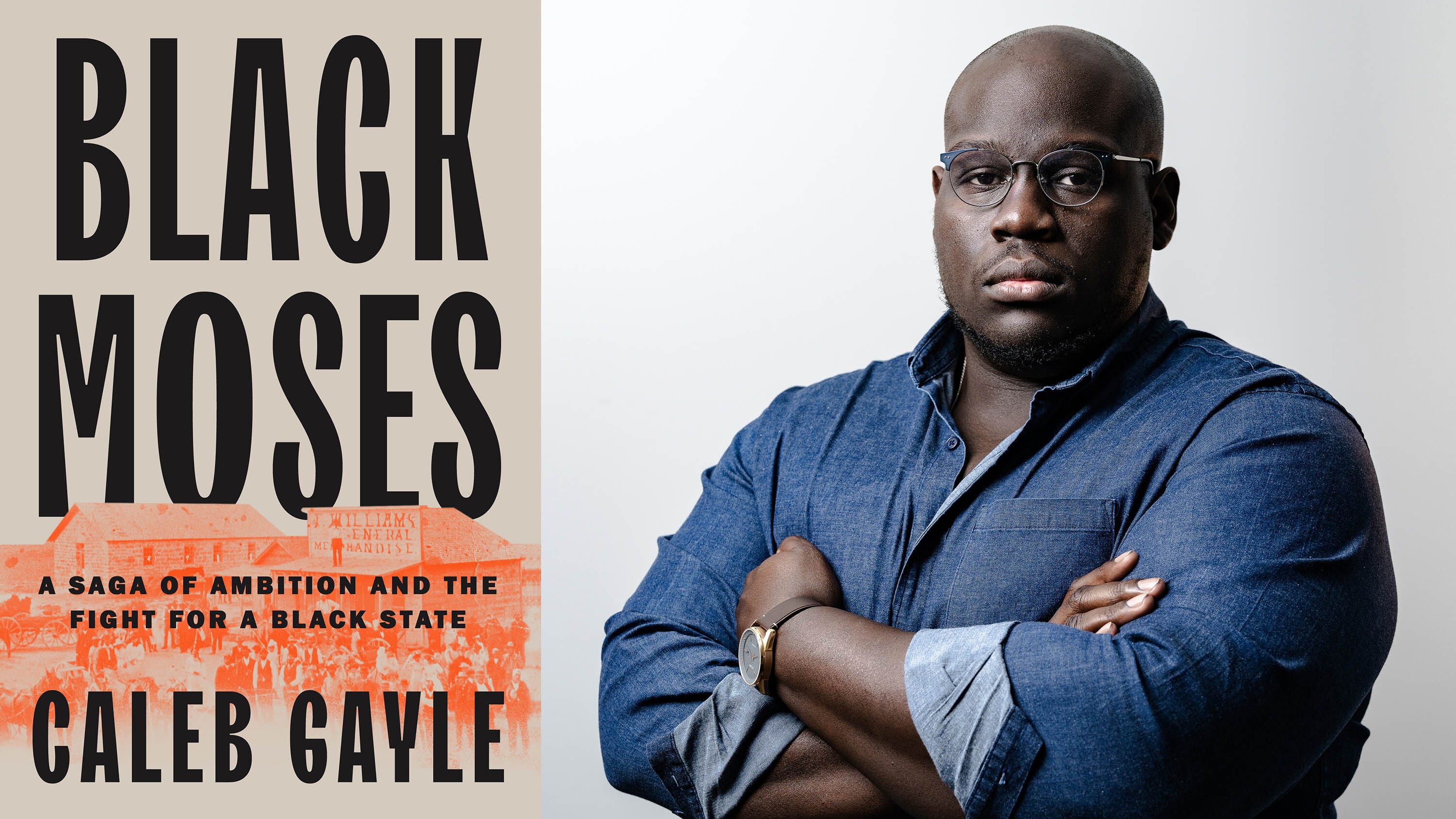
Caleb Gayle isn’t interested in reporting stories featuring straightforward heroes and villains.
Take his first book, We Refuse to Forget. Published in 2023, the Northeastern University professor of Journalism and Africana studies detailed the story of the Creek Nation, a Native American tribe that owned slaves but also recognized some Black people as tribal citizens. That history took another controversial turn in the 1970s when the tribe revoked Black Creeks’ citizenship.
In his new book, Black Moses: A Saga of Ambition and the Fight for a Black State, Gayle continues the exploration of murky histories. He follows Black businessman Edward McCabe’s post-Reconstruction push to turn Oklahoma into a Black-governed state. It’s the journalist’s first major work relying on nothing but the historical record and, he emphasizes, collaboration with historians.
Published in The New York Times Magazine and The Atlantic, Gayle’s longform essays and articles excavate untold stories from the past and present while balancing layers of emotion. His books brim with dramatic tension and the urgency of the ongoing fight for civil rights.
“I've always felt this deep and abiding urgency to tell stories that have pretty much been forgotten or overlooked, in part because I feel as if that overlooking and that forgetting isn't as hapless or passive an experience, but actually is far more intentional,” he says.
Depth Perception spoke with Gayle about reporting history through a journalistic lens, his deep connection to Oklahoma, and the pressure of telling untold stories. —Jenna Schnuer
Subscribe to Depth Perception to learn from top longform journalists and find the best in-depth reporting.
You are trying to make sure that people are not lost to time, whether intentionally or not. What's that pressure like to make sure that these stories are not left behind?
Coming from both the Black experience and the immigrant experience, the feeling and weight of your ancestors is something that's there as kind of a happy burden. I don't feel nearly as much pressure, because I feel [that] if I could tell the story really, really well, if I can help you see [the people I write about] for the fullness of their humanity, then I think that I can rest assured that their stories will do the work for you and do the work for me.
Is Black Moses the first work you've done that is more history than journalism? What do you consider this work?
It's definitely a work of history, but I feel as if journalists share a lot of methods, whether they realize it or not, with anthropologists and historians. I would say more so anthropologists because there are a ton of anthropologists who are examining the lives of people who have expired. But in many cases, part of their job is to sit, not just with that history, but also allow the present day to inform in a balanced way how we ought to read those stories from the past. I think that's where the journalism comes into force pretty heavily.
I hope journalists feel increasingly comfortable examining these stories. Who better to try and capture the public's attention than someone who doesn't necessarily feel as beholden to the sort of work that historians have to do, where they're arguing with the historiographical methods? And where can you literally get straight into the story as a journalist does?
I really hope more journalists fearlessly dig into history and collaborate with historians — that there's greater mind share, skill sharing, content sharing, between those groups who add so much to society’s prospects for learning, especially at a time when a lot of these histories are in a state of peril. I hope more and more journalists feel the [urge to] get into that niche, scratch that itch when they feel it, to collaborate with historians who are oftentimes just so eager to engage artists, to teach journalists how to do some of that archival work.
“I feel as if journalists share a lot of methods, whether they realize it or not, with anthropologists and historians.” — Caleb Gayle
Your books are about very complex characters and situations that are not so cut and dried. I don't think a lot of people know that Native Americans had enslaved Black people. In the new book, the central character is a Black man who wanted to colonize land that Native Americans were living on. Why do those stories intrigue you?
Maybe it's because I am of the age where [on TV], the antihero Tony Soprano was all the rage. Also, I think it's in part because I don't think any of us are perfect and that will help a reader connect with people who are so distant, both in terms of time and geography, making their way in America.
One day I will write a very straight up Superman Clark Kent type story [about a person who] is perfect and pristine. But for now, I have the wherewithal and stamina to persist in getting through or wading through really complex characters and subjects throughout history.
When did you start working on Black Moses? How did you first come across McCabe’s story?
Since 2019. McCabe first came up initially because Langston University [Oklahoma’s only HBCU] has something called the McCabe Honors. I, just curiously, was like, “Who is this?” It was like two sentences on the website [and I thought,] “Yeah, seems like an interesting fellow.”
So then, when I really started to examine more and more, I ended up realizing he actually made a short appearance in my first book, because there are a lot of advertisements from people who are Black people, who are citizens of some of these indigenous nations, who are writing in various magazines and publications about how Oklahoma and the Indian territories were the place for Black people.
"Everything is a big secret." A fact checker's quest to ensure remarkable reporting stands on solid ground
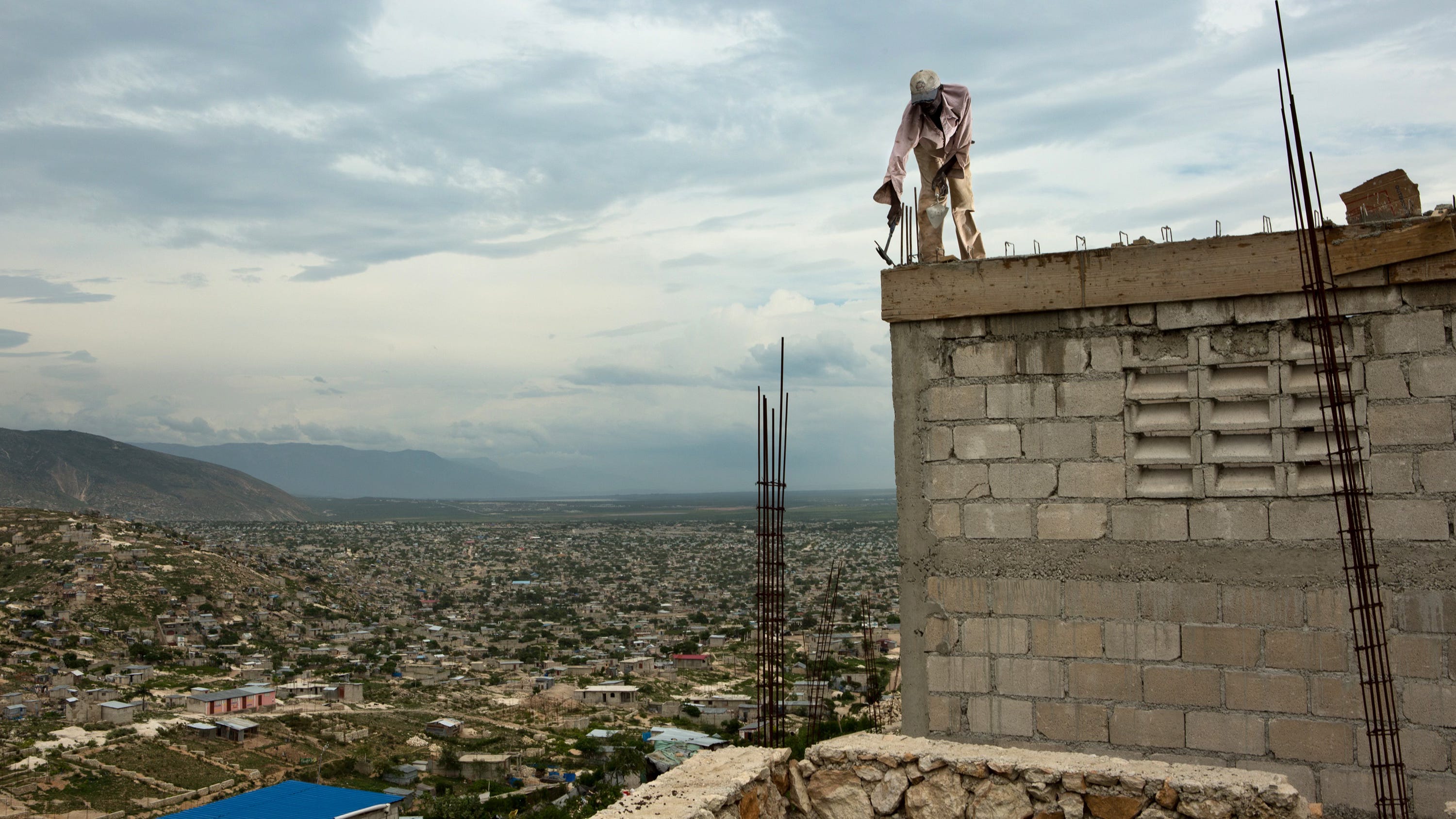
As the Canaan settlement outside Port-au-Prince, Haiti, grows, Jean Robert Destine, 40, adds cement to the wall of a home he is constructing for his nephew, May 6, 2016. Photo by Allison Shelley
In September 2024, Long Lead published Jacob Kushner’s “An Unnatural Disaster,” a feature charting the birth, life, and gradual destruction of Canaan — a city that rose from the rubble of Haiti’s catastrophic 2010 earthquake. Reported across nearly a decade, the Pulitzer Center-supported piece stands as both a testament to Haitians’ remarkable resilience and a sobering examination of how the collapse of state institutions can unravel even the most determined community-building efforts.
Yet behind this sweeping narrative stands the meticulous work of fact-checker Jameson Francisque. A 32-year-old former journalist living in Canada who left Haiti in 2023 amid escalating violence, Francisque brought both journalistic rigor and deep cultural understanding to the task of verifying the story's complex details. His work, while invisible to readers, was essential to maintaining the piece's authority and accuracy — and has been awarded a Sigma Delta Chi Award for Fact Checking by the Society of Professional Journalists. Facts matter. Honor Francisque’s perserverence by reading “An Unnatural Disaster,” today.
When you're working on something, do you share it with anybody else?
I'm in a writing group which includes poets and fiction writers and non-fiction writers and journalists, and so I talked with them about [the book] and they’ve seen a lot of those pages. On top of that, to try and get a sense of, and this is maybe where my business school brain — my MBA brain — kind of poisoned me forever, you want to market test. Who has heard about him? What do they want to know about him? What are the things that they wish that they knew about not just him, but the people that he led?
So in that way, to some extent, it didn't inform necessarily what I included, but it helped me think very carefully about the ways in which I wrote the narrative to ensure that it wasn't solely the academics or the other journalists I'm speaking to, but someone who probably never reads history, or maybe likes reading history and is combing through Amazon or their local indie and trying to figure out which one do I pick up today?
You grew up in Oklahoma. Is that why you return to reporting on it time and again? Do you think Oklahoma will remain the primary landscape in your work?
I think that the throughline of my work probably isn't so much just Oklahoma. It serves as this under-covered and underdeveloped tale of the collision of a lot of people's ambitions. Its topography, its history, almost surfaces as a way of articulating what happens in America with people who aren't usually straight, white, wealthy, landed men. What happens to those folks who want to be more? Who want to find a home somewhere? How much harder is it? What do they have to persist with?
Even in my next book project — which I'm not going to talk about in too much detail — it's in a completely different geography, but it's answering that question over the course of about 400 years. I think that has always been part of the motivation.
Oklahoma is an incredible cipher, if you will, or an incredible example, because for all of its faults, it's been used by various people groups, various iterations of what we consider our American government as a thing that can be created or recreated. And so I think that's what always has intrigued me is that it's a place of boundless ambition. It's not where dreams go to die, it's where they go to collide.
That next book, any hint as to where that geography is? I mean, talking about 400 years, I can guess but…
It will take place over England, the western coast of Africa, the Carolinas, in northern Georgia.
That’s a big, heavy book you're working on there. How deep are you into the reporting on that?
Yeah, I’ve been reporting that one since about 2023, hopefully signing myself up for many, many more years of reporting.