News, as unbelievable as it’s been lately, is moving faster than ever. In early September, the United States military struck a Venezuelan boat suspected of drug trafficking and killed 11 people in Caribbean waters. Months of subsequent leaks revealed dozens of other vessels were also targeted, killing more than 100 other people. In early January, the U.S. special forces snatched Venezuelan President Nicolás Maduro from Caracas and brought him to New York City to face federal narco-terrorism charges. Days later, Minneapolis erupted after a U.S. ICE agent shot and killed 37-year-old mother Renee Good. As if that wasn’t enough, President Trump meanwhile declared his ambition to take over Greenland, posing the biggest threat to NATO in its 76-year history.
This dizzying turn of events unfurled both on video and in print, giving people the ability to weigh the value of one medium versus the other. How did reading about Good’s shooting inform people compared to seeing the many viral videos that captured the moment online? Did the boat strike videos tell the story better, or did the reporting on them? What encapsulates confusion over Greenland more clearly, opinion columns or interviews with Inuit fishermen?
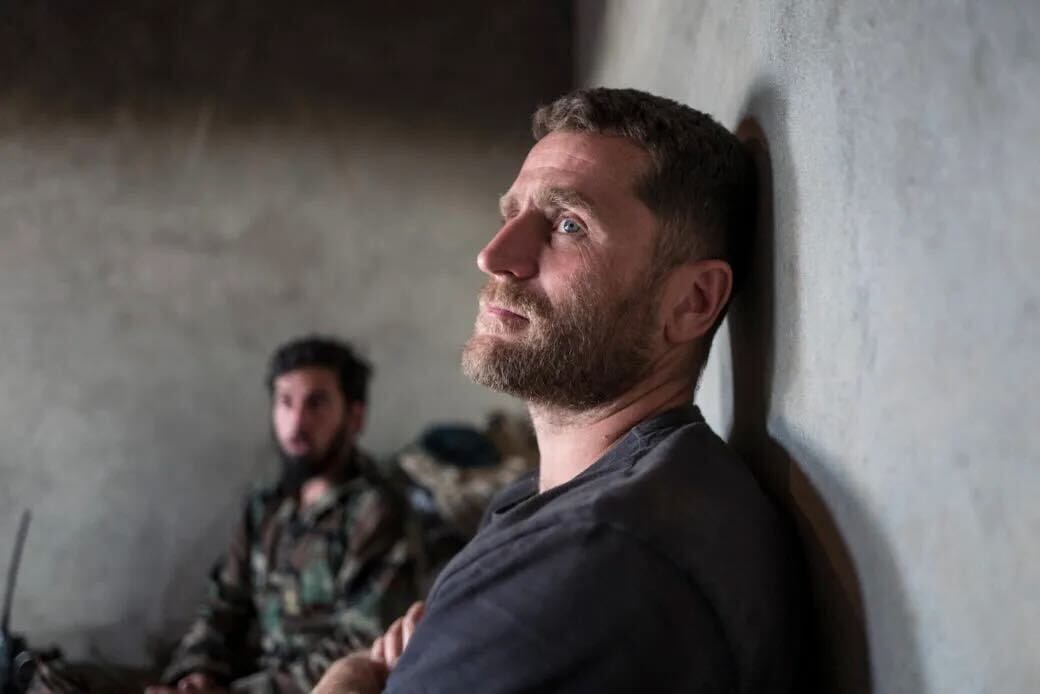
For nearly 25 years, Ben Anderson — journalist, war correspondent, author, television reporter, and documentarian — has risked his life toggling between print and film in his pursuit of truth in some of the world’s most dangerous war zones. While Anderson struggled to break into journalism as a writer, a transition to filmmaking launched his award-winning career. Ironically, his filmmaking success allowed him to return to his first love: conducting journalism in print. With the swirl of baffling geopolitical events over the last few months, Anderson seems uniquely qualified to assess the advantages and dangers of these events mediated by video and text.
Learn from top longform journalists and find the best in-depth reporting. Subscribe to Depth Perception:
In 2003, Anderson created Holidays In the Danger Zone for BBC Four, a television series he hosted that explored six countries referenced in former U.S. President George W. Bush’s notorious “axis of evil” speech: Iran, Iraq, North Korea, Syria, Libya, and Cuba. Anderson continued the series by covering other global conflicts and atrocities, from modern slavery in Dubai to gang wars in El Salvador. In 2007, Anderson released “Taking on the Taliban,” a film based on two months covering Afghanistan’s most violent province, Helmand, with the British Grenadier Guards. Six years later, Anderson was hired by Vice News as an on-air correspondent.
As Anderson’s TV and documentary career flourished, he filed reports for publications like The Times, Esquire, GQ, and the London Review of Books. In 2011, he published “No Worse Enemy: The Inside Story of the Chaotic Struggle for Afghanistan.”
Anderson speaks with Depth Perception about his experiences covering many foreign conflicts in print, TV, and film, as well as the advantages of each medium. —Brin-Jonathan Butler
The first widely reported U.S. military strike on a boat coming from Venezuela took place on Sept. 2, 2025. All 11 people aboard the vessel were killed on the pretext they were “narco-terrorists.” Four months later, Maduro was captured by U.S. forces and transported to New York to face federal charges. How have you interpreted this situation?
The only video of the strike that exists is the U.S. government’s video. So no one can report it effectively unless they get access to the full video. As for the broader Venezuela situation, I remember the first time I went to Venezuela and covered the protests in 2017 for Vice.
You can make all kinds of arguments for or against Maduro. You can make all kinds of arguments about what the U.S. has done in the past to, not just Venezuela, but Latin America as a whole. But it was very clear that the vast majority of people in the streets — in Caracas and elsewhere — hated the regime. They accused them of massive corruption, getting rich through drug trafficking, torture, imprisonment, and the violent crushing of any kind of dissent. It was very clear the vast majority of people felt that way.
It’s very easy for me to say I think U.S. foreign policy towards Latin America has mostly been awful for the last five decades. But it’s also true that Maduro is not a good guy, spectacularly corrupt, and that anyone suspected of dissent could well get nabbed off the streets and be tortured and maybe never seen again. It was very easy to figure out that was the truth after just a few days on the ground there.
Was there a kind of “gateway drug” related to war coverage that suggested it might be a calling for you?
Reading about British support for the Indonesian invasion of East Timor was the first one. As a teenager, I read about Palestine, Congo, Iraq, and other places and just thought, “Why is everyone not talking about this massive international story with tens or hundreds of thousands of people suffering? Why is no one talking about the fact that my government seems to be supporting the wrong side in almost every single case?” It was shocking to me to discover that as a teenager. I couldn’t believe it wasn’t the lead item every night on the news and wasn’t on the front page of every single newspaper.
Long Lead presents: “An Unnatural Disaster”
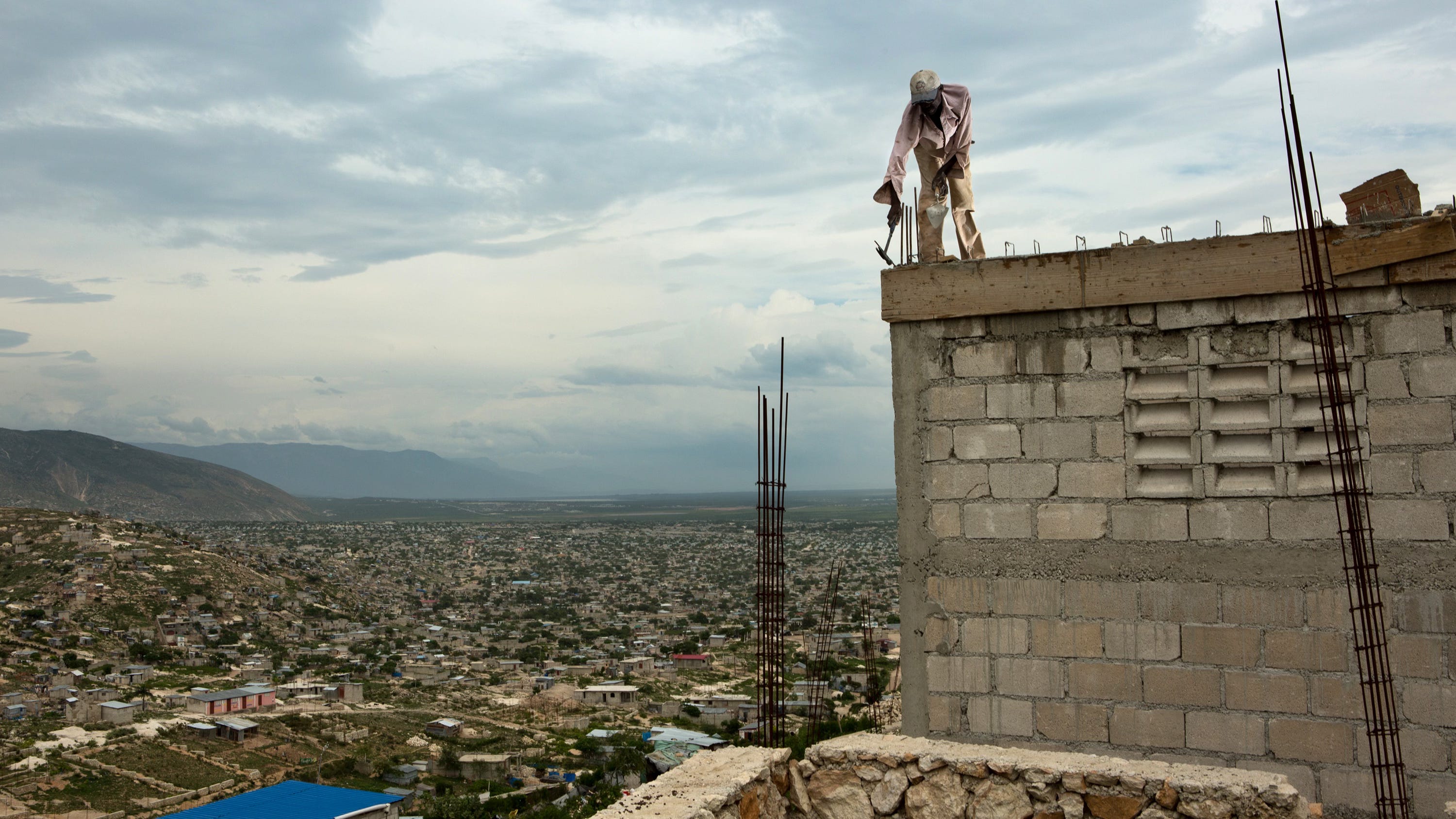
As the Canaan settlement outside Port-au-Prince, Haiti, grows, Jean Robert Destine, 40, adds cement to the wall of a home he is constructing for his nephew, May 6, 2016. Photo byAllison Shelley
One of the world’s newest cities, Canaan emerged from the rubble of an apocalyptic earthquake and the long, slow collapse of Haiti’s government. Now, on the edge of survival, its citizens are trapped, fighting to reclaim their lives. In the Long Lead feature “An Unnatural Disaster,” journalist Jacob Kushner follows this group, desperate to save their country, as they build a new city from nothing. Brought to life by dozens of photos by Allison Shelley, the piece reflects Haiti’s beauty and chaos, the hope of its people, and the dire straits of their plight.
Winner of the Society of Professional Journalists Sigma Delta Chi Award for Fact Checking and shortlisted for both the One World Media Print Award and the 2025 True Story Award, “An Unnatural Disaster” is free to read at Long Lead.
When you look at a situation like potential regime change in Venezuela — given you’re someone who has covered Afghanistan, North Korea, Iran, Guantanamo Bay, Gaza, Syria, on and on — how big a discrepancy is there between what you see on the ground and how the media depicts those situations to the public, in your experience?
It varies from conflict to conflict. In Afghanistan, when I first went there, I think I was one of the first ones to get to Helmand province in the south and really spend weeks on end with the British troops. The narrative at home was that the British are great at peacekeeping because of their experience in Northern Ireland. But I think most people would say, “Hang on a minute. Northern Ireland wasn’t good.” There was footage of them handing out lollipops to kids. I went out there and there were firefights lasting days. Bombs were dropping on buildings full of Taliban fighters a few hundred meters away from British soldiers who were running out of ammo and collapsing from heat exhaustion. That’s what really got my blood going as a reporter.
I kept going back and I did films about how the police force that [the British government was] funding and arming and training were pedophiles and drug addicts and criminals. That caused a bit of a stink. But the narrative remained that the Taliban were almost finished and we were backing the good guys. I kept thinking, “Am I stupid? Am I missing something here? Because it’s so clear the opposite is true.” I even wrote in my book that I didn’t think the government would stand for 24 hours after we left, which is pretty much what happened. So in the case of Afghanistan, it was very much the opposite of what we were being told.
You wanted a career as a writer, but what was the calculus for you choosing to mostly cover conflict in documentary form for television and film rather than as a writer?
I was trying to be a writer and I was writing articles. Obviously I couldn’t afford to go anywhere or travel anywhere and I got a couple rejections. Mostly I got no reply whatsoever because the articles were probably terrible.
Then a friend of a friend said someone needs someone to go undercover to expose the massive corruption in the funeral business. They said I’d be really good at it based on the kinds of things I’d done in my life. Basically, I was able to get dodgy characters to talk about dodgy things quite quickly and easily and if I got into a difficult position, I was able to talk my way out of it quite well. That was my entire CV that got me that job and I started watching documentaries.
There was a great [documentary] by Sean Langan called “Tea with the Taliban.” He just wandered around Taliban-controlled Afghanistan. This was the late 90s. There’s one scene I really remember where he’s filming with a tiny handheld camcorder. And he pulls up to a Taliban checkpoint and he’s told, “Put the camera down! Put the camera down! Taking images of the human face is forbidden.” But he doesn’t put the camera down. They approach him aggressively. He flips the screen over on his camcorder so they can see themselves. They all suddenly smile and remark how Allah made them so handsome. They start stroking their beards and mocking how one beard is more impressive than the other guy’s beard. And then he has tea with them and hangs out with them and they end up chatting for a while.
That tiny little thing alone made me think, “I don’t know if I can do that as a writer but as a documentary filmmaker? Maybe I’ve got a much [better] chance of success,” because, you know, my only real skills at that point were a bit of bravery, a bit of endurance, and almost foolhardy curiosity. It really wasn’t going to take me anywhere as a writer at that point. But as a documentary maker — certainly an undercover documentary maker initially — and then covering foreign conflict, it could get me a long way.
“I think there is an appetite if this work is done right. Young people are gobbling up all the footage they’re seeing from Gaza. Hopefully they’re also going off and picking up a few books by writers who’ve been covering these conflicts for years and years.” —Ben Anderson
Somewhere you were interviewed, you said a conflict you covered on film was seen by millions, while the book you wrote about the same place sold something like 10,000 copies by comparison. Should that marketplace reality frighten us about the role of how journalism is metabolized by the culture?
My book about covering Afghanistan, “No Worse Enemy” — with over 10 years of reporting, none of it opinion, all close-up eye witness testimony of the war falling apart — it’s sold maybe 16,000 [copies] by now. One documentary I did completely alone with a handheld camera, self-funded, ended up being on the BBC and Vice — and with YouTube also — it had over 20 million views.
So in terms of impact? I respect books far more than I respect documentaries. If you read a book properly, it can stay with you forever and change your life like very few documentaries or films. But in terms of making a living and how many people will be exposed to your work? Especially non-fiction work about the failing war in Afghanistan. There’s just not that many people that are going to read it. And if 16,000 [people] bought my book, how many even ended up reading it? The attention span just isn’t there anymore.
Also if I was just doing the book, there’s no way I could have funded, I think it was, 16 trips I took to Afghanistan in the end. A book advance might have afforded one trip. A really good advance, maybe a few more. But TV could fund that. In terms of the written word, I think it’s actually worse than what we’re talking about. I don’t know how many people even read full articles on a regular basis nowadays, let alone books.
With the ICE shooting of Renee Good in Minnesota, even before an investigation, prominent members of the administration were labeling her a “domestic terrorist” to defend the action. Since last September, there have been over 100 deaths attributed to U.S. military strikes to alleged drug-smuggling vessels with the people killed deemed “narco-terrorists.” A large portion of the U.S. supports these designations while an even larger portion rejects it. How do you see this increasing inability for the country to agree on what reality is anymore in so many situations.
There has to be some kind of device, I don’t know what it is, where basic facts can be agreed upon. I know everyone says we’re in a post-truth world and there are two completely separate universes. I agree that we’re there and I don’t know how we get back.
All these boats taken out weren’t even carrying fentanyl. Hardly any of them were headed to the United States either. Even the most simple basic facts like this are completely missed in most of the debates and in the coverage of these topics. It’s very frightening. There was a poll a little while ago that said, something to the effect of 49% of Americans thought that Palestinians were occupying Israeli land. Not the other way around.
I wondered what you made of Sean Penn being hired by Rolling Stone in 2016 to report on and interview El Chapo. Do you think we’ll see more of this kind of celebrity journalist parachuting into big stories to gain more readers? A kind of celebrity journalism-reality TV model?
Oh I think we’re there already. I used to work at the BBC and I was always amazed that the BBC would have correspondents based in countries all over the world. But whenever something major happened that became major news that everyone was talking about? They’d send their famous reporter over to that country. And I thought, “but surely this is exactlythe moment when you lean on the person that’s been there for years and knows everything and knows everyone there?” So I think, in a way, it’s been happening forever.
There was a famous moment where Shane Smith of Vice was at The New York Times offices talking to David Carr and bragging about how Vice was able to reach young people in a way that legacy media was failing hopelessly. Vice News was once valued at $5.7 billion and went bankrupt in 2023.
Obviously Shane got all kinds of things badly wrong, and I do wish he’d have done certain things differently so that we’d still be doing what we did today. But the one thing I think he got right was he said “young”people. Is a 65-year-old in a blazer telling young viewers what’s happening and lecturing them as effective at reaching them as showing real footage from places? That’s what I and a lot of my colleagues at Vice actually did. It wasn’t us standing there telling you. It was actually showing you things happening.
My goal was always to spend as much time as I could to maximize my chances of being there at the right time and actually capturing events. For example, we captured Saudi airstrikes on a wedding that killed like 30-35 civilians. It showed exactly what the U.S.-backed Saudi bombing campaign against Yemen was doing and what it was like.
Young people watched it in droves. The first Afghanistan film I did for Vice was 85 minutes long and it was largely about a corrupt police force. They were pedophiles. You would have thought no one would want to watch that. It’s had 20 to 25 million views on YouTube and Vice News combined.
I think there is an appetite if this work is done right. Young people are gobbling up all the footage they’re seeing from Gaza. Hopefully they’re also going off and picking up a few books by writers who’ve been covering these conflicts for years and years. The appetite is there for difficult subjects and to engage with them.